OpenAI’s Product Leader Shares 5 Phases To Build, Deploy, And Scale Your AI Product Strategy From Scratch
Recently, with Miqdad Jaffer, OpenAI’s Product Leader, we dove into everything you need to know about AI product strategy.
Today, we’re diving deeper into how to build, deploy, and scale your own successful AI product strategy and lead AI initiatives step-by-step.
But before we do that, let’s discuss why mastering AI product strategy should be the first thing on your mind.
MIT just revealed that most of organizations are getting ZERO return from Generative AI despite pouring billions into it.
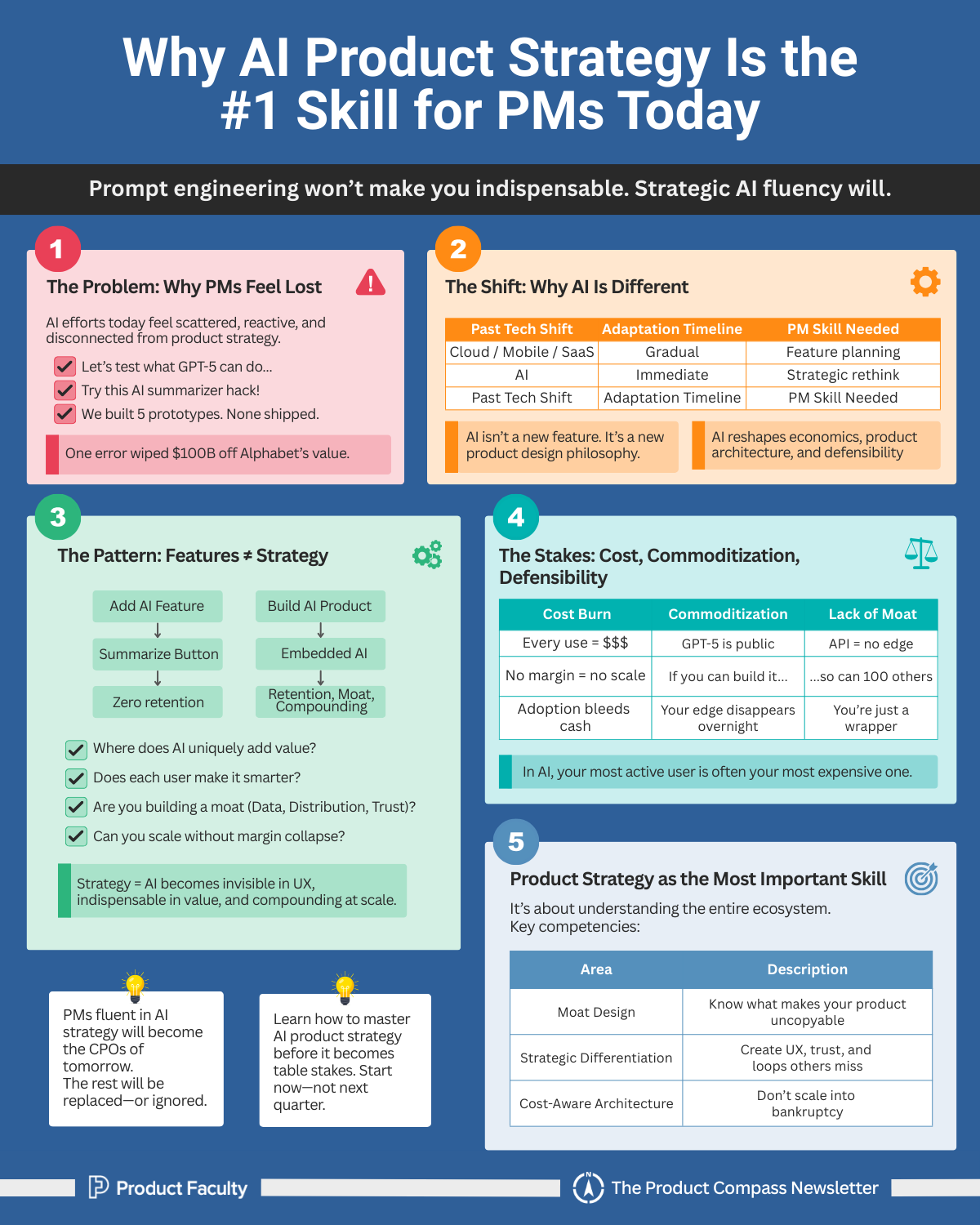
One hallucination in Google Bard wiped out $100B of Alphabet’s market cap.
And right now, you’re probably either thinking about leading AI initiatives or already running some…
But if you’re honest with yourself, deep down, you know it feels scattered and all over the place.
(It’s all okay, we’ve all been there 🙂)
Because let’s face it: the Slack channels are full of prompt experiments, prototypes are half-built, and every week there’s another “AI hack” that doesn’t connect to any real strategy.
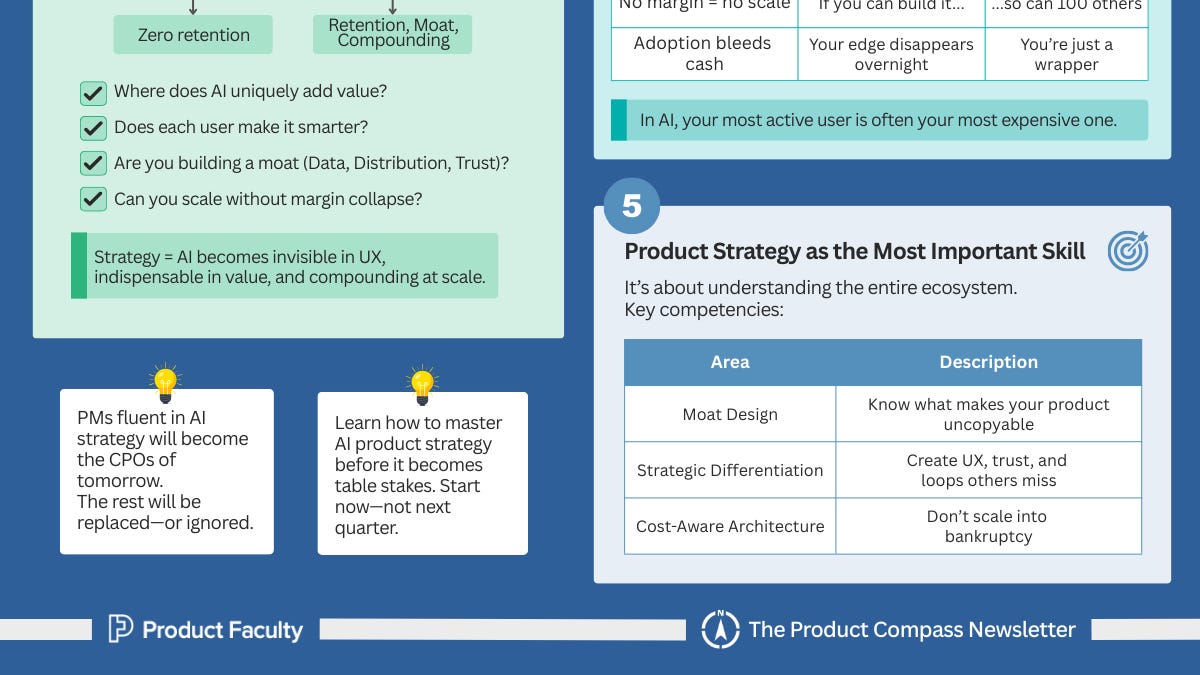
This is because over the past two decades, product management has absorbed new waves of technology: mobile, cloud, SaaS. But each of those was ultimately a platform shift you could adapt to slowly. AI is different. It isn’t just a new platform; it’s a new economics, a new product design philosophy, and a new kind of defensibility.
The PMs who understand how to build and scale AI products strategically will become the CPOs of tomorrow and eventually lead their companies toward sustainable success. The ones who don’t will struggle to stay relevant in organizations that expect AI fluency as table stakes.
And remember, AI product strategy isn’t about “knowing what ChatGPT can do,” or spinning up prototypes in an afternoon. Anyone can do that.
It’s about knowing where AI fits in your product, how it changes your unit economics, how to build feedback loops that compound value, and how to defend against commoditization. It’s the difference between being a PM who “adds AI” to a backlog and being a PM who sets the company’s direction in an AI-first market.
But here’s the common pattern I’ve seen most people get completely wrong.
Side Note: If you want to shorten your learning curve and master & how to build enterprise level AI Products from scratch from OpenAI’s Product Leader, our #1 AI PM Certification is for you.
3,000+ AI PMs graduated. 750+ reviews. Click here to get $500 off. (Next cohort starts Jan 26)
Adding AI Features vs. Building an AI-Powered Product
Too many teams confuse features with strategy. Slapping a “summarize” button or “AI assistant” into your product is not a strategy, it’s a novelty.
Users will try it, maybe even like it, but without defensibility or workflow integration it won’t retain, it won’t scale, and it won’t differentiate you from the hundreds of other tools doing the same thing.
Building an AI-powered product, by contrast, means designing from first principles:
Where does AI uniquely add value?
How do we architect the product so every new user makes it smarter, not just more expensive?
What moat are we building (data, distribution, or trust) that competitors can’t replicate?
How do we scale adoption without bleeding margins on inference costs?
In a nutshell, it’s ALL about rethinking the product so deeply that AI becomes its engine… invisible in the workflow, indispensable to the user, and compounding in value as you grow.
But why do you need to act right now… not a week from now, not a quarter from now… but right now?
The Stakes: Costs, Commoditization, and Defensibility
The stakes could not be higher. AI products operate under a completely different set of rules:
Costs don’t disappear with scale. Every user interaction burns compute, meaning your most engaged users are often your most expensive.
Commoditization happens overnight. Everyone has access to GPT-5 tomorrow, just like you do. If your only edge is calling an API, you have no edge.
Defensibility is everything. Without a moat, proprietary data, trusted governance, or instant distribution, you’re just another wrapper waiting to be replaced.
This is why AI product strategy is the most important skill for PMs right now. Again, it’s not just about writing clever prompts. It’s about understanding the full ecosystem: from moat to differentiation, from design to deployment, from experimentation to organizational leadership.
5 Phases of Building, Deploying, and Scaling Your AI Product Strategy
Here’s what we’re going to cover today:
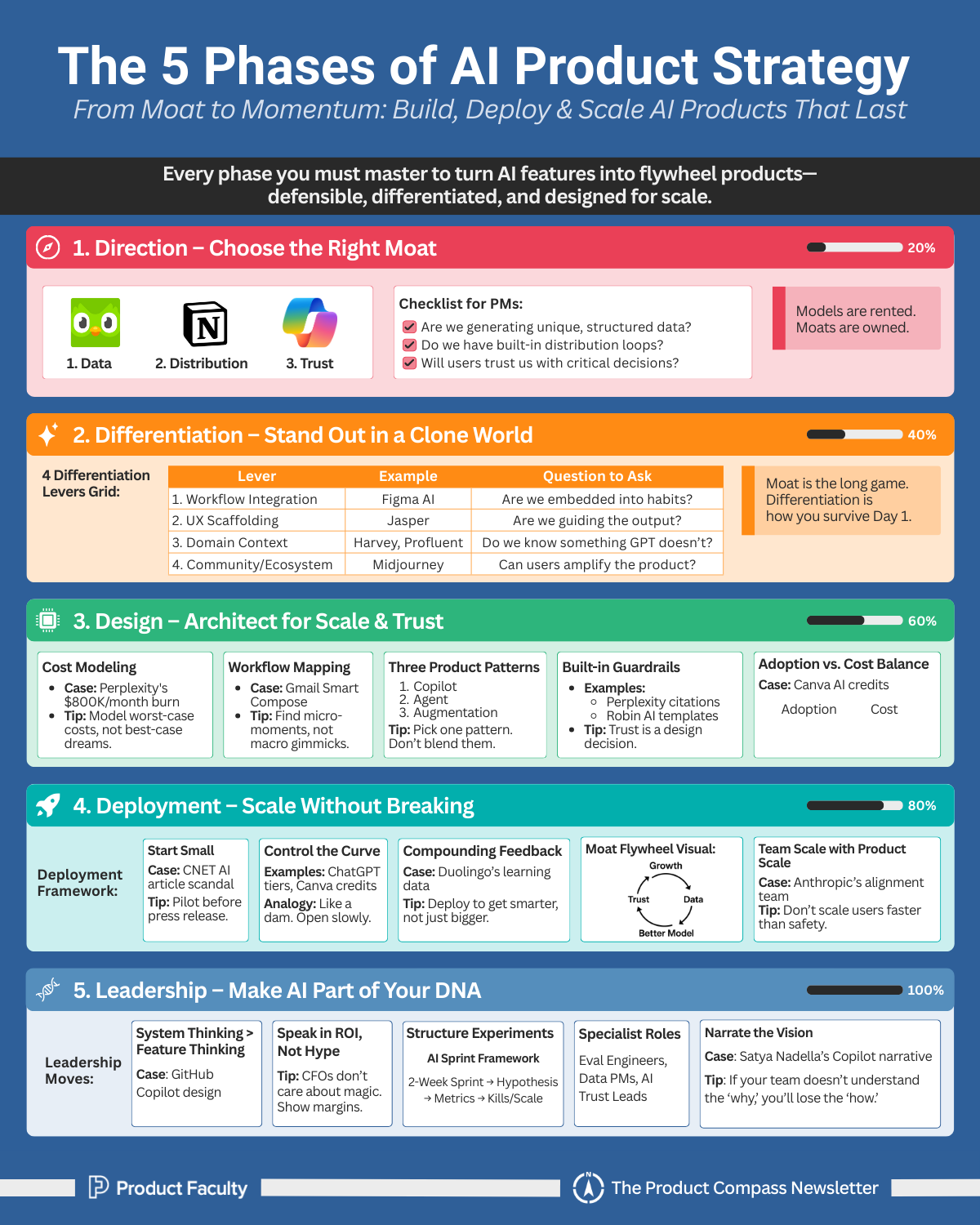
Phase 1: Direction - Choosing the Right Moat
Phase 2: Differentiation - Standing Out in a World of Commoditized Models
Phase 3: Design - Building the Product Architecture
Phase 4: Deployment - Scaling Without Breaking Costs
Phase 5: Leadership - Embedding AI Into the Org
Bonus: How to Run AI Experiments That Don’t Waste Time
Let’s dive into everything.
Phase 1: Direction - Choosing the Right Moat

When you’re building an AI product, the first instinct most PMs have is to ask: “What model should we use? GPT-4, Claude, or maybe we should fine-tune our own?”
That’s the wrong starting point.
The truth is this: AI models are temporary; moats are permanent.
Think of AI models like rented land. You can build a beautiful house on it today, but the landlord (OpenAI, Anthropic, Google) can change the rent tomorrow… or worse, build their own house right next to yours and undercut you.
Unless you own something deeper, something no one else can buy, copy, or spin up overnight, you’re always one API update away from irrelevance.
That’s why Direction is the first and most important phase of AI product strategy. Before you write a single line of code, before you wireframe the first AI-powered feature, you must decide: what kind of moat are we going to build?
Because if you get this wrong, everything else becomes a house of cards.
Why Moats Matter More in AI Than in SaaS
In traditional SaaS, your moat could be sticky workflows, brand, or integrations. Salesforce locked you in by becoming the system of record for sales. Atlassian spread by embedding itself in engineering workflows. These were durable because competitors couldn’t easily copy both the software and the distribution model.
In AI, the situation is different. Today, anyone with a credit card can spin up a wrapper around GPT-5. The barriers to entry are vanishingly low. Which means the only way to survive is to invest in assets that compound over time.
If SaaS moats were about “switching costs,” AI moats are about compounding returns. Every new user, every new interaction, every new distribution channel must make your product stronger and harder to copy.
The Three Moats That Matter
Let’s be blunt: in AI, there are only three moats worth chasing.
Data Moat
Distribution Moat
Trust Moat
Everything else is either a derivative of these or an illusion. Let’s unpack them.
1. The Data Moat
The data moat is the holy grail of AI defensibility.
Here’s the rule: if your product generates unique, structured, high-quality data every time it’s used, you’re building equity. That data can train better models, reduce costs, improve accuracy, and give you insights no competitor can buy off the shelf.
Case in point: Duolingo.
Duolingo didn’t just slap GPT into language learning. They had over a decade of fine-grained data on how millions of students learn: what mistakes they make, how they correct them, how fast they progress. When they fine-tuned models for Duolingo Max, they weren’t just relying on OpenAI’s base capabilities; they were infusing them with a treasure chest of human learning paths that no other company on earth had.
That’s the power of a data moat: every new user makes your product smarter, and every competitor falls further behind.
Analogy: Think of it like digging a well. GPT is the groundwater that everyone can access. But your users’ interactions are the pipes, the pumps, and the filtration system that only you own. The deeper your well, the cleaner and more abundant your water supply and the harder it is for anyone else to tap into it.
So get clarity on:
Are we collecting data competitors can’t get?
Is that data structured, high-quality, and usable for model improvement?
Can we create feedback loops so the product gets better as it scales?
If the answer is “no,” you’re not building a moat. You’re renting one.
2. The Distribution Moat
The second moat is distribution and in many cases, it’s even more decisive than data.
Why? Because even if you build a clever AI tool, if you can’t get it into the hands of users at scale, you’ll die before your data flywheel even starts spinning.
Take Notion AI. Notion didn’t invent AI note-taking. They weren’t the first to offer summarization or text generation inside docs. But they had something every wrapper lacked: tens of millions of daily users already inside their product. When they added AI features, distribution was instantaneous. Adoption was viral.
Their AI didn’t need to be better than anyone else’s, it just needed to be there where the users already were. That’s the distribution moat: owning the channels, workflows, and viral loops that competitors can’t easily replicate.
You need to know:
How do we get AI into the workflows users already live in?
Do we have a distribution advantage (user base, platform integrations, partnerships)?
Can we design viral loops where every new user pulls in another?
Without distribution, even the best AI model is a tree falling in the forest with no one to hear it.
3. The Trust Moat
The third, and often most underrated, moat is trust.
AI is probabilistic. It hallucinates. It fails silently. It produces outputs that can be biased, unsafe, or downright wrong. Which means the biggest bottleneck to adoption isn’t accuracy, it’s trust.
Look at Microsoft Copilot.
Why do enterprises pay for it? Not because it’s dramatically better. But because Microsoft guarantees data security, compliance, governance, and enterprise support. In short: trust.
Or take Perplexity. Their key differentiation isn’t just a slick interface. It’s the fact that they cite their sources, making users trust their outputs more than a generic chatbot.
Questions to ask yourself:
What makes our users trust this product with critical tasks?
How transparent are we about model limits, sources, and errors?
Are we building governance and safety into the product or bolting it on later?
The Moat Compass
So here’s your first action step as a PM or CPO building AI strategy: choose your compass.
Before you debate which model to use, or which features to ship, decide:
Is our moat going to be data (we’ll generate unique assets over time)?
Is it going to be the distribution (we already own workflows, we can embed AI instantly)?
Is it going to be trust (we can win by being the most reliable, compliant, and transparent)?
Pick one moat to dominate, and layer in the others as you scale.
Because if you don’t… if you build without a moat… you’re just another wrapper around GPT, waiting to be outcompeted by the next YC startup or the next OpenAI feature drop.
Phase 2: Differentiation - Standing Out in a World of Commoditized Models

Here’s the hard truth: every PM on the planet has access to the same models you do.
When GPT-5 drops, it doesn’t just drop for you. It drops for your competitor across the street, the YC team fresh out of Demo Day, and even that solo indie hacker in their bedroom. The barrier to calling an API is close to zero. Which means the old edge, “we have access to better models”, is gone.
The battlefield shifts to something else: differentiation.
Differentiation is about answering one question:
Why should users come to you when 100 other products can technically deliver the same AI outputs?
And the answer never lies in the model. It lies in workflow, experience, context, and compounding advantage.
Why Differentiation Matters More in AI
Let’s go back to the early days of the internet. In 1995, anyone could spin up a basic website. The HTML was the same, the browsers were the same.
What separated Amazon from the thousands of other ecommerce sites wasn’t the technology of HTML, it was Jeff Bezos’s relentless focus on customer experience (reviews, one-click checkout, fast delivery).
AI in 2025 is like the internet in 1995. Everyone’s using the same raw tech. The winners won’t be the ones with slightly better prompts or a cleverer wrapper. The winners will be the ones who create systems of differentiation that compound over time.
Four Differentiation Levers That Actually Work
From experience, I’ve seen four differentiation levers consistently matter:
Workflow Integration: embedding AI into daily habits instead of creating new ones.
UX Scaffolding: designing around the AI to reduce friction, hallucinations, and cognitive load.
Domain-Specific Context: infusing the AI with proprietary knowledge or expertise that generic models lack.
Community & Ecosystem: building network effects around your AI product.
Let’s break them down with examples you probably haven’t seen analyzed in this way.
1. Workflow Integration: Become Invisible, Not Shiny
The most successful AI products don’t look like AI products. They look like invisible helpers inside workflows people already use.
Take Figma AI for example. When Figma launched AI-powered design features, they didn’t create a new “AI playground.” Instead, they tucked the capabilities into existing design flows: quick mockups, instant copy suggestions, auto-layout adjustments. Designers didn’t have to “learn AI.” They just designed, and AI quietly accelerated their work.
Contrast that with dozens of “AI design assistants” that force you to leave your design tool, go to a separate app, generate assets, and re-import them.
Checklist for you:
Are we making users leave their core workflow to use AI?
Is AI saving them time at the exact moment they need it?
Would removing the AI feature feel like ripping out oxygen, or just a shiny add-on?
2. UX Scaffolding: Build the Guardrails Users Don’t Know They Need
Raw AI output is messy. But users want clarity, confidence, and a sense of control.
Differentiation often comes from the scaffolding you build around the AI to make it usable.
Example: Jasper. Jasper doesn’t win because it calls GPT better than you. It wins because it wraps AI outputs in templates, brand voices, tone controls, and structured workflows for marketers. That scaffolding is what makes a generic model feel like a purpose-built assistant.
Another example: Runway. Runway’s video generation tools succeed not because their models are uniquely magical, but because the product scaffolds outputs with clear timelines, editing rails, and collaborative layers that filmmakers understand. They turned stochastic outputs into predictable workflows.
Think of scaffolding like a ski slope. The mountain (AI model) is there for everyone.
But the guardrails, signage, and ski lifts (UX scaffolding) determine whether beginners crash or thrive.
3. Domain-Specific Context: Win Where Generalists Fail
Generic AI is powerful, but it lacks depth in specialized domains. Differentiation often comes from layering domain expertise on top of general models.
Example: Harvey (legal AI). Plenty of startups let you “chat with your contracts.” But Harvey embedded itself inside law firms, fine-tuned on case law, and partnered with firms like Allen & Overy. The result: a tool lawyers trust because it speaks their language and understands their domain context.
Another example: Profluent Bio. Instead of building yet another LLM chatbot, Profluent focused on protein language models. Their AI isn’t just a text generator; it’s a domain-specific engine trained on biological data that can design new proteins. That’s a moat no GPT wrapper will ever touch.
Do you know?
What proprietary domain knowledge can we encode that GPT cannot replicate?
Do we have access to domain experts who can help shape prompts, evals, and outputs?
Can we build vertical-specific features that make our product indispensable in one industry, rather than generic everywhere?
4. Community & Ecosystem: Make Users Your Moat
The most underestimated lever of differentiation is community. In AI, where outputs are probabilistic and creativity matters, users themselves often become the moat.
Example: Midjourney. Midjourney could have been “just another image generator.” Instead, they built an ecosystem on Discord where every prompt, every experiment, every masterpiece was shared in public. The community created a positive feedback loop, new users learned by watching, old users showcased their skills, and the collective knowledge compounded into a cultural moat.
Checklist for you:
Are we giving users a place to share, remix, and learn from each other?
Can we incentivize contributions (datasets, prompts, workflows) that compound our value?
Does our ecosystem get stronger as more people join, or are we stuck pushing top-down adoption?
The “Moat + Differentiation” Matrix
Here’s how you should think about it:
Moat (from Phase 1) → What compounds defensibility (data, distribution, trust).
Differentiation (Phase 2) → What makes you stand out day one (workflow, UX scaffolding, domain context, community).
You need both.
Moat is the long game.
Differentiation is the short game that keeps you alive long enough to build the long game.
Action Steps for you:
Audit your product today: If 10 clones launched tomorrow with the same API, why would users still choose you?
Pick one lever of differentiation to go all in on: workflow integration, UX scaffolding, domain context, or community.
Layer it with your moat: Data + Differentiation, Distribution + Differentiation, Trust + Differentiation.
Stress test: if your AI outputs were identical to competitors’, what around the AI would make you unbeatable?
Phase 3: Design - Building the Product Architecture

If Direction is about choosing your moat, and Differentiation is about standing out in a sea of clones, then Design is where the rubber meets the road.
Here’s the mindset shift you need to make:
AI products are not SaaS products with a few AI features. They are fundamentally different machines.
In SaaS, your marginal cost per user approaches zero. You can add another customer to Slack or Dropbox without worrying about per-message or per-file costs. But in AI, every user interaction costs you money. Every inference is a micro-transaction with a model. And if you don’t design carefully, you can wake up one morning with incredible adoption and an $800,000 monthly bill.
That’s why the design of your product architecture: the way you structure data flows, model usage, and user interactions, is the difference between a product that scales profitably and one that dies under its own success.
1. Cost Modeling: The Silent Killer of AI Products
One of the most common mistakes PMs make is treating AI like SaaS when it comes to cost. They assume: “Oh, we’ll scale users, costs will spread, and margins will improve.”
Wrong.
In AI, marginal costs don’t vanish. They scale with usage. And worse: your most engaged users are often the ones costing you the most.
Case Study: Perplexity AI
At one point, Perplexity was burning close to $800,000/month on inference costs.
Why? Because every query = API call to an expensive LLM.
More adoption → more costs → thinner margins.
This is the “inference treadmill”: the more successful you are, the faster you burn cash.
The Playbook for you:
Model worst-case costs, not best-case revenue. Ask: what happens if usage 10x’s in 6 months? Can our infra handle it? Can our balance sheet handle it?
Tier your model usage. Not every user request needs GPT-5. Many can be handled by distilled, fine-tuned smaller models.
Cache aggressively. If multiple users ask the same thing, why pay twice?
Control prompts. Bloated prompts = wasted tokens. Tight, structured prompts = 30–40% cost savings.
2. Workflow Mapping: Where Does AI Belong?
The second design principle is picking the right spots in the workflow to inject AI.
Too many teams sprinkle AI everywhere like hot sauce, “AI summarization here, AI auto-complete there”, without asking the deeper question: Where does AI actually create irreplaceable value?
Example: Gmail Smart Compose.
Google didn’t try to make the entire email-writing process AI-driven.
Instead, they found the exact friction point (typing repetitive phrases) and injected AI there.
Result: huge adoption, low cost, high trust.
Compare that to some AI email startups that try to auto-write entire emails from scratch. Sounds great, but trust issues and over-generation killed adoption.
So get clear on:
What are the “micro-moments” of user friction that AI can solve elegantly?
Is AI saving users time or just adding flash?
Would users still adopt the feature if we stripped the “AI” branding away?
3. Product Patterns in AI: Choose Your Architecture
When you zoom out, most AI products fall into one of three product patterns.
The design decision is about which pattern fits your user base, your moat, and your cost model.
a) Copilot Pattern (Assistive AI)
AI sits alongside the user, accelerating their work.
Examples: GitHub Copilot (code), Figma AI (design).
Strength: Users remain in control → high trust.
Risk: High frequency of use → high inference costs.
b) Agent Pattern (Autonomous AI)
AI acts as the user, taking multi-step actions.
Examples: Lindy for scheduling, Adept’s ACT-1.
Strength: Huge time savings.
Risk: Complexity, cascading errors, low tolerance for mistakes.
c) Augmentation Pattern (Embedded AI)
AI quietly enhances outputs, often without users noticing.
Examples: Grammarly (suggestions), Canva AI (auto-formatting).
Strength: Invisible adoption → low friction.
Risk: Harder to market; value is subtle, not flashy.
As a PM, your job is to pick the right pattern and double down.
Do not mix all three at once.
Do not call everything an “AI agent” just because it sounds sexy.
Clarity of design pattern → clarity of adoption and cost management.
4. Guardrails by Design: Don’t Bolt Them On Later
AI products fail when they assume “we’ll fix accuracy and hallucinations later.” Wrong approach.
Guardrails must be part of the architecture from day one.
Example: Perplexity’s citations.
They didn’t just generate answers.
They built trust scaffolding (links, citations, sources).
That design choice differentiated them from ChatGPT clones.
Another example: Robin AI (contracts).
Instead of letting AI free-write contracts, they force outputs into legal-safe templates.
Guardrails in architecture → trust at scale.
So if you want to make better AI products, you need to:
Constrain outputs into predictable structures (tables, JSON, templates).
Surface uncertainty (confidence scores, citations).
Build eval frameworks: hallucination rate, latency, cost per output.
5. The “Adoption vs. Cost” Balancing Act
Designing an AI product is a constant balancing act between:
Adoption → The more users engage, the more valuable you are.
Cost → The more users engage, the more you bleed cash.
If you over-prioritize adoption, you risk becoming Perplexity: loved by users, bankrupt by infra. If you over-prioritize cost, you risk becoming irrelevant: great margins, but no growth.
The art is in designing intelligent constraints.
Example: Canva AI.
They give free AI credits, but cap usage.
Power users must pay.
Design decision = keep CAC low, monetize high-engagement users, control inference burn.
Here’s what you need to do right now:
Build a cost model spreadsheet before you build the product. Include API costs, caching, prompt lengths, and worst-case user engagement.
Decide your workflow injection points. Don’t sprinkle AI everywhere; pick leverage points.
Choose your product pattern (Copilot, Agent, Augmentation) and design around it.
Embed guardrails into design, not post-mortems.
Balance adoption vs. cost with intelligent constraints (credits, tiering, caching).
Phase 4: Deployment - Scaling Without Breaking Costs

Here’s the paradox of AI products:
The very thing you want (adoption) is the very thing that can kill you (runaway costs).
Scaling SaaS was straightforward. Once you had your infra stable, adding another 100K users didn’t really change your unit economics. With AI, every marginal user interaction is a cost event. Which means deployment isn’t just a matter of “launch big”, it’s about designing a scalable growth engine that balances three forces:
User Growth
Cost Efficiency
Moat Compounding
Get this wrong, and you end up in the graveyard of “AI wrappers” that burned cash for a year and died. Get it right, and you end up with a compounding machine that grows stronger with every new user.
1. Start Small: Pilot, Don’t Spray
One of the biggest mistakes PMs make is deploying too broadly, too early. They want to impress execs, investors, or the press, so they ship an AI feature to all users on Day 1.
The result? Chaos. Latency issues, hallucinations, infra overload, and spiraling costs before you even know what’s working.
Case Study: CNET’s AI Articles
CNET quietly deployed AI-generated finance articles at scale.
Within weeks, errors, hallucinations, and credibility scandals blew up in the media.
Why? They scaled before running controlled pilots and feedback loops.
The better approach: pilot first.
Run AI features with a subset of users.
Collect cost data, user feedback, and retention metrics.
Only scale when the feedback loops are tight and the cost per active user is under control.
2. Control the Adoption Curve
Not all adoption is good adoption.
Some AI products celebrate spiking user numbers without realizing that heavy usage is burning them alive on inference costs. The deployment playbook must include controlled adoption levers.
Examples:
ChatGPT Free vs. Plus tiers → controlled usage through model gating (GPT-3.5 free, GPT-4 paid).
Canva AI Credits → free credits for casuals, paywalls for power users.
Runway Gen-2 → capped video generation length until infra matured.
Analogy: Scaling AI is like opening the floodgates of a dam. If you don’t control the release valves, the water that should power your turbines will instead wipe out the village.
3. Compounding Feedback Loops
The beauty of AI deployment is that, done right, every new user can actually make your product better, if you structure the feedback loops correctly.
Example: Duolingo (again).
Every student interaction → structured learning data.
Deployment at scale meant cheaper, smarter, and more accurate AI over time.
The question to ask: Is deployment giving us compounding assets (data, insights, trust) or just compounding costs?
4. The “Moat Flywheel” in Deployment
When you deploy right, you trigger a flywheel:
User Growth → More Feedback/Data
More Data → Smarter Models / Lower Costs
Smarter Models → Better UX + More Trust
Better UX/Trust → More Distribution + Growth
That’s how you scale from “wrapper” to “defensible platform.”
If deployment isn’t spinning this flywheel, you’re stuck in a hamster wheel — running hard, going nowhere, bleeding cash.
5. Scaling Teams Alongside the Product
Deployment isn’t just about infra; it’s also about org design.
Many AI teams fail because they scale users faster than they scale internal capabilities. Eval frameworks, data pipelines, and trust & safety guardrails need dedicated teams before you scale.
Case Study: Anthropic.
Obsessed with “Constitutional AI.”
Invested in alignment and safety research before scaling to enterprises.
Result: enterprises trust Claude for regulated industries.
Phase 5: Leadership - Embedding AI Into the Org

If Direction was about “what moat are we building,” Differentiation was about “how do we stand out,” Design was “how do we structure the product,” and Deployment was “how do we scale without breaking,” then Leadership is about:
How do we make AI a durable part of the company’s DNA, not a shiny experiment?
1. The PM Mindset Shift: From Features to Systems
Here’s the first leadership truth: PMs need to stop thinking of AI as features and start thinking of AI as systems.
In the SaaS world, PMs are trained to think in tickets:
Add this button.
Improve this flow.
Launch this integration.
But AI changes the game. It’s not a one-off feature you ship. It’s a system that evolves, learns, and compounds over time.
Example: GitHub Copilot.
This wasn’t “just another IDE feature.”
It fundamentally changed how developers write code, creating a system of interaction (suggestions, feedback, corrections) that gets smarter the more it’s used.
As a leader, you need to train your PMs to think like system designers, not feature shippers.
2. Executive Buy-In: Speak in ROI, Not Hype
One of the biggest traps in AI leadership is selling “magic” to executives. The hype cycle burns out fast. CEOs and CFOs don’t care if your AI demo looks futuristic, they care if it moves the needle.
How to Win Buy-In:
Speak in unit economics. Show “cost per inference” vs. “revenue per user.”
Speak in business outcomes. “This AI reduces support tickets by 30% → saves $5M annually.”
Speak in moats. “Every new user enriches our proprietary dataset → compounds defensibility.”
3. Culture of Experimentation (Without Chaos)
AI moves too fast for annual roadmaps to work. But here’s the paradox: too much experimentation turns into chaos, wasted sprints, and demo graveyards.
The leadership challenge is building a culture of experimentation with structure.
The AI Sprint Playbook:
Run 2-week “AI sprints” where PMs test one specific hypothesis.
Example: “Will AI reduce support ticket handling time by 20%?”
Define clear eval metrics (accuracy, latency, retention lift).
At the end of the sprint, kill 80% of ideas, double down on the 20% with ROI.
Case Study: Stripe.
Stripe runs AI experiments constantly, but every experiment is tied to a clear metric (fraud detection accuracy, checkout completion rates).
No vanity demos. Everything maps back to the business.
4. Building the Right Teams
As AI scales inside your org, you’ll hit the limits of traditional PM/eng structures. You need specialized roles to handle the complexity:
Eval Engineers → specialists who build evaluation frameworks (accuracy, hallucination rate, cost per inference).
Data PMs → PMs dedicated to collecting, cleaning, and leveraging proprietary data.
AI Ethicists / Trust Leads → ensuring bias, compliance, and governance are built-in.
5. Communication: Leading Beyond the Product Team
As a CPO or Head of Product, your job isn’t just building, it’s narrating.
Your engineers need to know why you’re making infra investments.
Your designers need to know why scaffolding matters.
Your sales team needs to know why this AI product will win in the market.
Your execs need to know why the cost curve bends in your favor.
Leaders who fail to narrate AI strategy end up with half the org confused, skeptical, or resisting adoption.
Example: Satya Nadella at Microsoft.
He didn’t just launch Copilot.
He reframed Microsoft’s entire narrative: “We’re moving from products you use to copilots that assist you in every workflow.”
That story aligned engineering, sales, and marketing around one vision.
Bonus: How to Run AI Experiments That Don’t Waste Time
(This is the request we hear most often from PMs. So we’re sharing what has worked for us and you should feel free to adapt, refine, or add to it for your own context.)
One of the most common mistakes I see teams make is treating AI initiatives like endless playgrounds. PMs spin up a “labs” channel, engineers build a few prototypes, and suddenly there are five half-baked demos floating around with no clear path forward.
Six weeks later, no one knows which experiments matter, what to kill, or what to scale.
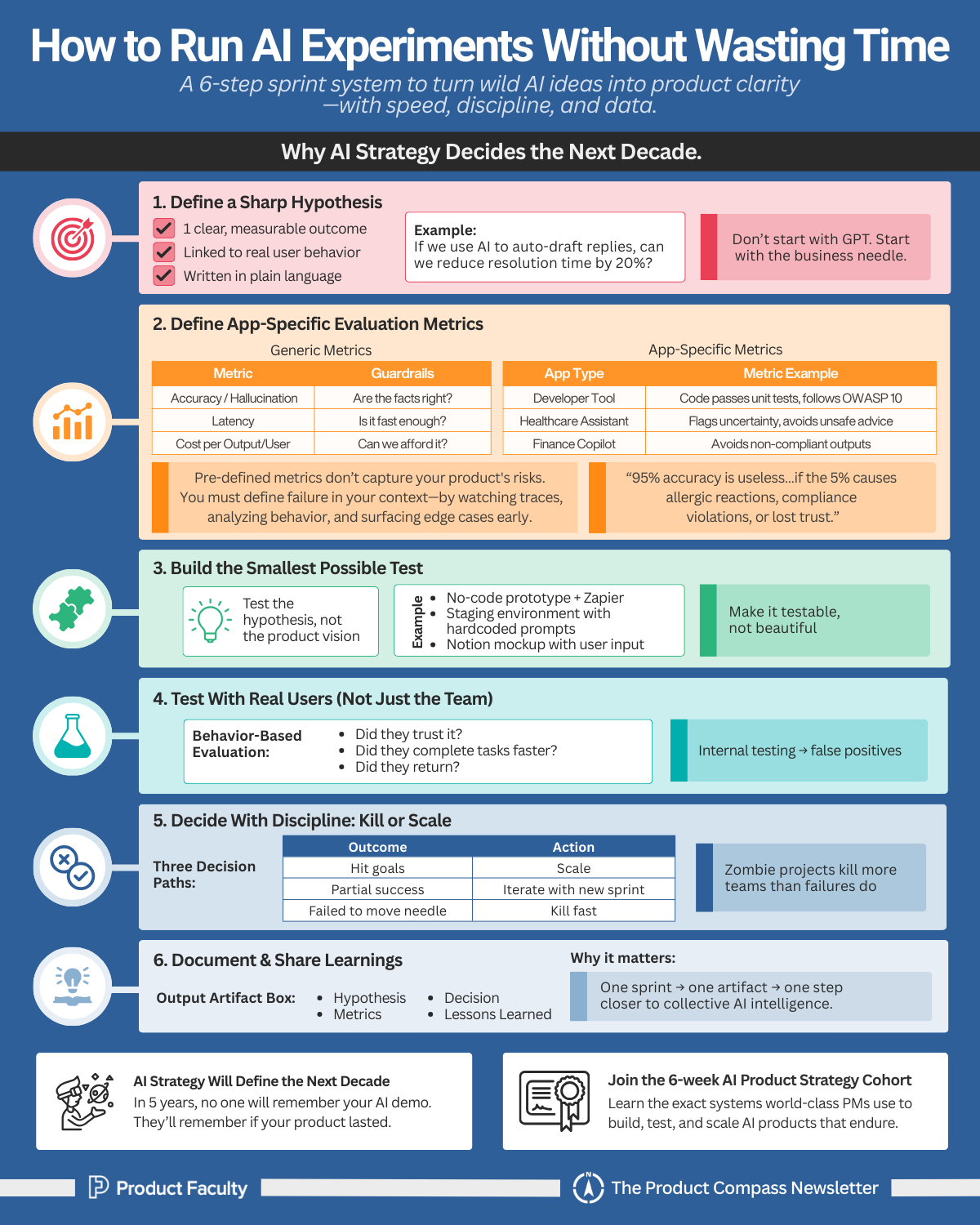
AI is moving too fast for that kind of waste. What you need is a structured way to experiment quickly enough to keep pace with change, but disciplined enough to make informed decisions. That’s where the 2-week AI sprint comes in.
Step 1: Define a Sharp Hypothesis
Don’t start with “let’s see what GPT-5 can do.” Start with a problem statement that ties directly to user value or business outcomes.
A good hypothesis looks like this:
“If we use AI to auto-draft customer support replies, we can reduce average ticket resolution time by 20% without lowering CSAT.”
“If we add AI-powered error explanations inside the dev console, we can reduce drop-offs by 15% during onboarding.”
Checklist for a good hypothesis:
Focused on one measurable outcome.
Tied to a real workflow, not novelty.
Expressed in plain language so anyone on the team understands it.
Step 2: Go Beyond Generic Metrics, Define App-Specific Evaluation
Generic metrics like accuracy or latency are never enough to evaluate AI products. They’re useful guardrails, but they don’t tell you if your AI is actually succeeding in the context of your product.
Think about it: if you’re building a recipe chatbot, it doesn’t matter if you’re hitting 95% factual accuracy in some benchmark. If the system recommends peanuts to a user with a nut allergy, you’ve failed and no hallucination rate metric will capture that.
Yes, you should track the universal metrics like:
Accuracy / hallucination rate
Latency
Cost per output / per active user
But the real differentiator comes from domain- and app-specific metrics that reflect how failure actually shows up for your users. For example:
A developer assistant must produce code that passes unit tests and is safe.
A healthcare assistant must flag uncertainty instead of giving unsafe advice.
A financial copilot must avoid non-compliant recommendations.
These app-specific metrics don’t come from a pre-defined list. They emerge bottom-up by analyzing traces, watching how the system behaves in real workflows, and deliberately defining the failure cases that matter most in your domain.
You can start with 1–2 generic metrics as broad guardrails. Defining app-specific metrics requires cycles of building, measuring, and learning.
Step 3: Build the Smallest Possible Test
Don’t waste engineering cycles overbuilding. For a 2-week sprint, the goal is not to make it beautifu, it’s to make it testable.
That might mean:
Running a prototype inside a Notion doc with Zapier automation.
Using a no-code front end to collect user feedback.
Hardcoding prompts into a staging environment.
Your job is to test the hypothesis, not the whole product vision.
Step 4: Test With Real Users (Not Just the Team)
Internal testing creates false positives because your team knows what to expect. Put the experiment in front of a small group of actual users (10, 20, 50 depending on the context) and measure how they react in the wild.
Don’t just ask “Did you like it?” Look at behavior: Did they finish tasks faster? Did they trust the AI’s output? Did they come back and use it again?
Step 5: Decide With Discipline: Kill or Scale
At the end of the 2-week sprint, you must make a call:
Scale → if the experiment hits its success metric and passes cost/trust thresholds.
Iterate → if results are promising but metrics are unclear (set up a new sprint).
Kill → if the experiment fails to move the needle or introduces more cost than value.
The worst outcome isn’t a failed experiment. The worst outcome is a zombie project that lingers for months, consuming resources without clarity.
Step 6: Document and Share Learnings
Every sprint should produce an artifact: the hypothesis, metrics, what worked, what failed, and the next decision.
Over time, this creates a knowledge base of AI experiments your team can learn from, instead of repeating the same dead ends.
Summary
The reality is clear: AI product strategy is the new dividing line between the companies that win and the ones that quietly fade away.
In the past, you could survive as a PM by mastering frameworks, optimizing roadmaps, and shipping features reliably. But in the age of AI, those skills alone are no longer enough.
The market no longer rewards you for adding features; it rewards you for building systems that compound value over time.
This is why AI product strategy will decide winners vs. losers. The winners will be the PMs and product leaders who know how to:
Build moats in data, distribution, and trust that competitors can’t replicate.
Differentiate in a world where everyone has the same foundation models.
Design products with architectures that balance adoption and cost efficiency.
Deploy in ways that scale intelligently, without destroying margins or eroding trust.
Lead organizations through the cultural and structural shifts required to make AI part of the company’s DNA.
The losers will be those who treat AI like a checkbox on the roadmap, or worse, those who avoid it altogether.
And here’s the hard truth: a PM without AI strategy skills will be irrelevant within five years.
As AI fluency becomes table stakes, companies won’t ask whether you know how to use AI; they’ll assume you do. What will set you apart is whether you know how to craft a durable, defensible strategy around it.
The invitation for you is this: don’t just experiment with AI on the margins. Don’t settle for being another team slapping “AI-powered” into a press release. Instead, build moat-driven, cost-conscious AI products that endure. Products that get smarter, not just more expensive. Products that retain trust, not erode it. Products that can’t be commoditized by the next GPT wrapper.
Because five years from now, the market won’t remember who shipped an AI demo first. It will remember who built AI products that lasted.
Do you have everything in place to make sure your product is remembered decades from now?
If not, learn it all here.
Want to build AI products, not just read about them?
Become a Fellow