Your Complete Roadmap to Earning a $180K–$569K AI PM Role
OpenAI is paying $569K. Google is paying $557K. Anthropic is paying $549K.
Netflix is paying $535K. Apple and Meta? $450K+.
…and the cycle goes on.
According to Live Data Technologies, this year alone:
7,128 AI PM hires
70% of them were external
100+ companies hiring aggressively
If anyone still thinks “AI PM” is hype, this dataset proves: the role is real, the demand is real, and the rewards are extremely real.
But that leads to the real question: Who actually gets these jobs?
Because it’s definitely not:
❌ PMs who “use AI”
❌ PMs who “prompt ChatGPT better than others.”
❌ PMs who add AI features like toppings on a SaaS product.
If that were the case…
Why are companies hiring 70% of their AI PMs externally?
Why aren’t they promoting the PMs who already work there?
Why not simply train their existing PMs to “use AI”?
There’s a reason and it’s the part nobody says out loud:
Companies aren’t hiring people who can use AI, they’re hiring people who can design, architect, and scale intelligent systems end-to-end.
AI PMs are not JUST prompt writers, they’re system designers who understand context engineering, agents, workflows, and constraints.
Companies want PMs who can decompose cognition, identify reasoning gaps, and orchestrate multi-agent decision systems.
AI PMs are chosen because they reduce risk, handle ambiguity, design guardrails, and make intelligence reliable… skills you can’t acquire by “just using AI.”
Remember, AI PMs aren’t hired for just their “AI skills.”
They’re hired for the 7 forces that define world-class AI product leadership — forces most traditional PMs simply do not possess.
1. THE 7-LAYER META-FRAMEWORK (that distinguishes AI PMs from everyone else)
Each layer is a capability traditional PMs rarely build… meaning this is where you create an unfair advantage.
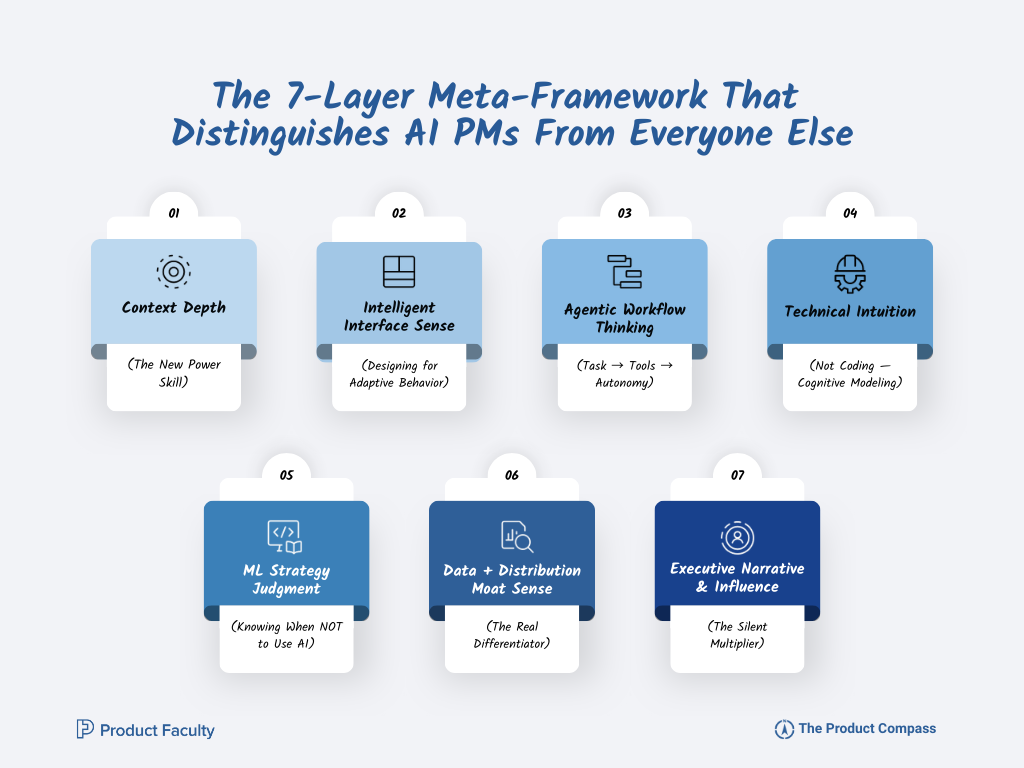
1.1. Context Depth (The New Power Skill)
Non-AI PMs think about features. AI PMs think in context.
In classic software, you decide what the product should do.
In AI products, you decide what the model should understand.
This is the single most important difference.
AI PMs know how to:
structure context
filter noise
define boundaries
constrain cognitive space
encode tasks into decomposable signals
design instructions that create consistent behavior
This is context engineering… the new literacy of AI product development.
If you master this, you instantly jump ahead of 90% of PMs.
1.2. Intelligent Interface Sense (Designing for Adaptive Behavior)
Generative AI doesn’t operate like traditional UX.
It adapts, evolves, responds, and reacts.
Great AI PMs understand:
how the interface should change based on uncertainty
how to expose model reasoning safely
how to manage user expectations
how to design transparency without overwhelming users
how to blend deterministic UX with probabilistic intelligence
1.3. Agentic Workflow Thinking (Task → Tools → Autonomy)
Traditional PMs think in “steps.”
AI PMs think in “agents executing tasks with tools.”
This includes:
decomposing workflows into atomic tasks
identifying which tasks can become agentic
defining tool boundaries
understanding autonomy levels
analyzing failures and evaluating multi-agent systems
deciding when humans intersect the loop
The future of AI products is not chatbots or LLM wrappers, it’s agentic systems that perform work.
To build them, you must see workflows like a systems architect, not a feature PM.
1.4. Technical Intuition (Not Coding — Cognitive Modeling)
The internet lies to PMs by telling them they need to “learn Python,” “become ML fluent,” or “train models.”
You don’t.
What you need is:
AI thinking - how you reason, collaborate, and adapt when facing ambiguity
mental models of how models behave
understanding retrieval and memory
understanding observability
understanding failure modes and funnels
understanding human-model alignment
understanding context windowsTechnical intuition ≠ coding.
Technical intuition = the ability to design intelligent systems without writing code.
1.5. ML Strategy Judgment (Knowing When NOT to Use AI)
AI PMs are judged not by how often they use AI… but by how strategically they use (or reject) it.
Great AI PMs know:
when orchestration outperforms autonomy
when heuristics outperform embeddings
when retrieval should replace generation
when human review is non-negotiable
when fine-tuning is a trap
when more context is worse
when general models underperform specialized workflows
1.6. Data + Distribution Moat Sense (The Real Differentiator)
There is one uncomfortable truth about AI PM roles:
If you don’t understand moats, you can’t build AI products that survive.
Because models commoditize. Features commoditize.
Interfaces commoditize.
What doesn’t commoditize?
proprietary data
workflow positioning
distribution networks
vertical knowledge
user trust
embeddedness in systems
AI PMs know how to build products that accumulate advantage, not just launch features.
1.7. Executive Narrative & Influence (The Silent Multiplier)
The best AI PMs are great storytellers!
To get anything shipped, you must:
frame tradeoffs
communicate constraints
set expectations
explain probabilistic systems
justify risks
narrate decisions that don’t have clear answers
influence skeptics
simplify complexity into confident direction
This is why many brilliant AI builders never become AI PMs.
They can think deeply, but they can’t explain deeply.
The market rewards the ones who can do both.
Mastering The 7-Layer Meta-Framework
If you develop these 7 forces, you become the kind of AI PM companies fight to hire.
If you don’t, you will always feel like you’re “catching up” to a field that keeps evolving faster than your career.
If you want to master all the skills required to become an AI PM, then Product Faculty’s AI PM Certification with OpenAI’s Product Lead is for you.
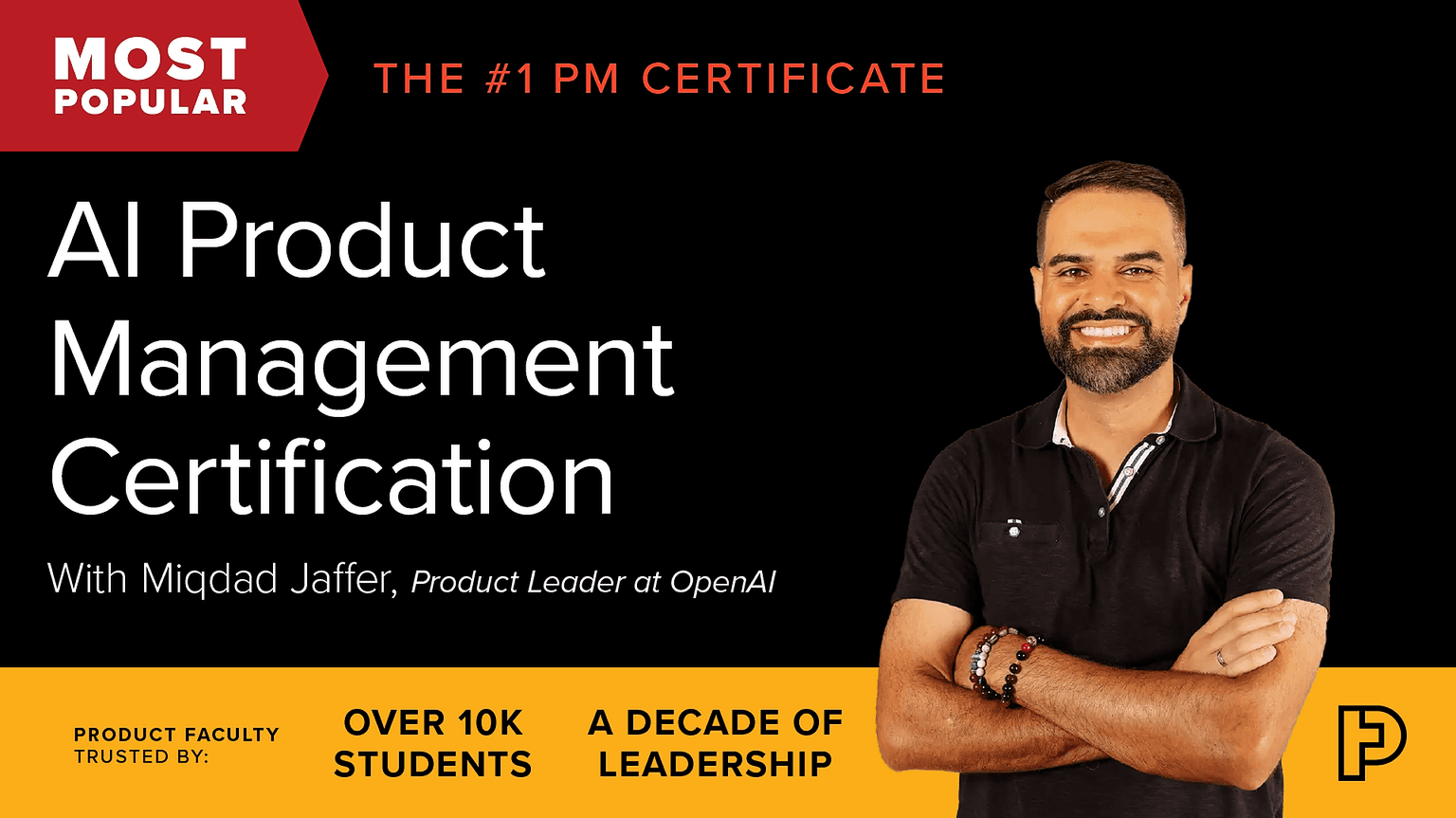
It’s the highest-rated AI PM program on Maven.
I’m also the AI Builds Lab leader there where you get to master building autonomous agents from scratch in 3 live sessions with me… apart from other live sessions you get with Miqdad Jaffer (instructor).
If you want to transform your career in 2026, this is where you start.
The next session starts January 26, 2026. A $500 discount for our community:
Key AI PM Resources With Collaboration Between Product Compass That Cover The 7-Layer Meta-Framework
Introduction to AI PM: Neural Networks, Transformers, and LLMs
RAG for PMs
Model Interfaces & APIs
Practice: Assistants & Responses API
Practice: Prototyping RAG with Gemini File Search
How LLMs Learn & Adapt
AI Evals & Observability
AI Agents for PMs
Practice: MCP (Model Context Protocol)
Practice: The Ultimate Guide to n8n for PMs
Practice: How to Build Autonomous AI Agents
Practice: Multi-Agent Systems
AI Strategy, Scaling, Distribution
2. THE AI PM PORTFOLIO THAT GETS YOU HIRED
There is one truth every hiring manager at every serious AI-first startup quietly believes but rarely says out loud:
Most AI PM portfolios are almost always useless.
They’re either:
ChatGPT wrappers
copied tutorials
prompt playgrounds
“here’s my chatbot” demos
thin UI mockups
or essays pretending to be “AI strategy”
None of these make you hirable.
In 2025, the only portfolios that get callbacks, phone screens, and deep-dive interviews do one thing: They prove you can think, design, and structure problems the way real AI PMs do inside top AI product teams.
That’s it.
If you show you can think like an AI PM, they assume they can train everything else.
The following portfolio system is built explicitly to demonstrate the exact hiring signals companies look for:
Agentic reasoning
Context engineering
System design
Technical intuition
UX for uncertainty
Evaluations
Safety thinking
Distribution & moat sense
Architecture logic
Tradeoff clarity
If your portfolio demonstrates these 10 signals, you get interviews.
If it doesn’t, you disappear into the noise.
Let’s build a portfolio that forces recruiters to call you back.
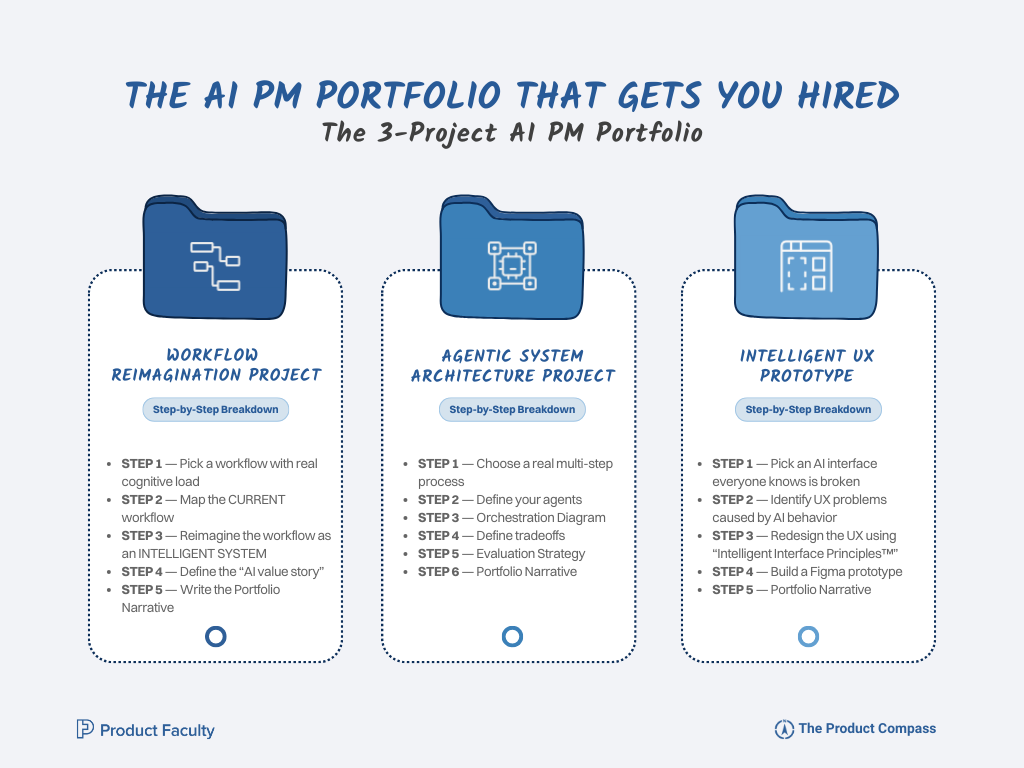
A set of three artifacts that show you can think like an AI PM — without writing code.
You’re about to build:
Workflow Reimagination Project
Agentic System Architecture Project
Intelligent UX Prototype
Each project is crafted for one purpose: to signal a specific set of AI PM mental models.
Let’s go deep.
2.1 Project 1 — The Workflow Reimagination Project
Signal: Can this PM rethink workflows for an intelligent system?
Traditional PMs ship features.
AI PMs redesign how work gets done.
This project proves you can decompose a complex workflow into:
actionable tasks
the right tools and capabilities
key decision points
required context and data sources
evaluation and feedback checkpoints
appropriate autonomy levels
This is one of the most important signals hiring managers look for.
Here’s a step-by-step breakdown:
STEP 1 — Pick a workflow with real cognitive load
Examples (choose one):
Insurance claim processing
Medical prior authorization
Customer onboarding for SaaS
Contract review
Marketplace seller verification
Financial underwriting
Product support triage
Avoid simple tasks like “summarize text” or “answer questions.”
You are proving your systems thinking, not your creativity with ChatGPT.
STEP 2 — Map the CURRENT workflow
A diagram like this:

Show:
bottlenecks
delays
repetitive tasks
error-prone sections
steps requiring reasoning
steps requiring human approval
steps that can benefit from structured context
This is where hiring managers lean forward.
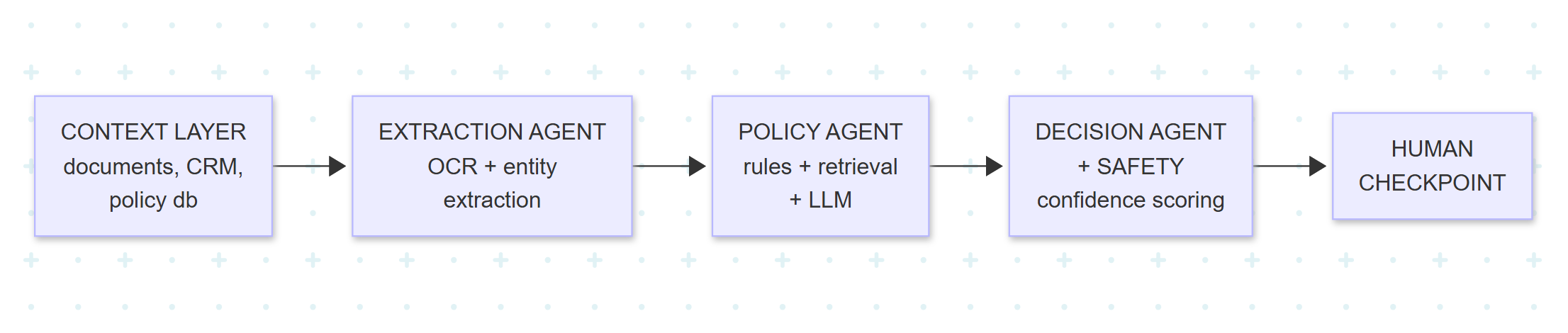
STEP 3 — Reimagine the workflow as an INTELLIGENT SYSTEM
This is where your AI PM thinking shines.
Your new architecture will include:
context sources
memory layers
retrieval layers
agentic tasks
guardrails
human approval boundaries
fallbacks
Example diagram:
STEP 4 — Define the “AI value story”
You must articulate the transformation:
70% automation vs 10% before
lower error rates
faster throughput
increased consistency
reduced cognitive load
scalable with volume
fewer decision bottlenecks
Hiring managers don’t care about fancy diagrams.
They care about why your new system is better.
STEP 5 — Write the portfolio narrative
Use this template:
PORTFOLIO 1 TEMPLATE: Workflow Reimagination Project
1. Problem Summary: A concise explanation of the workflow and why it’s cognitively heavy.
2. Current Workflow Map: Simple diagram + bullet explanation.
3. Pain Points Identified: Where humans struggle, where rules break, where context is missing.
4. AI Opportunity Statement: What tasks could be intelligent?
Where autonomy adds value?
Where retrieval helps?
Where guardrails matter?
5. Reimagined Intelligent Workflow: Full system mapping with component interactions.
6. Agent Responsibilities: Define tasks for:
extraction agent
reasoning agent
evaluation agent
human reviewer
7. Safety & Failure Modes: Confidence thresholds, Fallback rules, Escalation logic.
8. Metrics: What success looks like.
9. Why This Matters: The business case.
2.2. Project 2 — The Agentic System Architecture Project
Signal: Can this PM design a multi-agent system?
This project showcases whether a PM can architect real agentic workflows. A strong submission demonstrates:
thoughtful problem decomposition
selecting the right tools and agents
modeling context and data flows
designing orchestration logic
reasoning about autonomy and guardrails
building an evaluation strategy grounded in failure modes
enabling effective multi-agent collaboration
This is where your technical intuition shows up.
Here’s a step-by-step breakdown:
STEP 1 — Choose a real multi-step process
Examples:
Tax preparation
Travel itinerary planning + booking
Vendor onboarding
Compliance risk scoring
Ad campaign optimization
Sales forecasting with live data
Avoid trivial tasks like “write emails.”
STEP 2 — Define your agents
Every agent has:
purpose
inputs
outputs
tools
evaluation rules
constraints
autonomy boundaries
Example:
1. Research Agent
Tools: web search, retrieval
Output: structured insights
2. Decision Agent
Tools: policy database, scoring rules
Output: recommended action
3. Safety Agent
Tools: code-based rules, heuristics
Output: pass/fail + rationale
STEP 3 — Orchestration Diagram
Like this:

STEP 4 — Define tradeoffs
This is crucial and massively impressive to hiring managers.
Explain:
why not use a single agent
why not automate everything
why retrieval is needed
why human checkpoints exist
where hallucinations might occur
cost vs accuracy tradeoffs
STEP 5 — Evaluation Strategy
Most PMs get this part wrong.
You will design an eval system grounded in real failure modes, not generic metrics.
Your work here includes:
generating & labeling diverse traces (real + synthetic)
building a small, coherent failure taxonomy
defining pass/fail checks for each failure mode
selecting evaluator types (code-based vs. LLM-as-judge)
setting alignment targets (TPR/TNR)
planning regression detection & continuous error analysis
STEP 6 — Portfolio Narrative
Use this template:
PORTFOLIO 2 TEMPLATE: Agentic System Architecture Project
1. Problem Overview: Define the multi-step workflow.
2. Why Agents Are Required: Explain logic behind orchestration.
3. Agent Definitions: For each agent: inputs, outputs, tools, autonomy.
4. System Diagram: Multi-agent flow.
5. Guardrails & Safety Mechanisms: Include fallbacks and human-in-the-loop logic.
6. Evaluation Plan: How quality is measured.
7. Cost & Latency Considerations: What you trade and why.
8. Risks & Mitigations: Fallbacks, error modes, misalignment risks.
9. Why This Design Works: Tell the strategic story.
2.3. Project 3 — The Intelligent UX Prototype
Signal: Can this PM design UX for uncertainty, adaptivity, and real-time reasoning?
This is not Figma.
This is AI-specific UX, which includes:
uncertainty visualization
progressive disclosure
model transparency
adaptive interfaces
error recovery UX
debiasing UX
human-in-the-loop UX
explainability UX
trust-building design patterns
If you understand these, you climb straight to the top of the AI PM hiring list.
Here’s a step-by-step breakdown:
STEP 1 — Pick an AI interface everyone knows is broken
Examples:
file analysis
code review assistant
compliance evaluator
sales email generator
medical symptom checker
learning tutor
STEP 2 — Identify UX problems caused by AI behavior
Examples:
unpredictable outputs
hallucinations
missing context
too much text
unclear reasoning
no guardrails
confusing failures
unsafe instructions
STEP 3 — Redesign the UX using “Intelligent Interface Principles™”
Introduce features like:
uncertainty bars
confidence badges
explain steps
preview before action
edit reasoning
context inspector panel
adaptive mode switches
human override panel
fallback UX for failures
STEP 4 — Build a Figma prototype
You don’t need a perfect UI.
You need intelligent UX.
STEP 5 — Portfolio Narrative
Use this template:
PORTFOLIO 3 TEMPLATE: Intelligent UX Prototype
1. Problem Summary: Where current UX collapses under AI unpredictability.
2. Current UX Flow: Screenshot + critique.
3. Identified AI-Induced UX Failures: List uncertainty triggers.
4. UX Reimagined: Describe new patterns and interactions.
5. UX Screens: Show the new adaptive flows.
6. Safety & Transparency Elements: Explain why users trust the interface now.
7. Decision Boundary UX: How you prevent dangerous outputs.
8. Why This UX Works: The story that shows you think like an AI PM.
2.4. Why This Portfolio Works
Because it shows:
You can design AI workflows
You can think in agents
You can structure context
You understand uncertainty
You can build guardrails
You think about data
You think about evaluation
You know where human review belongs
You know how to present ambiguity
You know how to design for intelligence
Your goal is not to show that you built something.
Your goal is to show that you can THINK like an AI PM.
This is what gets you hired.
2.5. The Most Underrated AI PM Portfolio Strategy of 2025
If there is one portfolio tactic almost no PM uses — but every hiring manager secretly respects — it’s this one:
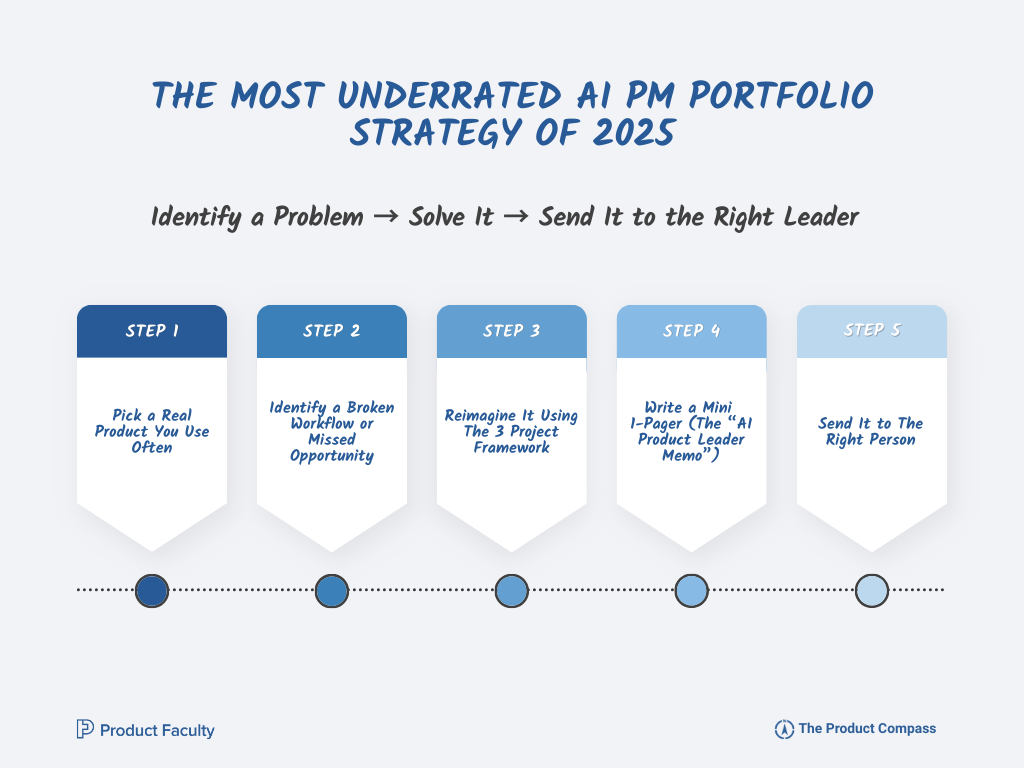
Find a real problem inside a company’s product, solve it intelligently using AI systems thinking, and send your solution directly to the product leader who owns that area.
This works because:
Every great product team is overwhelmed.
Every PM org has more problems than PMs.
Every AI transition creates workflow gaps.
Most teams know where the problems are… but they don’t have the time, energy, or bandwidth to reimagine workflows, rebuild UX, or redesign agentic systems from scratch.
So if you do that work for them — genuinely, thoughtfully, intelligently — three things happen:
You demonstrate you can think like an AI PM inside THEIR domain, using THEIR constraints.
You make their job easier, because you did the analysis they didn’t have time to do.
You become unforgettable. No generic resume or LinkedIn application can create this level of recall.
When you do this well, you don’t compete with 3,000 applicants.
You skip the line entirely.
Here’s exactly how to do it at the level that gets you hired:
Step 1 — Pick a real product you use often
Preferably:
a SaaS tool
an AI product
a workflow-heavy platform
a marketplace
a B2B enterprise tool
or your own company’s product
You need something with cognitive load, not cosmetic issues.
Avoid “design critiques.” We’re doing system critiques.
Step 2 — Identify a broken workflow or missed opportunity
Look for:
repeated manual steps
tasks that could be “agentified”
places where retrieval or memory is missing
decision points that cause friction
ambiguity the product doesn’t handle
error-prone user flows
high information density with no intelligent filtering
tasks people outsource to AI because the product can’t do it
If users are leaving the product to complete part of the workflow, you’ve found gold.
Step 3 — Reimagine it using the 3 project framework
This is where your portfolio intersects with your job search.
You will produce a deliverable that includes:
Workflow Reimagination: Show how you would restructure the workflow using context, tools, retrieval, and agentic steps.
Agentic System Architecture: Design a 2–3 agent system that handles the heavy cognitive steps.
Intelligent UX Prototype: Show how your redesigned interface manages uncertainty, transparency, and adaptive interactions.
This is where you shine — because no other candidate is doing this.
Step 4 — Write a mini 1-pager (the “AI product leader memo”)
Use this structure:
Subject: A workflow improvement opportunity I found in [Product Name]
1. Problem: Describe the broken workflow.
2. Why It Matters: Show the user, business, and system impact.
3. Proposed Intelligent Workflow: A small diagram with agents, context sources, and checkpoints.
4. Smart UX Redesign: Screens showing adaptive UI, uncertainty handling, and safety patterns.
5. The Strategic Angle: Why this helps the company create defensibility, differentiation, or retention.
6. Happy to Share More: Keep it humble but confident.
This memo screams AI PM thinking.
Step 5 — Send it to the right person
This part matters: don’t send it to generic emails or junior recruiters.
Send it to:
Head of Product
Director of Product
Head of AI
PM who owns that domain
or the founder (for startups)
Message structure:
Hi [Name], I’m a PM who has been deeply researching how AI can reshape workflows in [your domain].
I found a meaningful opportunity in [specific flow] inside your product and mapped a reimagined intelligent workflow with agentic architecture and adaptive UX.
Here it is:
I’m also attaching a short 1-pager. If it’s helpful, I’d be happy to walk you through the deeper design.
You aren’t begging for a job. You’re showing how you think.
This is what impresses product leaders.
3. THE AI PM INTERVIEW BREAKDOWN
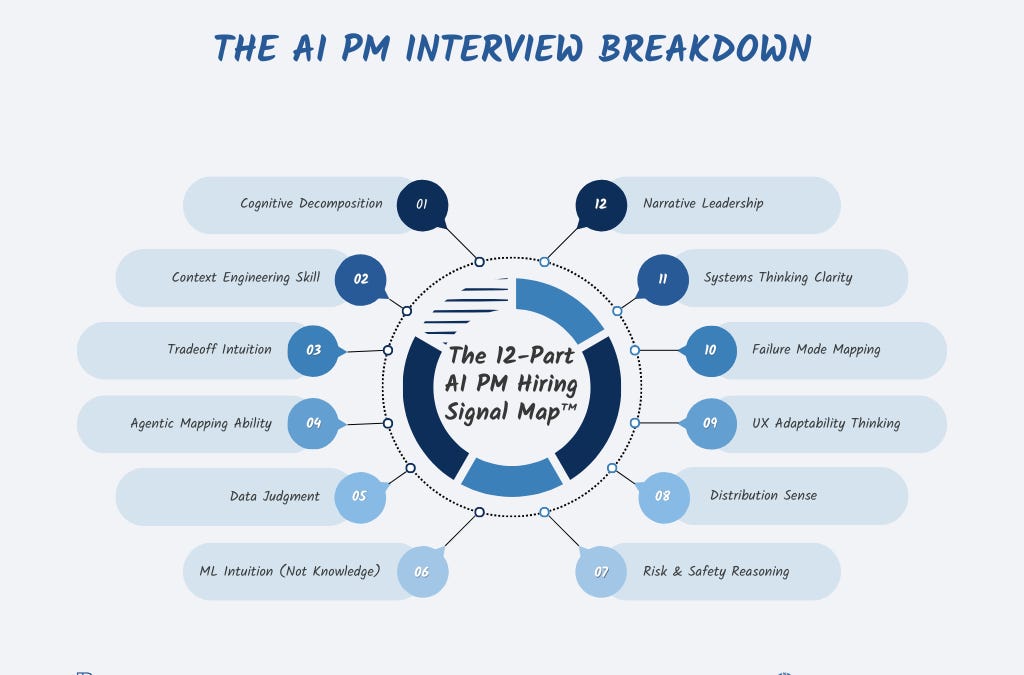
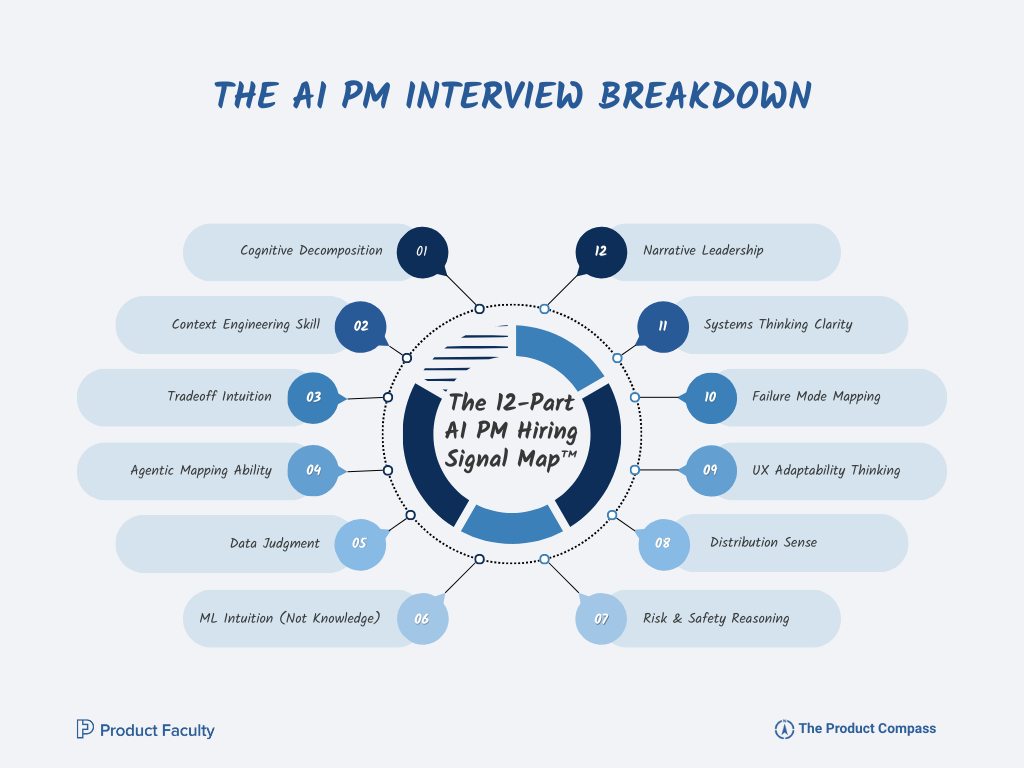
The 12-Part AI PM Hiring Signal Map™ (What Top AI Product Leaders REALLY Look For)
Every AI PM interview looks different on the surface (different prompts, different case studies, different take-homes, different company missions) but under the hood, almost all world-class AI product teams evaluate candidates using the same underlying signals.
Most candidates think they’re being evaluated on “product sense,” “prior experience,” or “technical knowledge.”
Wrong.
You’re being evaluated on patterns of thinking that reveal whether you can be trusted to design, ship, and scale intelligent systems in environments filled with ambiguity, probabilistic behavior, evolving models, unclear ground truth, regulatory risk, and extremely high business impact.
Below are the 12 signals that matter in detail — and what each one reveals about you.
Signal 1 — Cognitive Decomposition
Can you break big, ambiguous problems into clear, solvable cognitive tasks?
AI PMs do not survive by “brainstorming features.”
They survive by:
decomposing complex work into steps
identifying reasoning tasks
mapping decisions vs tools
separating planning vs doing
understanding cognitive load
Interviewers assess this within the first 90 seconds of your answer.
If you ramble → fail.
If you jump to solutions → fail.
If you break the problem into components → pass.
Signal 2 — Context Engineering Skill
Do you understand what the model must know to perform the task?
Traditional PMs ask: “What should the product do?”
AI PMs ask: “What does the model need to understand to do this well?”
Interviewers love to test:
how you structure context
how you filter noise
how you identify missing signals
how you’d make outputs consistent
If you talk about “prompts,” you lose points.
If you talk about “structured context,” you stand out.
Signal 3 — Tradeoff Intuition
Can you make hard decisions with incomplete information?
AI systems have no perfect answers, only acceptable tradeoffs.
Good candidates can:
draw boundaries
stop over-automation
know when human-in-loop is needed
decide accuracy vs latency
choose retrieval vs generation
reject unnecessary model complexity
Signal 4 — Agentic Mapping Ability
Can you convert workflows into multi-agent systems?
AI PMs must:
separate tasks into agents
define agent responsibilities
design orchestration flows
set boundaries for autonomy
explain how agents collaborate
If you can speak in “task → tool → autonomy,” you sound senior.
If you speak in “single LLM” language, you sound like a junior.
Signal 5 — Data Judgment
Do you understand the data needed to make the system reliable?
This is the single most overlooked skill.
AI PMs must understand:
what data is required
how clean it must be
which attributes matter
how labels are defined
where bias enters
how feedback loops form
how to generate synthetic data
Signal 6 — ML Intuition (Not ML Knowledge)
Interviewers ask questions to test:
your understanding of model behavior
how models fail
how models hallucinate
how context length affects accuracy
why retrieval improves consistency
when fine-tuning actually helps
They want to see if you can think causally about ML, not code it.
Signal 7 — Risk & Safety Reasoning
AI systems can create:
legal risk
compliance risk
safety risk
hallucination risk
brand trust risk
You must show:
where guardrails go
how to constrain outputs
when humans override
where confidence thresholds belong
how to avoid bad automation
If you don’t mention safety or risk in your answers, you lose the interview.
Signal 8 — Distribution Sense
You must think about:
how the product reaches users
how AI functionality affects onboarding
why workflows give competitiveness
how vertical knowledge becomes a moat
how habits form in intelligent UX
Companies want PMs who understand the business, not just the tech.
Signal 9 — UX Adaptability Thinking
AI UX = uncertainty UX.
Interviewers test:
how you design for unpredictable outputs
how you present confidence levels
how you preview actions
when you require confirmation
how you recover from errors
how you expose reasoning
Signal 10 — Failure Mode Mapping
Every AI system should have:
known failure modes
fallback logic
escalation paths
safety valves
eval triggers
self-correcting loops
If you can articulate these in interviews, you immediately stand out.
Signal 11 — Systems Thinking Clarity
Your answers must show:
clarity
causality
structure
logic
Hiring managers don’t care about your excitement or creativity.
They care whether your mind is organized enough to design intelligent systems responsibly.
Signal 12 — Narrative Leadership
If you can’t explain it simply, you can’t ship it.
AI PMs must:
explain ambiguity
persuade skeptics
translate complexity
justify tradeoffs
create alignment among executives
This determines whether teams trust you enough to ship your ideas.
Why These 12 Signals MATTER More Than Anything Else
Because these signals tell the interviewer:
“If we put this person into an AI team tomorrow, will they cause more clarity or more chaos?”
That’s the entire interview.
If you demonstrate:
structured thinking
deep context reasoning
safe system design
intelligent workflows
strong agentic logic
evaluation thinking
clear communication
strategic maturity
Then the interviewer thinks: “We can coach the rest.”
If you miss these signals, no course, no certificate, no brand name can save you.
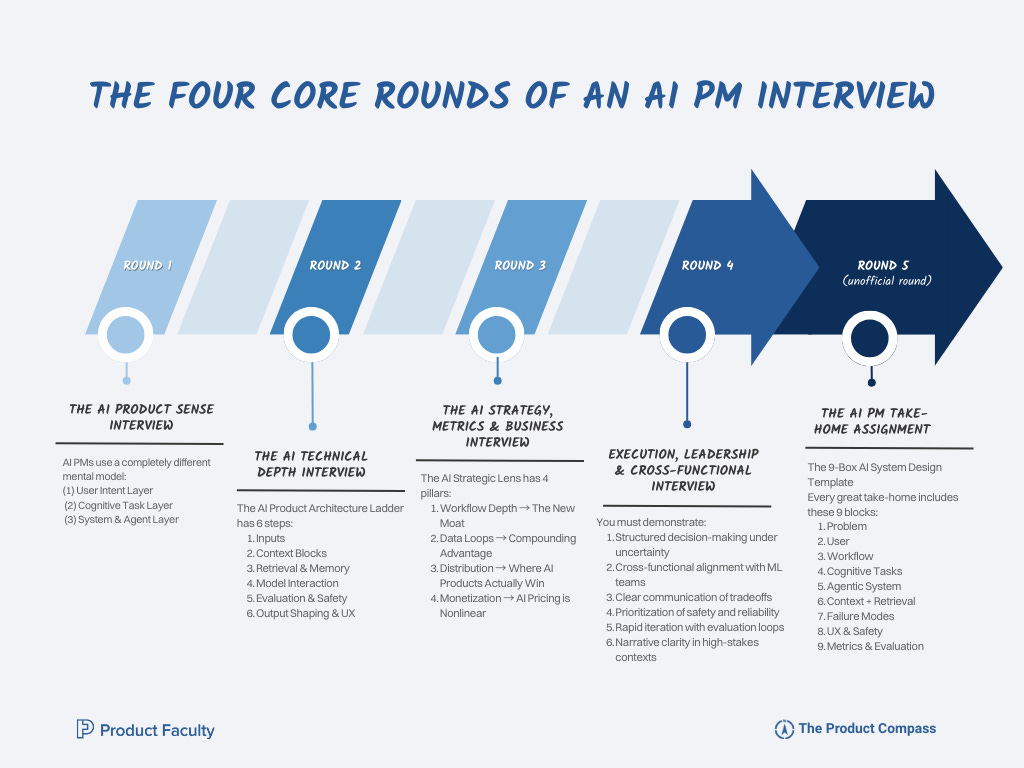
4. THE FOUR CORE ROUNDS OF AN AI PM INTERVIEW
Every company has slightly different labels (Product Sense, Technical, Strategy, Execution), but under the hood, all interviews collapse into four archetypes:
AI Product Sense Interview
AI Technical Depth Interview
AI Strategy, Metrics & Business Interview
Execution, Leadership, and Cross-Functional Interview
And then the “fifth” unofficial round every PM dreads:
The Take-Home Assignment or Whiteboard System Design
We will master each of them.
Round 1 — The AI Product Sense Interview
Traditional PMs use frameworks like CIRCLES.
AI PMs use a completely different mental model:
(1) User intent layer
(2) Cognitive task layer
(3) System & agent layer
Layer 1 — User intent layer
You start by identifying the true intent behind the user action.
But in AI, intent isn’t enough — you must surface:
user uncertainty
incomplete information
trust gaps
missing context
ambiguity in goals
hidden motivations
You must show that you recognize how profoundly unpredictable real users are. They change their minds, send partial information, and often don’t know what they want. Designing for intent means accounting for uncertainty, missing context, and ambiguity — especially when an intelligent system becomes a co-pilot, not a tool.
Example opener: “Before designing an AI system here, I want to understand the user’s intent, the level of ambiguity they bring, and the specific points where they expect intelligence rather than automation.”
Layer 2 — Cognitive task layer
This is the heart of AI Product Sense.
You break the user problem into tasks:
extraction
reasoning
planning
decision-making
classification
summarization
constraint validation
tool usage
You never jump to “let’s add an LLM.”
You decompose the cognitive steps.
Example: “Here are the cognitive tasks the user is performing subconsciously — and here’s where AI can meaningfully absorb that cognitive load.”
This instantly signals seniority.
Layer 3 — System & agent layer
Now you map the tasks to a system:
agents
retrieval
memory
tool usage
guardrails
human review
evaluation loops
This is where your AI PM intuition shines.
Example: “I see this as a 3-agent architecture: a planning agent, a constraints agent, and a reasoning agent, each with different autonomy levels and safety boundaries.”
No traditional PM speaks like this.
AI PMs must.
How to answer any AI Product Sense question (full structure)
User → Intent → Ambiguity
Tasks → Cognitive Decomposition
System → Agents → Tools
Risks → Failure Modes → Guardrails
Product Metrics → Success Definition
UX → Adaptation → Transparency
Tradeoffs → Why This Approach
This is a sophisticated, interview-winning structure.
Thanks for reading 55% of the post. Next, we cover:
🔒 Four Core Rounds of An AI PM Interview (Continued),
🔒 The AI PM Resume Framework,
🔒 The AI PM LinkedIn Framework,
🔒 Proven Signals That Get You Interviews,
🔒 The Zero → $180k–$550k+ AI PM Job Search Alchemy,
🔒 The 30-60-90 AI PM Job Search Plan,
🔒 The Single Best Cold Outreach Strategy for AI PMs.
Consider upgrading your account, if you haven’t already, for the full experience.
Round 2 — The AI Technical Depth Interview
This round does not test coding.
It tests whether you understand how intelligent systems behave.
The AI Product Architecture Ladder has 6 steps:
Inputs
Context Blocks
Retrieval & Memory
Model Interaction
Evaluation & Safety
Output Shaping & UX
Let’s break each one down.
Step 1 — Inputs
Define:
user inputs
tools
structured fields
raw data
You must show understanding of what the system starts with.
Step 2 — Context blocks
This is where you differentiate yourself.
Great candidates talk about:
structured context
filtered signals
noise removal
injected constraints
policy blocks
Explain: “The model must understand X, Y, and Z before reasoning begins — otherwise the entire output becomes unstable.”
This is context engineering.
Step 3 — Retrieval & memory
Great candidates demonstrate:
when retrieval improves consistency
how memory reduces instruction overhead
where dynamic context is needed
how to avoid hallucination loops
Step 4 — Model interaction
Here you show causal reasoning:
what the model does
what tasks are deterministic vs generative
where token limits matter
where latency matters
what the model cannot reliably do
Example long sentence: “Because models degrade significantly when operating outside well-structured context boundaries, I would tightly constrain the reasoning task and offload validation and deterministic rules to separate components.”
This is impressive to interviewers.
Step 5 — Evaluation & safety
This is where strong AI PM candidates shine.
Emphasize that models don’t fail predictably upfront — you discover recurring failure modes through trace analysis.
Strong candidates show they can detect, isolate, and mitigate those modes.
Include:
binary evaluators for each known failure mode
code-based checks for deterministic rules
LLM-as-judge evaluators for subjective or complex failures
alignment with human labels (TPR/TNR)
regression detection workflows
fallback paths (safe default, retry, or human approval)
multi-agent cross-checks for sensitive tasks
safety rules to override unsafe outputs
A strong framing:
“Once failure modes are identified, every output flows through targeted evaluators and safety rules. If any evaluator flags an issue, the system routes to a safer fallback or human review.”
This signals real AI maturity.
Step 6 — Output shaping & UX
Explain:
progressive disclosure
preview before commit
error recovery flows
transparency of reasoning
If you can articulate “output shaping,” you sound like a real AI PM.
Round 3 — The AI Strategy, Metrics & Business Interview
This interview tests whether you can think like a long-term product leader.
The AI Strategic Lens has 4 pillars:
Workflow Depth → The New Moat
“The more of the user’s workflow we own, the harder we are to replace.”Data Loops → Compounding Advantage
“Every usage should make the system better.”Distribution → Where AI Products Actually Win
“AI features do not distribute themselves; workflows do.”Monetization → AI Pricing is Nonlinear
“Charge for outcomes, not features.”
If you apply these 4 lenses in your answers, interviewers see you as strategic.
ROUND 4 — Execution, leadership & cross-functional interview
AI PM execution is different because:
ambiguity is higher
teams are cross-disciplinary
safety matters
engineering complexity is deeper
iteration cycles are shorter
You must demonstrate:
Structured decision-making under uncertainty
Cross-functional alignment with ML teams
Clear communication of tradeoffs
Prioritization of safety and reliability
Rapid iteration with evaluation loops
Narrative clarity in high-stakes contexts
Strong candidates sound like stabilizing forces — calm, structured, intelligent.
ROUND 5 — THE AI PM TAKE-HOME ASSIGNMENT
(The 9-Box AI System Design Template)
Every great take-home includes these 9 blocks:
Problem
User
Workflow
Cognitive Tasks
Agentic System
Context + Retrieval
AI Evals
UX & Safety
Product Metrics
If your submission follows these 9 boxes, you will stand out 100% of the time.
5. RESUME, LINKEDIN & SIGNALS THAT GET YOU INTERVIEWS
The AI PM Resume Framework™ — How to Signal You’re Already an AI PM (Even If Your Title Isn’t)
Getting an AI PM job is NOT about applying to hundreds of roles.
It is about sending a resume calibrated for AI hiring signals, paired with a LinkedIn profile that positions you as someone who already thinks, writes, and builds like an AI Product Manager.
This section will teach you exactly how to do both.
Let’s begin.
A resume designed to pass the AI PM filters recruiters never admit exists.
Your resume must tell a single, unmistakable story:
“This person thinks like an AI PM, designs like an AI PM, and is ready to operate on an AI product team today.”
To do that, your resume should contain these 6 essential narrative blocks:
Impact Narrative
Systems Narrative
AI-Specific Narrative
Technical Intuition Narrative
Execution & Leadership Narrative
Portfolio Narrative
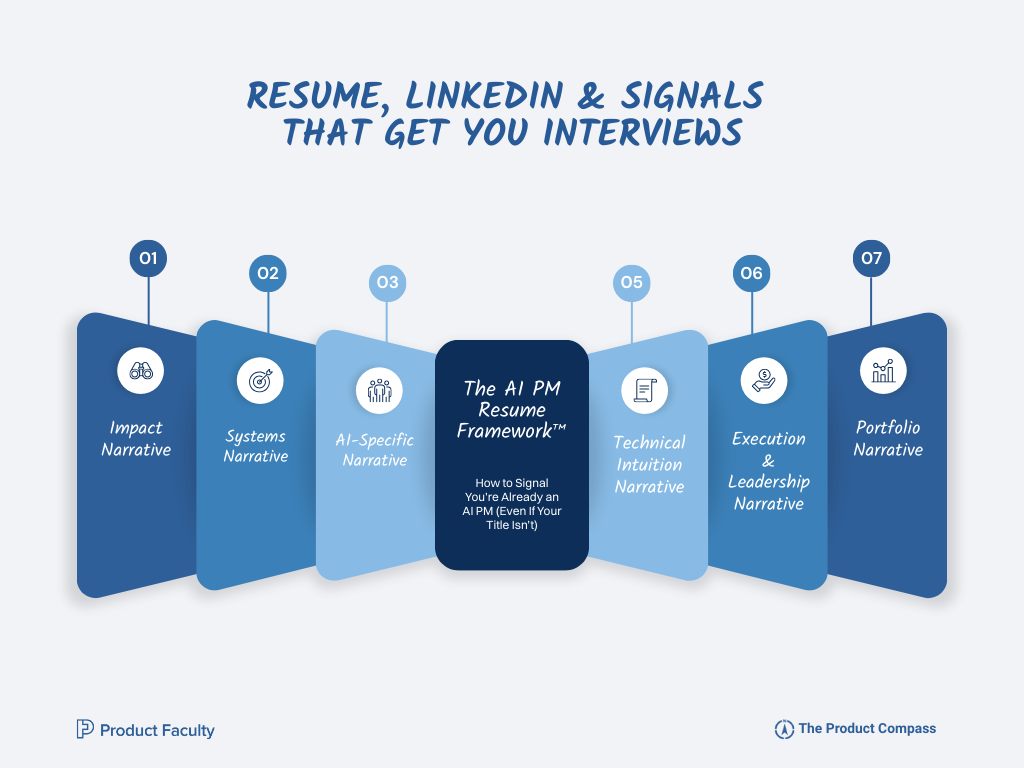
Most PM resumes fail because they only show #1 and #5.
AI PM resumes must show all six.
Let’s break them down.
Block 1 — Impact narrative (the outcomes section)
Traditional PM resumes focus on shipping features.
AI PM resumes focus on transforming workflows, reducing cognitive load, and improving intelligence-driven outcomes.
Shift from:
❌ “Shipped X feature used by 20K users.”
✅ “Reduced cognitive load in support workflow by 45% by redesigning reasoning steps and eliminating redundant decision-making tasks.”
Shift from:
❌ “Built dashboard for analytics team.”
✅ “Created structured context pipelines that improved accuracy and reduced manual interpretation for 12 analysts.”
Every bullet should speak in terms of:
problems
decisions
workflows
constraints
outcomes
NOT features.
Block 2 — Systems narrative (show you think in systems, not screens)
AI PMs are systems thinkers.
Show that you:
redesigned workflows
evaluated agents or tasks
mapped context flows
defined constraints
structured multi-step processes
Bullet example: “Decomposed customer onboarding into 7 cognitive steps and designed an intelligent validation flow that reduced manual review by 30%.”
The interviewer thought: “This person gets it.”
Block 3 — AI-specific narrative (show you understand intelligence)
This is where most candidates fall flat.
Do NOT write:
❌ “Integrated ChatGPT into product.”
That signals junior thinking.
Write things like:
“Designed structured context blocks to improve model consistency.”
“Created a retrieval strategy to reduce hallucinations in reasoning workflows.”
“Mapped uncertainty zones and implemented confidence-driven UX controls.”
“Defined guardrail rules for deterministic model evaluation.”
Now you’re speaking the language of AI PMs.
BLOCK 4 — Technical intuition narrative (signals engineers look for)
You don’t need coding skills.
You need reasoning about technical systems.
Show bullets like:
“Defined evaluation metrics for LLM performance across ambiguous decision tasks.”
“Collaborated with ML engineers to determine when to use retrieval vs generative reasoning.”
“Identified tradeoffs between latency and output accuracy for multi-agent orchestration.”
You are signaling: “I understand what matters technically, and I make good decisions.”
BLOCK 5 — Execution & leadership narrative (show you can drive AI projects)
AI projects involve:
rapid iteration
ambiguity
cross-functional alignment
safety considerations
Show bullets like:
“Led cross-functional team across ML, design, and policy to ship intelligent document analysis workflow in 6 weeks.”
“Drove alignment across engineering and legal to define safe boundaries for agent autonomy.”
“Implemented iterative evaluation loops to reduce variance and stabilize outputs over time.”
This shows you can handle AI-level complexity.
BLOCK 6 — Portfolio narrative (the 3-project portfolio + bonus strategy)
At the bottom of your resume:
Portfolio (Intelligent Systems Work):
– Workflow Reimagination: [link]
– Agentic System Architecture: [link]
– Intelligent UX Prototype: [link]
– Real-Company Problem Solved (Sent to VP Product): [link]
The AI PM LinkedIn Framework
LinkedIn is not a place to list accomplishments; it is a distribution engine for your AI PM identity.
Here’s how to design a LinkedIn that signals AI PM readiness before anyone reads your resume.
There are 5 zones to optimize:
Headline
About Section
Experience Section
Featured Section (Your Portfolio)
Content Flywheel (Your AI PM Thinking)
Let’s break them down.
ZONE 1 — Headline
Your headline must instantly communicate your positioning.
Examples:
Option A: Systems Thinker Headline
AI Product Manager (Systems, Agents, Context Engineering, Intelligent UX)
Option B: Workflow Reimagination Headline
PM → AI PM (Intelligent Systems, Agentic Workflows, Data-Driven Reasoning)
Option C: Domain-Specific AI PM Headline
AI Product Manager (FinTech Risk | Agentic Decision Systems | LLM Workflows)
Remember:
Your headline isn’t a title — it’s a signal.
Zone 2 — About section (the most important part)
Write a narrative that positions you as someone who:
thinks in intelligent workflows
designs agentic systems
understands AI’s constraints
understands data, retrieval, and context
builds adaptive UX
cares about safety and reasoning
Example (long, fluid, senior): “I design intelligent systems that reduce cognitive load, reimagine workflows, and deliver consistent decision-making under uncertainty.
My work focuses on context engineering, multi-agent orchestration, adaptive UX, and safe autonomy: principles that allow AI products to move beyond novelty and into scalable, high-impact systems.”
Then add your examples/portfolio you’ve built above with the detailed reasoning.
This instantly signals depth.
Zone 3 — Experience section
Rewrite your bullet points using:
reasoning verbs
system verbs
constraint verbs
safety verbs
workflow verbs
Examples:
“Rearchitected onboarding with intelligent validation workflows, reducing reviews by 30%.”
“Defined retrieval strategy and context schema to improve model accuracy.”
“Implemented multi-agent review system for document processing.”
Zone 4 — Featured section
Add links to:
Workflow Reimagination Project
Agentic System Architecture Project
Intelligent UX Prototype
Real-company problem analyses
Articles demonstrating your AI product thinking
This is your conversion engine.
Zone 5 — Content flywheel (optional but massive boost)
Want to build AI products, not just read about them?
Become a Fellow






Want to build AI products, not just read about them?
Become a Fellow