Travel
Famigo
Famigo is a planning assistant for busy parents who need to organize family outings without juggling multiple tabs for weather, maps, hours, and restaurant research. The product generates a customized day plan in seconds using real-world constraints such as operating hours, logistics, and weather. The demo shows a parent planning a Washington, DC outing with a 10-year-old, then revising the museum choice conversationally while the system revalidates the plan.
The problem
Planning a family outing means juggling disconnected tools — Google Maps, Yelp, weather apps, event sites, social media, and group chats — to research activities, compare options, check reviews, coordinate schedules, and estimate travel time. The result is decision fatigue and fragmented planning across too many apps. During the outing itself, unexpected issues — traffic, weather changes, crowds, nap or meal timing — force stressful last-minute replanning. For the busy parent acting as "family coordinator," high time pressure and constant context-switching turn what should be enjoyable into a chore.
The solution
Famigo is a family outing planning assistant that generates a customized day plan in seconds using real-world constraints such as operating hours, logistics, and weather. A parent describes their outing in natural language, and Famigo produces a complete, personalized itinerary combining family composition, children's ages, budget, timing, and preferences with grounded venue data. Plans can be refined conversationally — swap a restaurant, make it indoor, shorten the outing — without rebuilding from scratch. In the demo, a parent plans a Washington, DC outing with a 10-year-old, then revises the museum choice while the system revalidates the plan around operating hours and constraints.
How it works
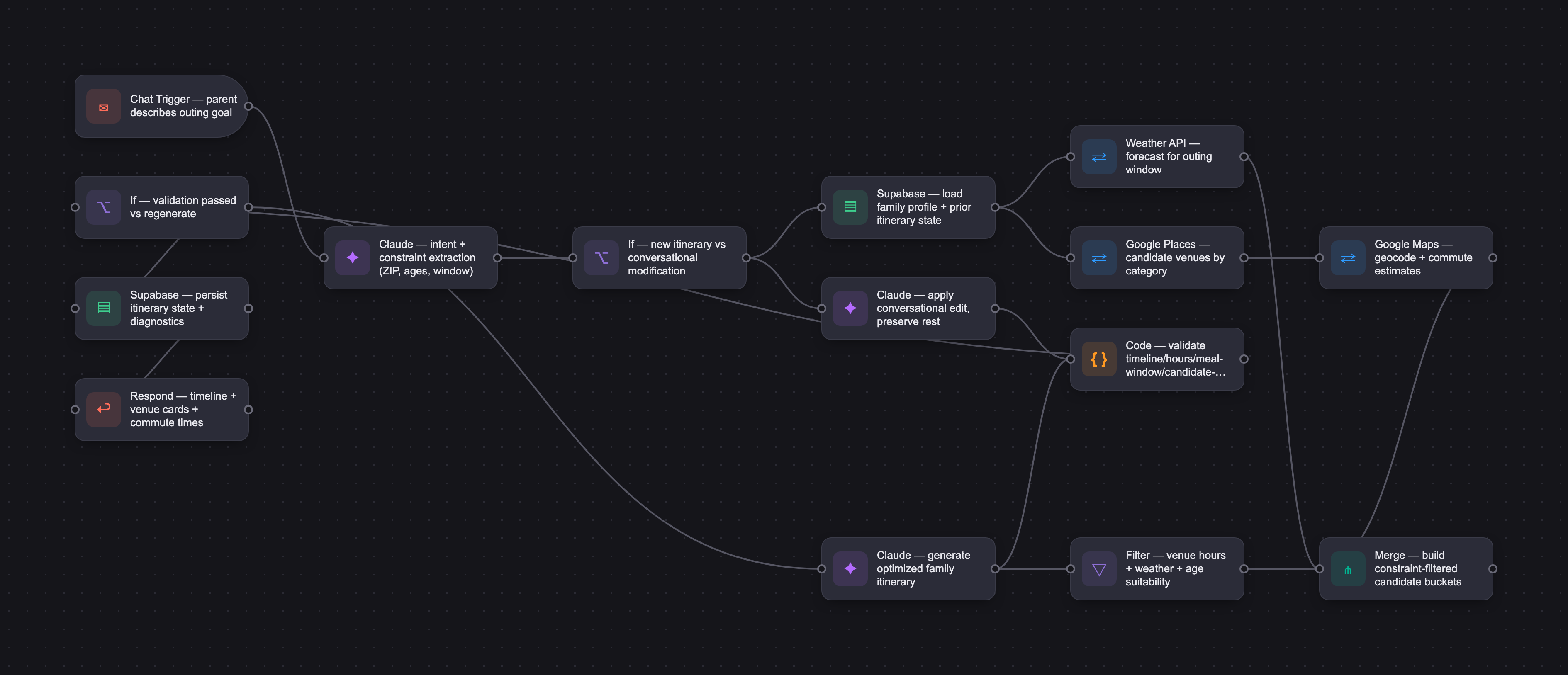
Famigo uses structured real-time data rather than model training. Core sources include user inputs, Google Places, Google Maps and geocoding, and weather APIs, plus the app's own itinerary state. Data is cleaned into structured candidate buckets, filtered by constraints, passed to the AI for generation, and validated before display. The prototype demonstrates three AI capabilities — intent understanding, itinerary generation, and conversational refinement — presented as a natural-language interface, a structured timeline, and venue cards. A key insight from evaluation was that most failures came from orchestration, retrieval, and validation logic rather than the language model itself; as grounding, weather integration, and venue validation improved, so did output quality. Manual evaluation showed roughly 95% hallucination avoidance and 90% factual accuracy, with conversational modification and multi-constraint planning as the main areas to improve.
Who it's for
Famigo is B2C, aimed at busy families with children — especially millennial and Gen Z parents planning local outings and weekend activities. The most revenue-impacting users are dual-income suburban and urban families with children under 12, who face the highest planning complexity and strongest willingness to pay for stress reduction. Typical buyers are parents aged 32–55 with 1–4 kids (children primarily ages 2–12), in middle-to-upper income, smartphone-heavy households. Secondary users include caregivers, grandparents, and family groups coordinating together.
Why it matters
The tailwinds are explosive GenAI adoption, growth in the experience economy, and rising decision fatigue, in a target segment projected to grow 10–15% over three to five years. The market is crowded — Mindtrip, Google, Yelp, and ChatGPT all compete — so Famigo's edge is family-specific optimization: context- and constraint-awareness and personalization. Famigo is a startup at prototype stage, planning a phased closed pilot → beta → public launch. It will launch free to validate product-market fit, introduce a freemium model during beta, and pursue a hybrid model of subscription revenue plus affiliate revenue from attractions and experiences booked through the platform.
The workflow
The PRD
| PRODUCT FACULTY — AI PRODUCT REQUIREMENTS DOCUMENT (PRD) TEMPLATE Version 1.0 | ||||||
|---|---|---|---|---|---|---|
| Your Name: | Vishal Mody | |||||
| Your Product: | Famigo - Family Outing Planning Assistant | |||||
| Your Industry: | Travel & Leisure Tech | |||||
| Date: | June 15, 2026 | |||||
| 4D Method | AI PRD | Instructor Feedback | ||||
| Phase | Activity | Theme | Topic | Key Question(s) | Your Response Include external links to visuals/prototypes as required. | |
| DISCOVERY | Understand your market, business, product & user context | Business Value Map | Market Attractiveness | What industry is your business in? (ie Financial services, Healthcare, Education, etc)? | Travel & Leisure Tech | Please leave this area blank. This space is for the Instructor to provide you with feedback. |
| What are the key challenges (headwinds) and opportunities (tailwinds) impacting growth in your industry? Who are the key competitors? | Tailwinds explosive GenAI adoption experience economy growth rising decision fatigue Headwinds crowded AI travel market competition monetization challenges Key Competitors Mindtrip, Google, Yelp, ChatGPT | |||||
| What is the projected growth rate of your target market segment over the next 3-5 years? | 10%-15% growth over 3-5 years | |||||
| Business Model | What growth stage is your business currently in (e.g., startup, scale-up, mature)? | startup | ||||
| How does your business make money? What do they sell? What is your primary revenue model (e.g., subscription, freemium, licensing, marketplace, transactional, etc?) | Phase 1: Freemium for consumers + affiliate partnerships | |||||
| Who is your primary customer base (B2B, B2C, B2B2C)? | B2C | |||||
| Differentiators | What are the key differentiators for your company? | Family-Specific Optimization -Context and Contraints aware -Personalization | ||||
| Feature Value Map (IMPORTANT NOTE: This section is only relevant if you are working on enhancing an existing product. It does not apply if you are developing a new product from 0 to 1.) | Customers | Who are the customers (ie buyers) of your product? | Parent(s) in the age group 32-55, with 1-4 kids Children primarily ages 2–12 Middle-to-upper income households Urban/suburban U.S. families Smartphone-heavy users | |||
| End Users | Who are the end-users of your product? Which users are the most revenue-generating / revenue-impacting for your company? What are their goals, roles, and context? | The primary end-users are busy families with children, especially millennial and Gen Z parents planning local outings, weekend activities, and short family experiences. Secondary users include caregivers, grandparents, and family groups coordinating activities together. The most revenue-generating users are dual-income suburban and urban families with children under 12, as they experience the highest planning complexity, strongest need for convenience, and greatest willingness to pay for stress reduction and personalized recommendations. Their goals are to plan enjoyable, low-stress outings that fit their family’s schedule, budget, energy levels, and children’s routines. Their role is typically the “family coordinator” responsible for organizing activities, transportation, meals, and timing. Their context is high time pressure, decision fatigue, and fragmented planning across multiple apps and sources. | ||||
| Current Products / Services | If you are a Product-led business: What are the core features of your product, and how do they address user needs? If you are a Service-led business: What are the key services you offer to customers? | The product’s core features include AI-powered itinerary generation, personalized family profiles, adaptive scheduling, stress alerts, and real-time backup recommendations. The AI itinerary generator creates customized outing plans based on family size, children’s ages, budget, interests, weather, and available time. Personalized family profiles remember preferences and routines to improve recommendations over time. Adaptive scheduling helps families avoid common stress points such as nap conflicts, long travel times, or overcrowded venues. Stress alerts proactively identify potential issues, while backup recommendations provide alternative indoor or nearby options when plans change unexpectedly. Together, these features reduce decision fatigue, simplify coordination, and help families plan smoother, more enjoyable outings. | ||||
| User Value Map | Target Persona | Who is your AI product / feature for? (Internal users, external users, an influencer, a buyer, etc) | The AI product is designed primarily for external users — specifically parents and family coordinators responsible for planning outings and activities for children and family groups. The primary buyer and end-user are typically busy millennial and Gen Z parents seeking to reduce planning stress and save time. | |||
| Journey Map (current-state) | What is the typical journey for your target persona when they are using your product / service, focusing on their ideal experience (happy path) as they interact with your product? | Currently, parents typically use multiple disconnected tools to plan family outings, including Google Maps, Yelp, weather apps, event sites, social media, and group chats. They spend significant time researching activities, comparing options, checking reviews, coordinating schedules, planning meals, and estimating travel time. During the outing, unexpected issues such as traffic, weather, crowds, or children’s routines often require last-minute adjustments, creating stress and decision fatigue throughout the experience. | ||||
| Pain-points | Where does the user experience friction, obstacles, or unmet needs throughout the journey? Identify which pain-points are most frequent and severe? | The main pain points are decision fatigue, fragmented planning across multiple apps, difficulty coordinating different family preferences and children’s routines, and unexpected logistical issues during the outing such as traffic, weather changes, long wait times, or meal timing conflicts. The most requent and severe pain points are: 1. Decision fatigue from researching and comparing too many options. 2. Coordinating schedules, and preferences across family members. 3. Last-minute disruptions that force stressful replanning right before ot during the outing. 4. Budget optimization 5. Meal co-ordination 6. Group coordination | ||||
| AI Opportunities | From your list of pain points, identify those that can effectively be addressed using Generative AI. Remember, this project focuses on leveraging LLM-powered AI to solve your target persona's pain points. Rank these pain points starting with the most severe and frequently occurring first. | The most requent and severe pain points are: 1. Decision fatigue from researching and comparing too many options. 2. Coordinating schedules, and preferences across family members. 3. Last-minute disruptions that force stressful replanning right before ot during the outing. 4. Budget optimization 5. Meal co-ordination 6. Group coordination | ||||
| Develop an AI Solution Hypothesis | AI Solution Hypothesis | Diverge | Ideate potential solutions to address your AI-solvable pain points. Focus on generating a high quantity of ideas rather than evaluating their quality at this stage. | Hypothesis 1 — Personalized Itinerary Generation If GenAI generates personalized family outing itineraries based on children’s ages, preferences, budget, timing, weather, and travel constraints, then parents will spend significantly less time planning activities and feel less decision fatigue. AI Capabilities reasoning across multiple constraints personalization itinerary generation contextual recommendations Hypothesis 2 — Adaptive Stress Reduction Assistant If AI proactively identifies logistical stress points (traffic, nap conflicts, meal timing, weather, overcrowding) and recommends adjustments or backup plans, then families will experience smoother outings with fewer disruptions. AI Capabilities predictive reasoning contextual awareness dynamic replanning recommendation optimization Hypothesis 3 — Conversational Family Planning Interface If families can plan outings using natural conversational prompts instead of manually searching across multiple apps, then users will perceive the planning experience as easier, faster, and less stressful. AI Capabilities conversational UX natural language understanding intent extraction recommendation synthesis | ||
| Converge | Rank your ideated solutions based on impact and feasibility. Identify your top three AI solutions, and clearly select the one you'll focus on for your project. | Hypothesis 1 — Personalized Itinerary Generation If GenAI generates personalized family outing itineraries based on children’s ages, preferences, budget, timing, weather, and travel constraints, then parents will spend significantly less time planning activities and feel less decision fatigue. AI Capabilities reasoning across multiple constraints personalization itinerary generation contextual recommendations Hypothesis 2 — Adaptive Stress Reduction Assistant If AI proactively identifies logistical stress points (traffic, nap conflicts, meal timing, weather, overcrowding) and recommends adjustments or backup plans, then families will experience smoother outings with fewer disruptions. AI Capabilities predictive reasoning contextual awareness dynamic replanning recommendation optimization Hypothesis 3 — Conversational Family Planning Interface If families can plan outings using natural conversational prompts instead of manually searching across multiple apps, then users will perceive the planning experience as easier, faster, and less stressful. AI Capabilities conversational UX natural language understanding intent extraction recommendation synthesis | ||||
| DESIGN | Define Target State Workflow | UX Flows & Wireframes Suggested Tool: Excalidraw | Workflow (future) | Assuming your product or feature works as desired, what is the target state workflow? | 1. Simple UX, easy to use and quick value 2. User starts with natural language intent 3. AI collects context automatically [family profile memory, weather, traffic/travel estimates previous preferences, child age constraints, venue suitability] 4. AI Understands Constraints & Priorities [nap windows, meal timing, travel fatigue, budget optimization, walking distance, weather suitability, crowd avoidance] 5. AI Generates Optimized Family Itinerary | Please leave this area blank. This space is for the Instructor to provide you with feedback. |
| Build Wireframes | Wireframes | How will users navigate through your AI solution? What are the key steps and decision points? What information will be displayed at each stage? What specific UI elements are needed on each screen? How will the layout accommodate AI features? | https://famigo-planner.lovable.app/ | |||
| Develop Prototype to showcase AI interactions | Prototype Screens Suggested Tool: lovable.dev | What aspects of the AI solution will you demonstrate in your prototype? How will the AI inputs, processing, and outputs be presented visually to users? Which features are essential for launch? What can be left for later releases? | The prototype will demonstrate three core AI capabilities: 1. Intent Understanding -Interprets natural-language requests and extracts planning requirements such as destination, timing, family composition, activity preferences, and dining preferences. 2. AI-Powered Itinerary Generation -Generates a complete, personalized family outing itinerary by combining user preferences with real-world context including weather, venue availability, ratings, operating hours, and travel considerations. 3. Conversational Itinerary Refinement -Allows users to modify an existing itinerary through natural conversation (e.g., swap a restaurant, make the plan more outdoor-focused, shorten the outing) without rebuilding the plan from scratch. The AI workflow is presented through: * A natural-language planning interface where users describe their outing goals. * A structured itinerary timeline showing activities, meals, commute times, and recommendations. * Venue cards containing ratings, reviews, addresses, and operating information. * A conversational chat panel allowing users to refine and update the itinerary in real time. | |||
| Initial Prompt Design | Master Prompt [Initial Design] | Create an initial master prompt. Consider the following: What tone or personality should the AI use? How should user input and system instructions be structured for maximum clarity? What system instruction will govern the AI's behavior? What examples might improve performance? How will you format outputs for consistency? | https://docs.google.com/document/d/1NiAYqekxIf2-6pM7MhMdg16aJH6wyVLdBrt6vcbKKRc/edit?usp=sharing | |||
| Prepare for Testing & Iteration | Evaluation Criteria & Test Plan | Evaluation Criteria | What specific quality benchmarks (e.g., clarity, relevance, tone, accuracy, SEO, hallucination avoidance) will define “good” output? | 1. Relevance: Meets all stated user requirements and preferences. 2. Grounding & Accuracy: Uses real venues, ratings, weather, and operating hours. 3. Constraint Compliance: Respects timing, logistics, weather, and venue availability. 4. Personalization: Tailored to family composition and interests. 5. Hallucination Avoidance: No invented venues or unsupported claims. 6. Modification Quality: Updates plans correctly while preserving unchanged portions. | ||
| Example Cases | What specific example use cases, edge cases, and negative cases should be covered by test prompts and outputs? | https://docs.google.com/spreadsheets/d/1xRyh2pBfqyg9UiMmBm4vld8Sx2r2EifilxzMpdcXLUY/edit?usp=sharing | ||||
| DEVELOP | AI Model Selection & Justification | AI Model Selection & Justification | Which AI model is best suited for your solution and why? What capabilities and limitations does it have? How will it integrate with your product? | https://docs.google.com/document/d/19YS46QkyPFC1YiVLrD_NfCepmkY16f8q-rKqjPBkrfU/edit?usp=sharing | Please leave this area blank. This space is for the Instructor to provide you with feedback. | |
| Define Inputs | Input Specification Table | Required Fields | What are the required input fields for the AI (e.g., title, description, keywords, tone)? Indicate format, source, requirement. | https://docs.google.com/document/d/1nB43vvhAL_yh1QpF8Cyr_XeobQKj-tf8chJ2jCL67dw/edit?usp=sharing | ||
| Optional Fields | Are there any optional or user-customizable fields? How do they impact the AI’s output? | https://docs.google.com/document/d/1nB43vvhAL_yh1QpF8Cyr_XeobQKj-tf8chJ2jCL67dw/edit?usp=sharing | ||||
| Define Good Output | Output Evaluation Checklist | Objective Criteria | What criteria will you use to judge output as “good”? (e.g., structure, use of keywords, tone, factuality, relevance) | Famigo outputs are evaluated based on relevance, personalization, factual accuracy, constraint compliance, logical itinerary flow, hallucination avoidance, conversational consistency, and overall trustworthiness. A high-quality itinerary satisfies user requirements while remaining realistic, grounded, and easy to execute. | ||
| Subjective Criteria | Are there any criteria that require human judgment or qualitative assessment? | Yes. Criteria such as personalization quality, itinerary flow, recommendation quality, activity appeal, and overall user satisfaction require human judgment because there is no single objectively correct answer. These dimensions are best evaluated through user feedback, human review, or future LLM-as-a-Judge frameworks. | ||||
| Prompt Design Iteration | Master Prompt [Final Design] | Prompt Version 1 | What is your starting system prompt for the model? What variations will you test? What techniques will you use to optimize performance? List initial instructions, persona, inputs, and constraints. | While the project did not implement a formal automated prompt evaluation framework, prompt optimization was guided by systematic testing of core, edge, and negative scenarios. Observed failures were used to refine system instructions, grounding context, validation rules, and conversational behaviors, creating an iterative feedback loop similar to real-world AI product development. | ||
| Prompt Iterations | If revised, what changes did you make and why? How do you track and record prompt evolution? | The prompt evolved through iterative testing and failure analysis. Major improvements included stronger grounding, destination-aware planning, conversational itinerary modification, weather-aware recommendations, constraint handling, and hallucination prevention. Prompt changes were tracked through regression testing and validation of representative use cases, edge cases, and negative scenarios to ensure quality improved without introducing new regressions. | ||||
| Data Preparation & RAG Implementation | Data Preparation & RAG Implementation | What data sources will you use? How will you prepare data for model training or evaluation? (e.g., cleaning, structuring). For RAG: How will you chunk, embed, retrieve relevant information? | Famigo uses structured real-time data rather than model training. Core data sources include user inputs, Google Places, Google Maps/geocoding, weather APIs, and the app’s itinerary state. Data is cleaned into structured candidate buckets, filtered by constraints, passed to the AI for itinerary generation, and validated before display. Traditional document RAG is not required for MVP, but future versions could add RAG for local guides, event data, reviews, and family activity content. | |||
| Create Evaluation Set | Example Input/Output Data for Testing | Typical Examples | What are the most common inputs and expected outputs? Use real data if possible. | Most Common Inputs and Expected Outputs Use Case 1: Local Family Outing Input Plan a family outing from Ashburn, VA this Saturday from 2 PM to 7 PM for two girls ages 7 and 12. Expected Output Personalized family itinerary Age-appropriate activities Restaurant recommendation Weather-aware planning Venue ratings and reviews Commute estimates Timeline-based itinerary Use Case 2: Outdoor Family Outing Input Plan a half-day outdoor outing for my family next Sunday from 7 AM to 1 PM starting from 22030. Expected Output Outdoor-focused activities Weather-adjusted recommendations Parks, trails, or nature attractions Lunch recommendation if outing overlaps lunch window Real venue information and operating hours Use Case 3: Destination-Based Day Trip Input Plan an outing to Washington DC with my 10-year-old tomorrow from 1 PM to 10 PM, starting from ZIP 22030. Expected Output Washington DC itinerary Destination-aware recommendations Museums, attractions, dining options Travel estimates from starting location Full-day itinerary timeline Use Case 4: Preference-Constrained Planning Input Plan an outing to Washington DC with my 10-year-old tomorrow from 1 PM to 10 PM, starting from ZIP 22030. Include a museum and Italian dinner. Expected Output Museum recommendation Italian restaurant recommendation Constraint-compliant itinerary Activities scheduled around operating hours Dinner scheduled within dinner time window Use Case 5: Conversational Itinerary Modification Input My kids like Italian. Can you swap out the food stop with an Italian restaurant? Expected Output Existing itinerary updated Only restaurant recommendation changes Other activities preserved Explanation of modifications made Use Case 6: Weather-Aware Modification Input Keep everything the same but make it indoor. Expected Output Outdoor activities replaced with indoor alternatives Existing itinerary structure preserved Weather-sensitive recommendations updated Dining and logistics maintained where possible | ||
| Edge Cases & Negative Cases | What examples test the AI’s limits? (e.g., missing data, ambiguous input, out-of-domain) | Key Limit Categories Missing data Ambiguous requests Conflicting constraints Impossible schedules Weather failures Venue availability conflicts Multi-constraint planning Conversational modifications Hallucination prevention Out-of-domain requests These scenarios help validate both the AI reasoning layer and the surrounding grounding and validation systems that make Famigo trustworthy. | ||||
| Test Example Data & Review Results | Manual Review | Run your input data with the prompt. How did your output perform in manual review? Which examples failed which criteria, and why? | https://docs.google.com/document/d/1YmXmjvSKw0jhMS7LNVQOTifH50c6FRsOf1dtMoMGz9M/edit?usp=sharing | |||
| Automated Evaluation | What pass/fail rate or scores did the AI achieve on core criteria? | The Famigo prototype was evaluated using a manual test suite consisting of core use cases, edge cases, and negative cases. Results were assessed against relevance, personalization, factual accuracy, constraint compliance, conversational consistency, and hallucination avoidance. Estimated Manual Evaluation Results | Criterion | Result | | Relevance to User Request | ~90% Pass | | Personalization | ~85% Pass | | Factual Accuracy | ~90% Pass | | Constraint Compliance | ~80% Pass | | Conversational Modification | ~75% Pass | | Hallucination Avoidance | ~95% Pass | | Timeline Structure & Clarity | ~90% Pass | | Overall User Acceptance | ~85% Pass | ### Areas Performing Well * Natural-language itinerary generation * Venue grounding and validation * Weather-aware recommendations * Destination-based planning * Hallucination prevention * Structured itinerary presentation ### Areas Requiring Improvement * Conversational itinerary modifications * Complex multi-constraint planning * Timeline sequencing and meal timing * Recommendation diversity and quality * Edge-case handling for missing or ambiguous information ### Key Insight The majority of failures were related to orchestration, retrieval, and validation logic rather than the language model itself. As grounding, weather integration, venue validation, and conversational state management improved, overall output quality increased significantly. ### Future Evaluation Targets | Metric | Target | | Relevance | >95% | | Constraint Compliance | >95% | | Modification Success | >90% | | Hallucination Rate | <1% | | User Acceptance Rate | >90% | ### Because the project relied primarily on manual evaluation rather than a formal benchmark dataset, the reported scores are directional estimates derived from regression testing across representative use cases, edge cases, and negative scenarios. | ||||
| Handle Edge Cases & Iterate | Edge Case Identification | What edge cases did you identify in testing or real usage? | The most common edge cases fell into five categories: Missing or ambiguous information Weather and external data availability Location and destination interpretation Conversational state management Constraint and scheduling conflicts Testing these scenarios significantly improved the reliability, trustworthiness, and usability of the final solution. | |||
| Updates & Adjustments | What prompt or system adjustments have you made based on failures, feedback, or edge case observations? | https://docs.google.com/document/d/1wHYBLYEZ48FIYTJ2w95gqINigRviRV3oqYNNkIXk6zo/edit?usp=sharing | ||||
| Automate Evaluation Approach | Evaluation Method | What is your chosen approach for evaluation (human, model grader, script)? How will you scale testing to diverse/large test sets? | The evaluation approach is hybrid: script-based checks for objective constraints, human review for subjective itinerary quality, and future LLM-as-a-judge scoring for scale. Testing will be scaled using a structured prompt matrix covering core, edge, and negative cases, with automated regression checks run after each major product or prompt change. | |||
| Evaluation Frequency | How often will you re-run evaluations for new data, new prompts, or post-launch monitoring? | Evaluations will be re-run after every major prompt, model, retrieval, or feature change, with a full regression suite executed before production releases. Post-launch, quality metrics and user feedback will be reviewed weekly, while a comprehensive evaluation benchmark will be run monthly to detect quality drift and regressions. | ||||
| DEPLOY | Finalize Launch & Rollout Plan | Operational Readiness Checklist | Technical Readiness | Is infra (APIs, databases, rate limits, monitoring, rollback) tested and documented? | Infrastructure Testing & Documentation Infrastructure is partially tested and documented. Core APIs, fallbacks, diagnostics, and validation logic were tested through live prototype scenarios. However, production readiness would require additional monitoring, caching, rate-limit management, automated rollback procedures, load testing, and cost tracking. | Please leave this area blank. This space is for the Instructor to provide you with feedback. |
| Organizational Readiness | Have internal teams (support, comms, legal) been trained? Is documentation complete? | No. Famigo is currently a prototype for AI PM capstone project, so formal support, communications, and legal team training has not been conducted. However, core product, architecture, evaluation, and testing documentation is complete. Additional operational, support, monitoring, and compliance documentation would be required before a production launch. | ||||
| Launch & Rollout Strategy | Launch Approach | What is your launch approach? Pilot, AB test, or all users—who gets access and when? | Closed Pilot → Beta → Public Launch This phased approach provides the fastest path to learning while minimizing operational and quality risks. Famigo will launch through a phased rollout. The initial pilot will target a small group of local families to validate itinerary quality, conversational modifications, and user satisfaction. Successful pilot results will lead to a broader beta release, followed by a public launch once recommendation quality, reliability, and operational metrics meet target thresholds. We'll launch free to validate product-market fit. During beta, we'll introduce a freemium model to test willingness to pay. Long term, we see a hybrid business model: subscription revenue for advanced planning features and affiliate revenue from attractions, events, and family experiences booked through the platform. | |||
| Scale Readiness | How will you ensure readiness for scale? How will you monitor initial volume and scale up? | Famigo is designed as a modular AI application where core services can scale independently. Key components include: Frontend user experience layer AI orchestration layer Weather services Location and venue services Validation and evaluation layer This separation allows individual services to scale without requiring major architectural changes. We’ll scale Famigo in phases: pilot, beta, then public launch. Along the way, we’ll monitor product adoption, AI quality, API reliability, and infrastructure costs. Automated evaluations, observability, caching, and regression testing will ensure we can grow usage without sacrificing recommendation quality or user trust. | ||||
| Go-to-Market Plan | Marketing / Training Assets | What assets (FAQ, demo, guides) will you prepare for external communication/marketing? | External Communication & Marketing Assets To support pilot, beta, and public launch phases, Famigo Team will prepare a set of customer-facing and stakeholder-facing assets. 1. Product Demo Purpose: Investor presentations Product demonstrations User onboarding Community outreach 2. Landing Page Purpose: User acquisition Waitlist collection Product awareness 3. Frequently Asked Questions (FAQ) Purpose: Reduce support burden Improve user trust 4. Pilot Feedback Survey Purpose: Product improvement Pilot success measurement | |||
| Stakeholder / Internal Comms | How will you communicate launch plans, progress, and outcomes internally? | Launch plans, progress, and outcomes will be communicated through weekly status updates, evaluation reviews, release-readiness meetings, and post-launch retrospectives. Product metrics, AI quality metrics, user feedback, and operational performance will be tracked and shared through dashboards and launch reports to guide future roadmap decisions. | ||||
| Confirm Legal, Privacy & Risk Protocols | Data & Privacy | How do you handle and protect user data, including storage, privacy, and compliance? | Famigo follows a privacy-by-design approach. The system collects only the information necessary to generate personalized itineraries, protects data through secure cloud infrastructure and encrypted communications, and limits sharing to trusted AI, weather, and location providers. Future production releases would add formal privacy policies, user data controls, retention policies, and compliance support for regulations such as GDPR and CCPA. | |||
| Policy & Compliance | Are content moderation, legal, and audit processes in place? Are you compliant with regulations needed for your domain? | Famigo currently incorporates several foundational safeguards appropriate for a prototype-stage AI application. Content safety is supported through AI-provider moderation controls, grounded recommendation generation, venue validation, and application-level guardrails that reduce hallucinations and prevent unsupported recommendations. Because the platform operates in a low-risk consumer domain focused on family outing planning, content moderation requirements are less extensive than those required for regulated industries such as healthcare, finance, or legal services. From an auditability perspective, Famigo includes diagnostic and validation mechanisms that provide visibility into how recommendations are generated. These include weather retrieval diagnostics, venue discovery diagnostics, AI generation diagnostics, validation-path logging, and error reporting. These capabilities enable troubleshooting, root-cause analysis, and evaluation of recommendation quality, although formal audit logging and governance processes have not yet been implemented. On the legal and compliance front, the platform currently minimizes risk by collecting only the information necessary to generate personalized itineraries, such as location, timing, and activity preferences. However, formal legal artifacts—including a Privacy Policy, Terms of Service, data retention policy, consent framework, and vendor compliance reviews—would need to be completed prior to a public commercial launch. From a regulatory standpoint, Famigo is not currently subject to high-risk industry regulations because it does not provide medical, legal, financial, or safety-critical recommendations. The primary compliance considerations for future releases are expected to be privacy and data protection regulations such as GDPR and CCPA, child privacy considerations under COPPA due to the family-oriented nature of the product, and adherence to third-party provider terms for services such as Google Maps, Google Places, weather providers, and AI model vendors. | ||||
| Define Success Metrics | Success Metrics | User/Business Metrics | What user metrics will indicate success? What business metrics will demonstrate value? | User Success Metrics: Planning time saved Itinerary acceptance rate User satisfaction (CSAT/NPS) Retention and repeat usage Modification success rate Business Metrics: User growth Subscription conversion Monthly recurring revenue Retention Affiliate/partner revenue Cost per itinerary | ||
| AI Metrics | How will you measure AI performance and accuracy? | Key AI Performance Metrics: Venue Grounding Accuracy >95% Constraint Compliance >95% Modification Success Rate >90% Hallucination Rate <1% Itinerary Acceptance Rate >85% User Satisfaction (CSAT) >4.5/5 Planning Time Reduction 80–90% AI performance is measured through three layers: accuracy (grounding, hallucination rate, constraint compliance), quality (relevance, personalization, itinerary flow), and user outcomes (acceptance rate, satisfaction, planning time saved). Success is ultimately measured by whether users accept and use the generated itinerary with minimal modifications. | ||||
| Monitor, Iterate & Improve | User Support & Feedback Plan | Support Channels | Where can users get support? Is escalation and ownership clear? | Users will have access to support through in-app feedback, email, FAQs, and onboarding guides. Ownership is clearly defined across support, product/AI, and engineering functions, with a structured escalation path for recommendation issues, API failures, infrastructure incidents, and user experience concerns. This ensures issues are routed quickly to the appropriate team while maintaining accountability and user trust. | ||
| Feedback Workflow | How do you gather, triage, and act on feedback and bugs? How are critical issues prioritized and communicated? | Feedback is collected through user surveys, in-app reports, evaluation failures, and operational monitoring. Issues are triaged by severity (P0–P3), assigned to the appropriate owner, and investigated through root-cause analysis. Critical issues receive immediate attention and stakeholder communication, while all resolved issues are incorporated into regression tests and evaluation datasets to prevent future regressions. | ||||
| Monitoring & Continuous Improvement | Monitoring Approach | What monitoring/logging is in place to spot operational/AI issues post-launch? | Famigo includes application-level diagnostics and logging to identify operational issues, AI failures, and recommendation quality problems. ### AI Monitoring The platform captures diagnostic information throughout the itinerary generation process, including: * Intent classification results * New itinerary vs. modification detection * Constraint extraction results * Candidate venue counts by category * AI generation success/failure status * Hallucination detection and validation failures * Missing or unsatisfied user requirements * Itinerary validation outcomes --- ## API & Integration Monitoring ### Weather Monitoring Tracked metrics include: * Weather API success/failure rate * Weather provider fallback usage * Forecast retrieval latency * Weather unavailable scenarios * Forecast-window matching success ### Location & Venue Monitoring Tracked metrics include: * Geocoding success rate * Google Places request success/failure rate * Candidate retrieval counts * Empty candidate searches * API response errors --- ## Validation Monitoring Famigo records itinerary validation results including: * Timeline ordering validation * Venue-hours compliance * Meal-window compliance * Weather alignment checks * Constraint satisfaction checks * Candidate-only recommendation validation Famigo currently includes detailed request-level diagnostics for itinerary generation, weather retrieval, venue discovery, validation outcomes, and AI execution. These diagnostics were instrumental in debugging issues related to location handling, weather grounding, conversational modifications, and venue retrieval. However, monitoring is currently diagnostic-driven rather than operationally centralized. Future releases will add structured observability, dashboards, alerting, historical trend analysis, and user-level analytics to support production-scale monitoring and continuous quality improvement. | |||
| Ongoing Improvement | How will you collect learnings, review performance, and update your system continuously post-launch? | Post-launch, Famigo will continuously improve through a combination of user feedback, product analytics, AI diagnostics, and structured evaluation testing. Performance will be reviewed weekly and monthly, while every significant issue or regression will be analyzed, added to the evaluation suite, and used to drive prompt, retrieval, validation, or product improvements. This creates a closed feedback loop that enables continuous learning and quality improvement over time. | ||||