Founder Validation
Signal Room
AI product that turns a founder's raw startup idea into a structured validation map, evidence review, and pre-seed readiness assessment for experienced domain operators.
The problem
Experienced operators in regulated industries spot a real gap through years of work but have no structured path to validate it. Traditional accelerators — YC, Techstars, 500 Global, Antler — require a full-time commitment and existing product, serving only the top ~5%; the other ~95% at the education stage are too early for accelerators and too serious for generic content. These founders know their domain cold but lack founder craft. Their biggest gaps are customer discovery done properly, distinguishing flattery from real demand, converting domain credibility into structured evidence, and knowing when accumulated validation justifies commitment. Human-delivered support costs roughly $317–$5,000 per founder per month — unaffordable for this segment without subsidy or equity extraction. The most common outcome today is quietly shelving the idea.
The solution
Signal Room turns a founder's raw startup idea into a structured validation map, evidence review, and pre-seed readiness assessment. It guides the founder through idea capture, a customer profile, discovery outreach, an interview script, and a market landscape, then produces a Readiness Review graded on five pre-seed venture-readiness areas: Founder-Market Fit, Customer Validation, Market Potential, Timing / Why Now, and Wedge / Product Thesis. It is deliberately vertical — payments and fintech first, logistics in Phase 2 — and codifies regulated-industry realities like access friction, value-chain stakeholder mapping, pilot feasibility, and compliance gating. Its synthetic feedback is intellectually honest: gated behind real customer-discovery activity and never positioned as a replacement for talking to humans. The primary job is helping the founder generate real validation — signed pilots, LOIs, early adopters — not interview transcripts or polished decks.
How it works
Signal Room uses a multi-agent architecture rather than one master prompt: a Founder Brain governs founder-facing conversation while bounded specialist agents produce structured artifacts, all sequenced by a backend state machine that owns workflow order, readiness gates, and legal transitions. The final Readiness Review runs on Claude Sonnet 4.6, chosen for long-context synthesis, strict rubric adherence, and calibrated, evidence-grounded judgment — comparable Haiku and OpenAI experiments showed weaker rubric adherence and score calibration. The evaluator runs only after a complete evidence payload is ready and reasons strictly from the bounded evidence, never inventing traction, partnerships, or compliance conclusions. Deterministic fallbacks handle malformed output, and generation metadata marks whether each output is agent-generated, fallback, or mixed. Automated checks currently cover workflow reliability and output contracts — including a discovery smoke test verifying 17 interview-note and 20 email-reply signals — while an LLM-quality eval suite with golden examples is a known post-MVP item. RAG over discovery methodology and payments documents is on the roadmap once eval baselines exist.
Who it's for
Signal Room is primarily B2C, targeting "Domain Expert Sam" — a 28–45-year-old with 5–15+ years operating in payments/fintech or transportation/logistics who has identified a specific gap, carries earned industry credibility, and has been thinking about the idea for 6–24 months without committing full-time or raising capital. Sam is strong on domain expertise, regulatory knowledge, and network but weak on founder craft: structured customer discovery, hypothesis testing, value-proposition articulation, and fundraising. Later phases add service-provider sponsorships, an acceleration tier with a small equity stake, and corporate partnerships — an integrated funnel from education through acceleration to corporate access under one brand.
Why it matters
The underserved 95% is the largest unaddressed segment in founder development. YC alone rejects an estimated 39,000–59,000 serious tech founders per year with no structured next step, and roughly 800K earlier-stage aspiring founders sit below even that bar. EdTech professional learning grows ~12–15% CAGR while AI-in-founder-tooling grows over 40% YoY off a small base. Agentic delivery is what makes the segment viable: Signal Room targets ~$6–11 per founder per month fully loaded against $317–$5,000 for human delivery — a 30–50x cost reduction that supports a $20/mo PPP-tiered subscription without subsidy. Rather than competing on "who else does founder education," it serves senior payments and logistics operators with structured, domain-specific validation no horizontal AI tool or subsidy-dependent program can match.
The workflow
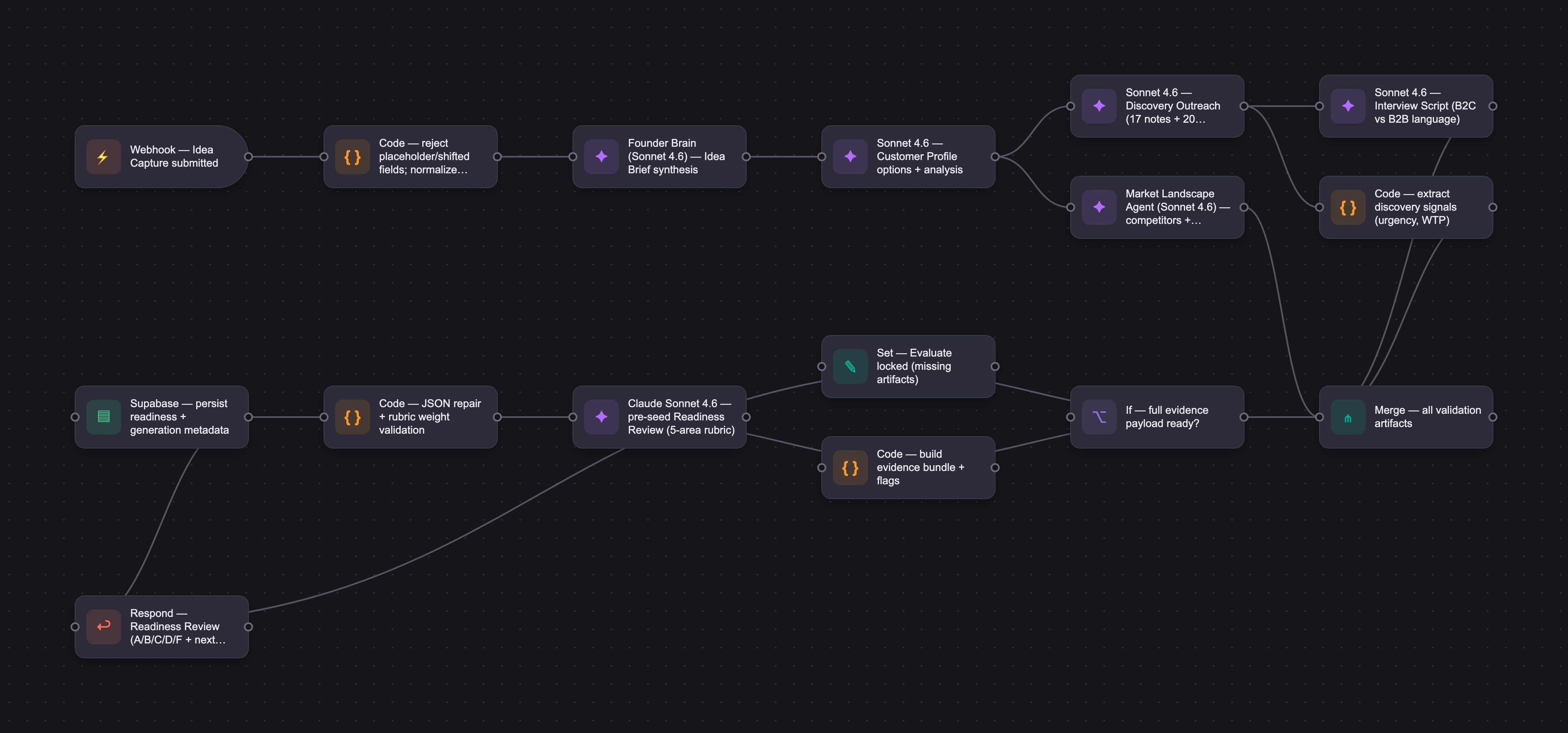
The PRD
| 1 | ||||||
|---|---|---|---|---|---|---|
| Your Name: | Michelangelo Ho | |||||
| Your Product: | Signal Room | |||||
| Your Industry: | EdTech (at the intersection of EdTech & founder tools and adjacent to VC ecosystem) | |||||
| Date: | May 10th | |||||
| 4D Method | AI PRD | Instructor Feedback | ||||
| Phase | Activity | Theme | Topic | Key Question(s) | Your Response Include external links to visuals/prototypes as required. | |
| DISCOVERY | Understand your market, business, product & user context | Business Value Map | Market Attractiveness | What industry is your business in? (ie Financial services, Healthcare, Education, etc)? | At the intersection of three industries: EdTech (professional and founder education), VC and startup infrastructure (founder tools), and the early-stage Venture Capital ecosystem. The primary positioning is EdTech for aspiring founders, delivered as an agentic SaaS platform. The vertical focus is on two domains where I have deep operating expertise: Financial Services (payments and fintech) and Transportation & Logistics (freight, middle-mile, last-mile). Payments launches first; logistics follows in Phase 2. | ** Updated discovery per below feedback on 5/14 Michelangelo — the ATDC operating experience is doing more work than most market analyses I see, and you should lean into that harder. The "95% education-stage" insight is genuinely first-hand and specific it's the kind of observation that turns a TAM slide into a founder story. Your headwinds are honest, especially the churn risk and the GPT-wrapper trust erosion. That's rare. Three places to sharpen: Your ICP is still a category. "Aspiring founder in payments/logistics" spans a solo ideator googling "how to start a fintech company" and an ex-Stripe BD lead with a deck and three design partners. Those two people need different prompts, different onboarding, different pricing. Pick one. Your entire product prompt design, eval criteria, community gating changes based on which one you choose. Your TAM chain is Georgia-hub-baseline × 3–10x digital multiplier × 95% filter × global extrapolation each step compounds uncertainty. Anchor one link externally. Kauffman Foundation publishes annual startup formation rates; LinkedIn self-reported "open to entrepreneurship" data exists. One third-party number turns this from narrative into argument. Your competitor section lists names but doesn't evaluate them against your ICP's actual gap. For On Deck and Maven specifically: what do they charge, what stage do they serve, and where exactly does the 95% segment fall through their cracks? That's the comparison that makes your four-part differentiation claim ("vertical + agentic + progression + community") land as evidence rather than positioning. One more thing "agentic AI makes this segment economically serviceable" is the strongest claim in the PRD, but it's unsupported. What does human coaching cost per founder-hour at ATDC? What does your agentic delivery need to cost to work at $20/mo? That unit-economics sketch is what turns AI-necessity from assertion into logic. As you move into Design, the persona you choose from that 95% their specific trigger moment, their current workaround, their definition of "progress" is what your target workflow and master prompt need to be built around. |
| What are the key challenges (headwinds) and opportunities (tailwinds) impacting growth in your industry? Who are the key competitors? | Tailwinds: The underserved 95% is the largest unaddressed segment in founder development. From my operating experience leading the FinTech accelerator at the Advanced Technology Development Center (ATDC), Georgia Tech's state-funded incubator, in 2015-17, my team supported ~1,000 Georgia-based aspiring and active FinTech entrepreneurs per year. ~95% were at the education stage: too early for traditional accelerators (YC, Techstars, Antler all serve the top ~5%), too serious for generic online content. Agentic AI is the first technology that makes this segment economically serviceable (see Unit Economics below). YC application volume validates serious tech-founder formation at scale. YC receives ~40,000-60,000 tech-founder applications per year globally (source: YC), with 0.96-2% acceptance rates leaving ~39,000-59,000 serious tech founders per year rejected with no structured next step. Batch composition: ~15% fintech, ~35% B2B SaaS, ~50%+ AI. YC applicants are the late end of the education stage, not the full population. YC requires a formed team, MVP, and early traction: ~800K earlier-stage tech-aspiring founders (source: ATDC) exists below this bar with no structured path. LLM capabilities have made domain-specific agentic coaching economically viable for the first time, opening a new product category. Capital concentration in AI-first startups (65%+ of US VC deal value in 2025) creates an underserved population of non-AI-first founders in verticals like payments and logistics. Vertical SaaS and embedded fintech continue to grow rapidly, sustaining demand for founders building in payments-adjacent spaces. Headwinds: AI-for-founders is becoming a crowded category with low-quality entrants (thin GPT wrappers, fake "AI co-founder" tools) that risk eroding category trust. Aspiring founders are price-sensitive and high-churn: converting them to paying customers is harder than headline TAM suggests. Generic LLMs are improving rapidly: anything not deeply domain-specific or workflow-integrated risks commoditization. Community-driven products are operationally expensive at scale. Bootstrapped path means slower growth than VC-funded competitors who outspend on acquisition. Key Competitors: The relevant question is not "who else does founder education?" but "who else serves a senior payments or logistics operator who has identified a specific gap and needs to validate it without committing full-time?" On Deck Founder Fellowship | $2,990 / 10-week cohort | Cohort timing forces median pace. Generalist content. Price gates out part-time exploration. On Deck Scale | Higher tier, 6-month | For founders who already have a company to scale. Serves the 5%, not the 95%. Maven cohort courses | $500-$3,000 per cohort | Skill-specific, 4-6 weeks. No vertical depth. Output is "learn a topic," not "validate an idea." Reforge | ~$2,000/year | Operator skills for existing roles, not founder craft. Y Combinator | $500K for 7% equity | Requires team + MVP + early traction. By design rejects the 95%. Techstars | $220K for 5% + uncapped SAFE | 3-month cohort, requires full-time exclusivity and working prototype. Operating economics: ~$600K/year supporting ~10 companies = ~$60K/founder/year (~$5,000/month/founder during active program). The program operates as a thin layer designed to extract equity value through the fund; per-founder cost is concentrated because human attention is reserved for a tiny portfolio. By design serves the 5%. Same structural problem as YC and traditional accelerators in the US. 500 Global | $150K for 6% + $37,500 program fee | 4-month in-person in Palo Alto. Adds geographic barrier. Antler / Entrepreneur First | Stipend + equity, full-time cohort | Requires quitting the day job to participate. ATDC FinTech and Supply Chain Tech programs. State-subsidized & Georgia residents only. Runs as a non-profit by seasoned entrepreneurs and supporting staff. Generalist with verticals like FinTech and Logistics. ATDC operates on a ~$38M/year budget (state funding + corporate vertical sponsors + service provider sponsors) supporting ~10,000 entrepreneurs annually: ~$3,800/founder/year, or ~$317/month per founder in fully-loaded cost. The model is mission-driven (state economic development for job creation, not profit). Without blended subsidy, this cost is unrecoverable from founders directly: the structural reason ATDC-style programs cannot exist at scale without public and corporate funding, and cannot expand beyond the state they serve. Fintech Sandbox | Free | Data access for building, not validation for deciding. Requires alpha product and technical team. A natural downstream partner, not a current alternative. Generic LLMs (ChatGPT, Claude) | $20/mo | No vertical depth, no memory, no progression, no community. Free content (YC Startup School, Steve Blank) | Free | Generic, no agentic guidance, no accountability. The pattern: every competitor either (a) requires full-time commitment and existing product (YC, Techstars, 500 Global, Antler/EF); (b) offers episodic, generalist engagement with no vertical depth (On Deck, Maven, Reforge); (c) solves a different problem (Fintech Sandbox); (d) lacks structure, depth, or progression (generic LLMs, free content); or (e) is geographically restricted and subsidy-dependent (ATDC). The fully-loaded cost of human-delivered founder support ranges from ~$317/month per founder at the mission-driven end (ATDC) to ~$5,000/month per founder during an active Techstars program — both well above what the 95% segment can sustain without subsidy or equity. No competitor serves early-stage payments or logistics founders with structured, agentic, domain-specific validation support at a price point the 95% can actually pay. | |||||
| What is the projected growth rate of your target market segment over the next 3-5 years? | Category growth (CAGR): EdTech professional learning grows ~12-15% CAGR through 2030. AI-in-founder-tooling (emerging) grows >40% YoY off a small base. TAM: Phase 1 aspiring tech founders, education stage: 800K entrepreneurs (source: ATDC) at blended ~$25/mo ARPU = $240M annually. SAM: Phase 1 tech founders in payments + logistics — 20% of TAM (~15% fintech share from YC batch composition + ~5% logistics-tech) = $48M annually addressable. Pricing (PPP): $20/mo base in Tier 1 markets (US, Canada, UK, Western EU, Australia/NZ, Singapore/HK); ~$10-12/mo in Tier 2 (Eastern EU); ~$6-8/mo in Tier 3 (India). Token overages scale within each tier. Blended ARPU ~$22-26/mo weighted by geo mix (~80% Tier 1, ~4% Tier 2, ~16% Tier 3). Phase 2 (the 5%): Smaller, higher-ARPU segment progressing from Phase 1. Sizing TBD pending Phase 2 acceleration model and fund-vehicle decisions. | |||||
| Business Model | What growth stage is your business currently in (e.g., startup, scale-up, mature)? | - Startup at the idea validation stage | ||||
| How does your business make money? What do they sell? What is your primary revenue model (e.g., subscription, freemium, licensing, marketplace, transactional, etc?) | Hybrid usage-based SaaS with PPP tiered pricing. Low monthly base subscription + token-metered overages for heavier users, priced regionally. Phase 1 (Education tier): $20/mo Tier 1, ~$10-12/mo Tier 2, ~$6-8/mo Tier 3. Quarterly minimum. Service-provider sponsorships (Phase 2 onward): Legal, accounting, marketing firms pay for access to the founder funnel as vetted lead generation. Phase 2 Acceleration tier (future): Higher token tier + small equity stake (tbd%) for $tbd check size. Deployed via separate fund entity once SaaS thesis is validated. Phase 3 Corporate partnerships (future): Corporates (Stripe, Amazon) provide distribution access to graduated founders; may include sponsorship or partnership structures. Unit Economics: Human-delivered founder support to the 95% segment costs ~$317-$5,000/month per founder depending on program model (see Competitors above). Agentic delivery changes this economics entirely. Agentic delivery target (Signal Room): Token cost per active user: ~$3-6/month blended. Mid-tier models (Claude Haiku, GPT-4o-mini) at ~$1-$5 per million tokens handle 90%+ of work; ~1.5-2M tokens/user/month at the base tier covers 50-150 substantive agentic tasks. Heavy users hit overage caps that bill actual cost back. Other COGS (infrastructure, support): ~$3-5/user/month. Blended base revenue: ~$15-18/user/month after PPP tiering. Gross margin: ~$7-12/month per user (~55-65% at base), higher with overages from the heaviest ~20% of users. The gap: Human delivery to the 95% segment requires ~$317/founder/month in blended subsidy at the mission-driven end, and far more at the for-profit end. Agentic delivery costs ~$6-11/founder/month fully loaded. That 30-50x cost reduction is what makes the 95% segment structurally viable at $20/month without subsidy and/or equity extraction. | |||||
| Who is your primary customer base (B2B, B2C, B2B2C)? | Primarily B2C. | |||||
| Differentiators | What are the key differentiators for your company? | PURSUE: Category-defining focus on the underserved 95%: education-stage aspiring entrepreneurs that traditional accelerators cannot economically serve. Founder credibility as a wedge. Combined operator and investor experience establishes a base of trust no horizontal AI competitor can easily replicate. The agent layer must convert that trust into product-driven retention. Codified regulated-industry operational knowledge: access friction, value-chain stakeholder mapping, pilot feasibility, compliance gating. These affect every founder in payments and logistics regardless of customer size. Horizontal AI tools cannot replicate this. Vertical domain specialization in payments + logistics. Generic competitors cannot credibly do this without deep operating expertise. Continuous-flow Phase 2 acceleration (vs. cohort-based), made economically viable by agent leverage. Founders progress at their own pace. Integrated funnel from education through acceleration to corporate access, under one brand. Intellectually honest synthetic feedback: gated behind real customer discovery activity, never positioned as a replacement for talking to humans. ELIMINATE: Cohort-fixed timelines that force median pace. Horizontal coaching across every vertical: the platform will not serve dating apps, consumer fashion, or general SaaS. High human-time cost at idea-stage: agents do volume work; human time is reserved for paid upsells. RAISE: Domain depth in payments and logistics, deeper than any horizontal competitor. Founder-paced progression with milestone-based unlocks. Honest pain-point identification over cheerleading. Community signal-to-noise (curated, gated, domain-specific). REDUCE: Generic content creation: leverage existing free content (Steve Blank, YC library) where appropriate. Default high-touch human mentoring at Phase 1: available as paid office-hours upsell only. | ||||
| Feature Value Map (IMPORTANT NOTE: This section is only relevant if you are working on enhancing an existing product. It does not apply if you are developing a new product from 0 to 1.) | Customers | Who are the customers (ie buyers) of your product? | NA, building 0-1 | |||
| End Users | Who are the end-users of your product? Which users are the most revenue-generating / revenue-impacting for your company? What are their goals, roles, and context? | NA, building 0-1 | ||||
| Current Products / Services | If you are a Product-led business: What are the core features of your product, and how do they address user needs? If you are a Service-led business: What are the key services you offer to customers? | NA, building 0-1 | ||||
| User Value Map | Target Persona | Who is your AI product / feature for? (Internal users, external users, an influencer, a buyer, etc) | Target Persona (ICP): Domain Expert Sam: the highest revenue-impacting persona. Sam represents the underserved 95% of education-stage aspiring entrepreneurs validated through ATDC observation (~95% of ~2,000 entrepreneurs required education-phase support). The largest unaddressed segment in founder development. Sam has not yet committed full-time and shouldn't commit until real market validation justifies it. The product's primary job is to help Sam generate that validation: signed pilots, LOIs, early adopters, paid commitments — not interview transcripts or polished pitch decks. The full-time commitment is the discrete event separating Phase 1 from Phase 2, but it's driven by accumulated evidence, not fundraising urgency. Fundraising is a downstream outcome of validation, not the goal. What defines Sam: 5-15+ years operating experience in payments/fintech or transportation/logistics Specific gap identified through their work: a concrete pain point seen for years, not a generic "I want to be a founder" idea Industry credibility earned through their operating role: peers take their meetings, former colleagues give warm intros Mental availability to do real validation work, by whatever path got them there (employed evenings/weekends, underemployed/consulting, between roles, recently laid off) Domain fluency: knows regulatory landscape, unit economics, value chain, and operational realities deeply Demographics: 28-45 years old College-educated, often with technical or business graduate degrees Roles: senior PM at a fintech, payments ops lead at a marketplace, engineer at a logistics-tech company, BD lead at a 3PL, compliance/risk specialist in financial services, freight ops director at a carrier, AE at a payments processor Income $120K-$300K (Tier 1); equivalent senior-professional income elsewhere Geographically dispersed (US, Canada, UK, EU, Singapore, India) Tech-fluent, comfortable with AI tools Role context: Has been thinking about a specific idea in their domain for 6-24 months Has not committed full-time (status varies: employed, underemployed, between roles) Has not raised external capital May have a co-founder candidate, may be solo Has bookmarked YC Startup School but found generic startup advice insufficient for their regulated-industry context Goals: Validate whether the specific gap is a real opportunity through evidence stronger than opinion (signed LOIs, paid pilots, early adoption). Convert domain credibility into structured customer evidence systematically. Reach validation that justifies full commitment: because the opportunity is real, not because of fundraising urgency. Eventually raise capital as a downstream outcome of accumulated validation. Avoid wasting 6-18 months building something no customer wants. Skills: Strong: domain expertise, regulatory knowledge, industry unit economics, value-chain understanding, peer network. Weak: founder craft: customer discovery (never done structured), hypothesis testing, value proposition articulation, pitch creation, fundraising, investor research, term sheet literacy. Frustrations: Knows the domain cold but doesn't know how to do customer discovery properly. Has the right network but doesn't know how to systematically work it without burning relationships. Can't tell flattery from real demand even from industry counterparts. Generic startup advice doesn't apply to their regulated-industry context. Doesn't know how to convert "interest" into LOIs, pilots, paying customers. No structured way to test the idea without disrupting their current life situation. Channels: LinkedIn (heavy), domain-specific Twitter/X, Substack newsletters (Lenny's, Not Boring, Stratechery), industry podcasts (Payments on Fire, Freight Caviar), Reddit, occasional in-person meetups. | |||
| Journey Map (current-state) | What is the typical journey for your target persona when they are using your product / service, focusing on their ideal experience (happy path) as they interact with your product? | Sam's journey from "I've seen this gap for years" to "I've validated it enough to commit": currently navigated without structured support. Stage 1: SPARK ("I'm finally going to act on this gap") | Weeks 0-4: Idea crystallization in spare moments; initial research; conversations with 1-2 trusted former colleagues; buying a domain name (often the first concrete action); sketching on paper. Stage 2: EXPLORE ("Is this opportunity as big as I think?") | Weeks 4-12: Researching competitors in their domain; sizing the market using industry knowledge; casual conversations with peers; browsing pitch decks; lurking in founder communities. Stage 3: TEST ("Will industry counterparts actually commit?") | Weeks 12-32: Attempting structured customer discovery for the first time (typically done badly); building a landing page or waitlist; creating a paper prototype; testing value prop on industry peers; learning that "this is interesting" is not "I'll pay for it." Stage 4: BUILD V0 ("Let me show industry counterparts something real") | Weeks 32-52: Building a prototype evenings/weekends or with contract dev; informed by domain knowledge but unsure if building the right slice; first serious doubts about whether validation is strong enough. Stage 5: DECIDE ("Do I have enough evidence to commit?") | Weeks 52-78: Assessing whether real customer validation has accumulated; serious co-founder conversations; exploring fundraising as a downstream consequence; reconsidering the idea if validation is weak. Most common outcome under current conditions: quietly shelving the idea. | ||||
| Pain-points | Where does the user experience friction, obstacles, or unmet needs throughout the journey? Identify which pain-points are most frequent and severe? | Severity is rated for Sam specifically: domain-knowledge pain points are less acute (he knows the regulations and unit economics already); founder-craft pain points are more acute (his operating role didn't teach customer discovery, fundraising, or pitch creation). Idea clarity: can't articulate the idea concisely. High | Recurring Customer discovery: doesn't know who to talk to (Sam knows industry peers but not how to systematically work the network). Very high | Persistent Customer discovery: doesn't know what to ask; asks leading questions. Very high | Persistent Customer discovery: can't distinguish flattery from real demand. Very high | Persistent Customer discovery: can't see patterns across interviews. Very high | Persistent Outreach paralysis: gives up after few unanswered messages (industry peers expect different framing than generic startup outreach). Very high | Persistent Hypothesis structuring: doesn't know which assumptions are load-bearing (has intuition but hasn't converted it to testable hypotheses). Very high | Recurring Competitive landscape: misses adjacent threats; over-indexes on direct competitors. High | Episodic Market sizing: can't credibly estimate TAM/SAM/SOM. Medium | Episodic Financial modeling: never built one. High | Episodic Pricing strategy: defaults to freemium or arbitrary numbers. Medium | Episodic Value proposition: can describe the gap but not always the value (knows the problem; struggles to articulate why his solution wins). Very high | Recurring Pitch creation: doesn't know how to structure a deck for non-domain VCs. High | Episodic Pitch practice: no one to practice against. High | Episodic Fundraising strategy: when, how much, from whom. High | Episodic Investor research: doesn't know which investors fit thesis and stage. High | Episodic Term sheet literacy: can't distinguish standard from predatory. High | Episodic Co-founder evaluation: rushes or never decides. High | Episodic Domain regulatory knowledge: MTL, PCI, KYC; FMCSA, broker authority (already knows). Medium | Persistent Domain unit economics: interchange, per-mile (already knows). Medium | Persistent Go-to-market: domain-specific channels and sales motion (knows channels but not founder-led sales motion). High | Recurring Loneliness and isolation (industry peers aren't building). Medium | Persistent Imposter syndrome. Medium | Persistent Accountability gap: no deadlines or external pressure. High | Persistent Pivot-vs-persist decision quality. High | Episodic Legal setup: incorporation, equity split, state choice. Medium | Episodic Tool overload. Medium | Persistent Time management alongside current life situation. High | Persistent Spousal and family conversations. Medium | Episodic Idea-theft anxiety. Medium | Persistent The full-commitment decision: can't tell when accumulated validation is enough. Very high | Episodic Domain-specific access friction: even with credibility, converting peer relationships into structured discovery without burning them requires more than cold outreach. High | Persistent Value-chain stakeholder mapping: knows the value chain as operator but doesn't always realize founder-led discovery requires interviewing all stakeholders, not just familiar ones. High | Persistent Pilot/test feasibility blindness: knows operational constraints as operator but transitioning to founder (who must design around them) reveals blind spots. High | Episodic but existential Risk, legal, privacy gating: knows external compliance requirements but doesn't know how to navigate them as a founder pitching enterprises. High | Episodic | ||||
| AI Opportunities | From your list of pain points, identify those that can effectively be addressed using Generative AI. Remember, this project focuses on leveraging LLM-powered AI to solve your target persona's pain points. Rank these pain points starting with the most severe and frequently occurring first. | The dominant pain point at the education stage is founder craft applied to a domain Sam already understands deeply: specifically customer discovery and converting domain credibility into structured validation evidence. Sam has the network, regulatory knowledge, and industry intuition. What he lacks is the systematic founder process. The Customer Discovery Agent, layered with Payments Domain Knowledge as a founder-lens check, gives him exactly what his operator background didn't. AI-addressable, ranked: Customer discovery (combined #2, #3, #4, #5) | Translation + Scaling + Consistency | Direct path to validation evidence along the ladder: interviews → expressed interest → LOIs → signed pilots → paying customers → contracts. Sam's biggest founder-craft gap. Hypothesis structuring (#7) | Translation + Expertise | Converts Sam's operating intuition into testable hypotheses with riskiness prioritization. Highest value per minute of agent time. Outreach paralysis and access friction (#6, #32) | Scaling + Consistency + Expertise | Volume of qualified conversations is the bottleneck. Generates domain-positioned outreach for the network Sam already has. Value proposition articulation (#12) | Translation | Sam describes the gap deeply but struggles to articulate why his solution wins. Critical for both discovery and downstream fundraising. Pilot feasibility (#34) | Expertise | Existential: founders who don't surface operational constraints early build the wrong thing. Full-commitment decision (#31) | Translation + Expertise | Surfaces whether accumulated validation justifies commitment. Domain regulatory + unit economics (#19, #20) | Expertise + Consistency | Sam knows this; agent serves as a founder-lens check on the few places operator knowledge needs founder reframing. Risk, legal, privacy gating (#35) | Expertise + Translation | Navigating regs as a founder pitching enterprises. Pitch creation + practice (#13, #14) | Translation + Scaling + Expertise | High-leverage during the fundraising window. Investor research + fundraising strategy (#15, #16) | Expertise + Scaling | Downstream of validation. Competitive landscape (#8) | Expertise + Scaling | Frames opportunity, informs hypothesis priorities. Financial modeling (#10) | Translation + Expertise | Required for credible commit decision. Market sizing (#9) | Expertise + Consistency | Sam knows the market but not formal sizing. GTM strategy (#21) | Expertise | Founder-led sales motion. Term sheet literacy (#17) | Expertise + Translation | Late-stage, defensive. Pivot-vs-persist (#25) | Translation + Expertise | Adjacent to commit decision. Not AI-addressable (require human community, time, or life-circumstances support): #18 co-founder evaluation, #22 loneliness/isolation (community), #23 imposter syndrome, #24 accountability gap (community can nudge), #26 legal setup (partial), #27 tool overload, #28 time management, #29 family conversations, #30 idea-theft anxiety. | ||||
| Develop an AI Solution Hypothesis | AI Solution Hypothesis | Diverge | Ideate potential solutions to address your AI-solvable pain points. Focus on generating a high quantity of ideas rather than evaluating their quality at this stage. | Customer Discovery Agent (end-to-end): Multi-step agent that surfaces warm-intro paths through Sam's network, generates domain-positioned outreach for regulated industries, maps required value-chain stakeholders per account. Drafts outreach, schedules calls, transcribes interviews, extracts patterns, drives toward real commitments along the evidence ladder. | #2, #3, #4, #5, #6, #32, #33 | Explore → Test Hypothesis Structuring Agent: Converts domain intuition into testable hypothesis tree, prioritized by riskiness. | #7 | Spark → Explore Payments Domain Knowledge Agent: Founder-lens check on existing domain expertise. Codified expertise on payment rails, interchange, MTL/PCI/KYC, fraud benchmarks. Catches operator-to-founder transition mistakes; surfaces pilot feasibility and risk/legal/privacy gating early. | #19, #20, #21, #34, #35 | All stages Logistics Domain Knowledge Agent: Same function for logistics. Lane economics, broker authority, FMCSA, OTR, final-mile cost structures. | #19, #20, #21, #34, #35 | All stages Synthetic Persona Feedback Agent: Simulates target user reactions to pitches, value props, pricing. Gated behind real interview activity. | #4, #12, #14 | Test → Build V0 Pitch Construction Agent: Generates deck structures from business reality, translating domain insight into non-domain-VC language. | #13 | Build V0 → Decide Pitch Practice Agent: Role-plays investor personas (skeptical, friendly, technical, financial) with structured feedback. | #14 | Build V0 → Decide Investor Research + Matching Agent: Builds investor pipeline matched to thesis, stage, geography, domain. | #15, #16 | Decide Outreach Engine: Drafts, personalizes, sends, tracks, follows up on outreach for both customer discovery and investors. | #6, #16 | Test, Decide Insight Synthesis Agent: Maintains learning ledger, surfaces patterns, flags pivot/persist moments. | #5, #25 | Test → Decide Founder Brain (memory layer): Persistent state across all interactions; foundational infrastructure. | All | All Value Prop Translation Agent: Converts deep domain understanding into benefit-led positioning; tests variants. | #12 | Explore → Test Financial Model Generator: Domain-specific financial models with reasonable defaults. | #10 | Build V0 → Decide Competitive Intelligence Agent: Monitors competitive landscape; surfaces material changes only. | #8 | All Term Sheet Reader: Flags non-standard or predatory terms; explains in plain language. | #17 | Decide | ||
| Converge | Rank your ideated solutions based on impact and feasibility. Identify your top three AI solutions, and clearly select the one you'll focus on for your project. | Top three: Customer Discovery Agent (end-to-end), supported by the Founder Brain memory layer as foundational infrastructure, and differentiated by the Payments Domain Knowledge Agent as the v0 vertical. 1) the core job to be done is converting domain credibility into structured customer evidence. Sam already knows payments deeply: what he lacks is the founder craft to systematically validate his idea. Customer discovery is his single biggest gap and the most universal capability he needs. 2) The Founder Brain memory layer is foundational because without persistent state every agent feels generic and switching costs collapse. 3) The Payments Domain Knowledge Agent is the v0 vertical differentiator: not because Sam needs to be taught payments (he knows), but because it catches the specific mistakes domain experts make transitioning from operator to founder. Scored 0-10 on Impact and Feasibility: Customer Discovery Agent (end-to-end) | Impact 10 | Feasibility 8 | Combined 18 | Explore → Test Hypothesis Structuring Agent | Impact 9 | Feasibility 9 | Combined 18 | Spark → Explore Founder Brain (memory layer) | Impact 10 | Feasibility 7 | Combined 17 | All Payments Domain Knowledge Agent | 9 | 7 | 16 | All Pitch Construction Agent | 7 | 9 | 16 | Build V0 → Decide Pitch Practice Agent | 7 | 9 | 16 | Build V0 → Decide Insight Synthesis Agent | 9 | 7 | 16 | Test → Decide Logistics Domain Knowledge Agent | 8 | 7 | 15 | All Investor Research + Matching | 7 | 8 | 15 | Decide Outreach Engine | 8 | 7 | 15 | Test, Decide Value Prop Translation Agent | 7 | 8 | 15 | Explore → Test Synthetic Persona Feedback | 7 | 7 | 14 | Test → Build V0 Financial Model Generator | 7 | 7 | 14 | Build V0 → Decide Term Sheet Reader | 7 | 7 | 14 | Decide Competitive Intelligence Agent | 6 | 6 | 12 | All | ||||
| DESIGN | Define Target State Workflow | UX Flows & Wireframes Suggested Tool: Excalidraw | Workflow (future) | Assuming your product or feature works as desired, what is the target state workflow? | https://excalidraw.com/#json=OAvj6XI4RaU5kt0fKJNSV,x7Jbb2fZo7KyTkWVn0PGzw | Please leave this area blank. This space is for the Instructor to provide you with feedback. |
| Build Wireframes | Wireframes | How will users navigate through your AI solution? What are the key steps and decision points? What information will be displayed at each stage? What specific UI elements are needed on each screen? How will the layout accommodate AI features? | https://excalidraw.com/#json=GyRVusikNvHG6gmFwtlP6,zGiRz58LdUSChJqqSj2VYg | |||
| Develop Prototype to showcase AI interactions | Prototype Screens Suggested Tool: lovable.dev | What aspects of the AI solution will you demonstrate in your prototype? How will the AI inputs, processing, and outputs be presented visually to users? Which features are essential for launch? What can be left for later releases? | https://lovable.dev/projects/13897617-b424-49b1-a8d6-1c670ea4d930?magic_link=mc_497cddc8-b724-4344-ad7d-32c1ef6e457a | |||
| Initial Prompt Design | Master Prompt [Initial Design] | Create an initial master prompt. Consider the following: What tone or personality should the AI use? How should user input and system instructions be structured for maximum clarity? What system instruction will govern the AI's behavior? What examples might improve performance? How will you format outputs for consistency? | https://docs.google.com/document/d/10UN_y3ckl0ILOf0yytCVOscn45PAgJAyL48JdN_ipKI/edit?usp=sharing | |||
| Prepare for Testing & Iteration | Evaluation Criteria & Test Plan | Evaluation Criteria | What specific quality benchmarks (e.g., clarity, relevance, tone, accuracy, SEO, hallucination avoidance) will define “good” output? | https://docs.google.com/document/d/1zRHzWSg3Madh8c7MXPsqmGUPipO2wagi7USZ64ODEPM/edit?usp=sharing | ||
| Example Cases | What specific example use cases, edge cases, and negative cases should be covered by test prompts and outputs? | https://docs.google.com/document/d/1d3nm6Bz52vTezdZw4UGbicK4b8WLdK2XHpNHgbCIJxo/edit?usp=sharing | ||||
| DEVELOP | AI Model Selection & Justification | AI Model Selection & Justification | Which AI model is best suited for your solution and why? What capabilities and limitations does it have? How will it integrate with your product? | MVP model selection: Claude Sonnet 4.6. Signal Room uses a mixed-model architecture, with specialist agents and deterministic backend contracts doing different jobs. For the final Readiness Review, the MVP uses Claude Sonnet 4.6 because this evaluator step requires long-context synthesis, strict rubric adherence, evidence grounding, and calibrated judgment across the full validation payload. Comparable Claude Haiku 4.5 and OpenAI-model experiments were less reliable for this specific task: they showed weaker rubric adherence, evidence grounding, and readiness-score calibration, including cases where available Market Landscape sizing evidence was not credited correctly. Claude Sonnet 4.6 produced stronger final evaluation behavior for the pre-seed readiness rubric and evidence-based judgment required in the MVP. OpenAI `gpt-5.4-nano` remains relevant to the broader system and roadmap: the backend uses OpenAI Agents SDK patterns, and OpenAI File Search / Responses API are strong candidates for future RAG over customer-discovery methodology and payments-domain documents. For the June MVP, however, I am intentionally avoiding evaluator-provider changes and keeping the stable Claude Sonnet 4.6 readiness path. This reduces demo risk, preserves the working state machine/evidence bundle flow, and lets evaluation work focus on baseline quality checks rather than model migration. | Please leave this area blank. This space is for the Instructor to provide you with feedback. | |
| Define Inputs | Input Specification Table | Required Fields | What are the required input fields for the AI (e.g., title, description, keywords, tone)? Indicate format, source, requirement. | Signal Room requires a structured validation payload rather than a single freeform prompt. The required inputs are collected progressively through the product flow and stored by the backend state machine. Required inputs: - Problem: freeform text captured during Idea Capture. Source: founder input. - Solution approach: freeform text captured during Idea Capture. Source: founder input. - Target customer: freeform text captured during Idea Capture. Source: founder input. - Business model type: structured enum: B2C, B2B, B2B2C, or Marketplace. Source: founder input with backend normalization. - Founder name: freeform text. Source: founder input. - Founder backstory / relationship to the problem: structured or freeform text. Source: founder input. - Validation stage: structured enum / normalized text. Source: founder input. - Idea Brief: structured object with big idea, elevator pitch, and detail. Source: generated by Signal AI from Idea Capture. - Selected Customer Profile: structured object. Source: founder selection from generated Customer Profile options. - Customer Profile Analysis: structured object. Source: generated by Signal AI from Idea Capture, Idea Brief, and selected Customer Profile. - Discovery Outreach evidence: structured discovery state including interview-note signals, simulated outreach wave replies, extracted signals, and readiness threshold status. Source: product simulation / founder evidence workflow. - Interview Script: structured object with usable interview sections and questions. Source: generated by Signal AI after discovery evidence is ready. - Market Landscape: structured object with market analysis, competitor database, market sizing, positioning, and module completion status. Source: generated by Market Landscape agent. - Readiness payload metadata: artifact readiness, generation source metadata, business model type, evidence counts, and state-machine status. Source: backend. The final Readiness Review requires all major validation artifacts to be present before evaluation starts. This prevents the evaluator from scoring an idea using partial evidence. | ||
| Optional Fields | Are there any optional or user-customizable fields? How do they impact the AI’s output? | Optional inputs improve specificity but are not required for the MVP flow to complete. Optional fields: - Opening idea seed: a longer initial description from the founder. This helps Signal AI generate more contextual Idea Capture choices and preserve nuance. - Business model description: optional custom explanation when the founder’s model does not fit cleanly into B2C, B2B, B2B2C, or Marketplace. This helps downstream agents preserve nuance while still using a canonical model type. - Founder-submitted evidence: optional narrative or supporting context about founder-market fit, domain experience, unfair advantages, or gaps. This can improve the Readiness Review’s Founder-Market Fit assessment. - Founder-uploaded / founder-added contacts: optional discovery contacts. These improve the realism and relevance of Discovery Outreach. - Contact notes or interview notes: optional founder-provided evidence. These can strengthen Customer Validation if they contain specific pain, urgency, workaround, or willingness-to-pay signals. - Improvement requests: optional founder feedback during Idea Brief review. These guide regeneration without changing the underlying state machine. - Domain context: optional inferred or founder-supplied domain information, such as payments, logistics, healthcare, or education. This helps tailor Market Landscape, Interview Script, and readiness reasoning. - Funding path: optional future field. The MVP defaults to a pre-seed venture-readiness lens, but future versions may support bootstrapped, venture-backed, or strategic partnership pathways. These optional inputs make the AI outputs more grounded, specific, and personalized. If they are absent, the system still runs using the required validation payload and deterministic fallbacks, but outputs may be less tailored. | ||||
| Define Good Output | Output Evaluation Checklist | Objective Criteria | What criteria will you use to judge output as “good”? (e.g., structure, use of keywords, tone, factuality, relevance) | Good output must meet both product-contract criteria and quality criteria. Objective criteria: - Valid structure: outputs must be parseable JSON or normalized structured objects matching the expected step contract. - Evidence bundle clarity: the Readiness Review should receive explicit evidence summaries and flags, including discovery signal counts, willingness-to-pay signals, high-urgency signals, market sizing presence, founder evidence presence, known gaps, and key assumptions. - Required fields present: each artifact must include its required sections, such as Idea Brief fields, Customer Profile fields, Interview Script sections, Market Landscape modules, and Readiness Review rubric areas. - Workflow compatibility: output must be usable by the next step in the state machine without manual repair. - Frontend renderability: output must use shapes the frontend can display safely, especially Interview Script, Market Landscape, and Readiness Review. - Evidence completeness: Readiness Review must only run when Idea Capture, Idea Brief, Customer Profile, Discovery Outreach, Interview Script, and Market Landscape are ready. - Evidence grounding: evaluation claims must map back to available founder, discovery, interview, and market evidence. - Rubric compliance: Readiness Review must use the five pre-seed venture-readiness areas: Founder-Market Fit, Customer Validation, Market Potential, Timing / Why Now, and Wedge / Product Thesis. - Grade validity: grades must use the expected A/B/C/D/F format, and rubric weights must sum to 100%. - Business-model awareness: outputs must adapt to B2C, B2B, B2B2C, and Marketplace differences rather than using one generic startup pattern. - No unsupported claims: the AI should not invent traction, partnerships, market facts, customer commitments, or regulatory conclusions not present in the evidence. - Actionability: next steps must be concrete and connected to the weakest evidence areas. | ||
| Subjective Criteria | Are there any criteria that require human judgment or qualitative assessment? | Yes. Some quality criteria require human review because they involve judgment, nuance, and product usefulness. Subjective criteria: - Synthesis quality: the output should synthesize the founder’s idea and evidence rather than restating inputs. - Calibration against examples: the Readiness Review should grade consistently against known-good examples, especially for cases where evidence is directionally strong but not yet proven by paid pilots, LOIs, or signed commitments. - Specificity: recommendations should feel tailored to the founder’s domain, customer type, and validation stage. - Calibration: the Readiness Review should be appropriately strict without being discouraging or overly generous. - Founder usefulness: the output should help the founder decide what to do next, not just summarize what happened. - Strategic judgment: the AI should identify the most important evidence gaps, not treat all gaps equally. - Tone: Signal AI should sound clear, direct, and constructive, with enough honesty to be useful. - Domain fit: outputs should reflect the realities of the founder’s market, especially for payments, logistics, regulated industries, and marketplace models. - Trustworthiness: the AI should distinguish evidence from assumptions and avoid sounding more certain than the evidence supports. - Coaching quality: discovery questions, outreach guidance, and interview scripts should help the founder get better signal from real customers. - Demo readiness: the output should be understandable and credible to a viewer seeing the product for the first time. | ||||
| Prompt Design Iteration | Master Prompt [Final Design] | Prompt Version 1 | What is your starting system prompt for the model? What variations will you test? What techniques will you use to optimize performance? List initial instructions, persona, inputs, and constraints. | The MVP evolved away from one large master prompt into a multi-agent prompt architecture. Signal AI is governed by a Founder Brain prompt for founder-facing conversation, plus bounded specialist prompts for specific artifacts: Idea Brief, Customer Profile options, Customer Profile analysis, Discovery Outreach, Interview Script, Market Landscape, and Readiness Review. Final prompt design principles: - Founder Brain owns conversation quality, founder-facing synthesis, and review handoffs. - Backend state machine owns workflow order, readiness gates, and legal transitions. - Specialist agents own bounded structured outputs. - Tools and backend functions own memory reads/writes, artifact storage, and evidence bundle construction. - Prompts are constrained to use supplied context only and not invent traction, partnerships, market facts, or validation evidence. - Outputs are expected to be structured and compatible with frontend rendering. - Readiness Review uses a fixed pre-seed venture-readiness rubric and must reason only from the bounded evidence payload. Prompt techniques used: - Role separation: different prompts for conversation, artifact generation, market analysis, outreach, and evaluation. - Structured outputs: required fields and schemas for generated artifacts. - Context bundles: backend-built inputs so each agent receives only relevant evidence. - Human gates: founder approval before advancing key workflow stages. - Deterministic fallbacks: backend recovery paths when model output is empty, malformed, or incomplete. - Source metadata: generated outputs track whether they came from an agent, fallback, or mixed source. - Guardrails: the system prevents unsupported step advancement and blocks evaluation until required evidence is ready. Prompt variations tested included broader Founder Brain orchestration, direct structured specialist generation, fallback-backed generation, and a direct-evaluator experiment. The current MVP keeps the stable specialist-agent plus backend-state-machine approach because it produced the most reliable demo path. | ||
| Prompt Iterations | If revised, what changes did you make and why? How do you track and record prompt evolution? | The prompt architecture went through several iterations as the product moved from a broad conversational assistant toward a more reliable agent/state-machine workflow. Key iterations: - Replaced a single broad Founder Brain flow with a backend-owned state machine and specialist agents for bounded outputs. - Moved Idea Capture to a structured capture contract so required fields are collected consistently. - Added validation against placeholder or shifted answers so weak Idea Capture data does not poison downstream outputs. - Added direct structured generation for Idea Brief, Customer Profile options, and Customer Profile analysis. - Split Customer Profile into option generation, founder selection, and selected-profile analysis. - Reworked Discovery Outreach around simulated interview notes and simulated outreach waves so the MVP can produce a complete evidence payload. - Made Interview Script and Market Landscape separate artifacts that must be ready before Readiness Review. - Restricted Readiness Review to the top-nav Evaluate action after full evidence readiness. - Added generation metadata so outputs can be distinguished as agent-generated, fallback-generated, or mixed. - Parked the Copy B direct-evaluator experiment after it reduced latency directionally but made the product path less reliable. Prompt and behavior changes are tracked through local Git commits, handoff files, and prompt registry notes. The current source of truth is the local backend/frontend code, especially `founder_agents.py`, `main.py`, `state_machine.py`, and frontend renderers. Historical prompt docs in Google Drive are treated as reference material, not the live source of truth. A key learning from the Readiness Review work is that evaluator quality depends as much on input structure as prompt wording. Future iterations should improve the evaluation evidence bundle with explicit evidence flags and summaries, then add rubric calibration anchors and 3-5 ideal evaluation examples to teach the evaluator what strong, weak, and borderline cases look like. | ||||
| Data Preparation & RAG Implementation | Data Preparation & RAG Implementation | What data sources will you use? How will you prepare data for model training or evaluation? (e.g., cleaning, structuring). For RAG: How will you chunk, embed, retrieve relevant information? | The MVP does not include production RAG in the core user flow. For the June submission, Signal Room relies on structured founder input, generated validation artifacts, simulated discovery evidence, and backend-built evidence bundles. This keeps the product stable and avoids adding retrieval complexity before baseline evaluation is in place. Before adding RAG to the Readiness Review, I would first improve the evaluator’s structured evidence bundle and golden examples. RAG can help with external market/domain grounding later, but the evaluator first needs reliable internal evidence summaries, calibration anchors, and examples of good judgments. Current MVP data sources: - Founder-provided Idea Capture responses. - Generated Idea Brief, Customer Profile, Discovery Outreach, Interview Script, and Market Landscape artifacts. - Simulated customer discovery evidence: 17 contextual interview notes and 20 simulated outreach replies. - Extracted discovery signals, including pain, current workaround, urgency, willingness to pay, competitor/tool mentions, and commitment level. - Optional founder-submitted evidence for founder-market fit. - Generation metadata showing whether outputs came from agents, fallbacks, or mixed sources. RAG roadmap: I have a candidate RAG corpus with customer discovery methodology documents and payments-domain PDFs. The first future RAG implementation would use OpenAI File Search / Responses API to retrieve relevant methodology and domain context. Customer discovery methodology would support Founder Brain, Discovery Outreach, and Interview Script quality. Payments-domain retrieval would support Market Landscape and Readiness Review for payments-related ideas. Preparation approach: - Separate methodology documents from domain/factual documents. - Chunk documents by section and topic rather than arbitrary length when possible. - Store source metadata such as file name, section title, topic, domain, and document type. - Retrieve only when the workflow step benefits from external context. - Keep retrieved facts separate from founder evidence and model assumptions. - Require citations or source references when retrieved factual claims influence Market Landscape or Readiness Review. RAG is intentionally placed on the roadmap rather than the MVP path because eval baselines should come first. The product needs to measure whether retrieval improves grounding and calibration before using it in the final readiness evaluator. | |||
| Create Evaluation Set | Example Input/Output Data for Testing | Typical Examples | What are the most common inputs and expected outputs? Use real data if possible. | Typical test examples should mirror the MVP’s Phase 1 focus on payments/fintech founders. The common input is a founder with domain experience who has identified a specific payments-related gap and needs to turn that idea into structured validation evidence. Example 1: US-to-Dominican Republic remittance transparency Input: A founder describes a tool for Dominican immigrants in the US sending money to the Dominican Republic. The product shows the true recipient amount after fees, exchange-rate spread, timing, and pickup tradeoffs. The target customer is a regular sender supporting family abroad, and the business model is B2C. Expected outputs: - Idea Brief clearly names the hidden-cost remittance problem and target sender. - Customer Profile focuses on regular US-to-DR senders, not generic fintech users. - Discovery Outreach surfaces evidence around trust, hidden FX spread, provider switching, recipient convenience, and willingness to pay. - Interview Script uses consumer language rather than enterprise pilot language. - Market Landscape includes remittance providers, comparison substitutes, trust barriers, regulatory/compliance considerations, and TAM/SAM/SOM-style sizing assumptions. - Readiness Review should credit founder-market fit and available market sizing evidence while still identifying remaining proof needed around switching behavior, trust, and willingness to pay. Example 2: B2B payments reconciliation for marketplaces Input: A founder describes a workflow tool for marketplace finance teams that reconcile payouts, refunds, chargebacks, processor fees, and seller balances across multiple payment processors. The business model is B2B, and the buyer is a finance or payments operations leader. Expected outputs: - Idea Brief explains the operational pain of fragmented payment reconciliation. - Customer Profile identifies marketplace payments operations or finance leaders with high-volume reconciliation pain. - Discovery Outreach validates current spreadsheet/manual workarounds, frequency of reconciliation errors, and budget ownership. - Interview Script asks workflow, risk, audit, tooling, implementation, and willingness-to-pay questions. - Market Landscape includes payment processors, reconciliation tools, ERP/accounting workarounds, and build-vs-buy substitutes. - Readiness Review should distinguish strong workflow pain from still-unproven budget commitment or pilot readiness. Example 3: Embedded fraud-risk alerting for vertical SaaS payments Input: A founder describes an AI-assisted fraud-risk alert layer for vertical SaaS platforms that process payments for merchants and need earlier warning signals around disputes, chargebacks, or suspicious transaction patterns. The business model is B2B or B2B2C depending on whether the SaaS platform buys it directly or distributes it to merchants. Expected outputs: - Idea Brief explains the fraud/chargeback pain and why vertical SaaS platforms are the starting customer. - Customer Profile clarifies the buyer, operator, and end-user distinction. - Discovery Outreach validates fraud pain, current risk tooling, alert fatigue, integration requirements, and compliance concerns. - Interview Script asks about risk thresholds, false positives, operational workflow, data access, and willingness to pilot. - Market Landscape includes fraud tools, payment risk platforms, processor-native alerts, and internal risk workflows. - Readiness Review should credit domain-specific urgency while identifying unresolved questions around data access, integration complexity, and regulatory/compliance risk. These examples are synthetic and privacy-safe but reflect the MVP’s target domain and actual validation workflow. They are designed to test whether Signal Room can handle B2C, B2B, and B2B2C payments ideas while keeping outputs specific to payments rather than generic startup advice. | ||
| Edge Cases & Negative Cases | What examples test the AI’s limits? (e.g., missing data, ambiguous input, out-of-domain) | The MVP edge cases focus on payments/fintech ideas that test whether Signal Room can stay grounded, avoid unsupported claims, and preserve the correct workflow gates. Edge cases: - Ambiguous payer / business model: a founder says consumers use the product, banks distribute it, and employers may pay. The system must clarify or classify the model correctly as B2C, B2B, B2B2C, or Marketplace without losing nuance. - Weak founder input: the founder provides a vague idea such as “AI for payments” with no clear problem, customer, or solution. Signal Room should ask for sharper inputs and should not generate confident downstream artifacts from weak data. - Missing founder backstory: the founder has not explained their relationship to the problem. The Readiness Review should not invent founder-market fit. - Incomplete discovery evidence: Market Landscape is ready, but Discovery Outreach or Interview Script is incomplete. Readiness Review should remain locked. - Market sizing present but imperfect: Market Landscape includes TAM/SAM/SOM-style assumptions, but not perfect external citations. The evaluator should credit that sizing evidence while noting uncertainty, not claim market sizing is missing. - Simulated evidence provenance: discovery evidence is simulated/generated for MVP demo purposes. The evaluator should treat it as valid MVP discovery evidence while not overstating it as real customer commitments. - Regulatory overclaim risk: a payments idea touches KYC, AML, PCI, money transmission, or fraud. The AI should flag regulatory assumptions and avoid giving legal/compliance conclusions. - B2C vs B2B language mismatch: a consumer remittance idea should not receive enterprise pilot/procurement language, while a B2B reconciliation idea should include buyer, budget, implementation, and workflow questions. - Out-of-domain idea: a founder enters a dating app, fashion marketplace, or unrelated consumer social idea. The system should still collect basic idea information but should not pretend to have deep vertical expertise. - Evidence contradiction: customer discovery signals show interest but low willingness to pay. The Readiness Review should reflect the contradiction rather than giving a uniformly positive grade. Negative cases: - Placeholder answers such as “a,” “not sure,” or copied text across multiple fields should not pass Idea Capture readiness. - The evaluator should not start when required artifacts are missing. - The evaluator should not invent traction, pilots, LOIs, revenue, partnerships, citations, or compliance status. - The frontend should not display a broken or empty Readiness Review if the output is malformed. | ||||
| Test Example Data & Review Results | Manual Review | Run your input data with the prompt. How did your output perform in manual review? Which examples failed which criteria, and why? | Manual review focused on whether the MVP could complete the core validation workflow and whether the final Readiness Review was useful, grounded, and renderable. Reviewed examples: - US-to-Dominican Republic remittance transparency idea. - Payments/fintech founder-market-fit evidence rerun. - Hosted MVP flow through Idea Capture, Customer Profile, Discovery Outreach, Market Landscape, Interview Script, and Readiness Review. What performed well: - The workflow successfully moved from idea capture to structured validation artifacts. - Discovery Outreach produced enough MVP evidence to support a Readiness Review: 17 simulated interview-note signals and 20 simulated email-reply signals. - Interview Script generated usable content and rendered correctly after parser/display fixes. - Readiness Review rendered the active idea’s backend evaluation rather than static mock data. - Adding founder evidence improved the Founder-Market Fit assessment, showing that the evaluator could respond to stronger evidence. - The top-nav Evaluate action correctly became the only intended Readiness Review trigger after the full evidence payload was ready. Issues found: - In one readiness review, the evaluator under-credited available Market Landscape sizing evidence and treated market size evidence as missing or weaker than it was. - Earlier Interview Script outputs used domain-specific section keys that the frontend did not initially recognize, causing render compatibility risk. - Some evaluator behavior required parser safeguards, including recovery from otherwise-valid JSON with an extra trailing brace. - The product needed stricter readiness gates so evaluation could not run from Market Landscape completion alone. Actions taken: - Readiness Review is now gated on the full payload: Idea Capture, Idea Brief, selected Customer Profile, Customer Profile analysis, Discovery Outreach insights, Interview Script, and Market Landscape. - Interview Script rendering was hardened to support multiple structured output shapes. - Evaluation parsing was made more tolerant of minor JSON issues. - The current MVP keeps the stable Claude Sonnet 4.6 evaluator path because it performed better for final readiness judgment than comparable OpenAI-model experiments. Remaining quality improvement: - Future evaluator work should improve the evidence bundle, add rubric calibration anchors, and include 3-5 ideal readiness-review examples to improve consistency and grounding. | |||
| Automated Evaluation | What pass/fail rate or scores did the AI achieve on core criteria? | For the MVP, automated testing is focused on workflow reliability and output contracts. A full automated LLM-quality evaluation suite is not yet implemented and is a key roadmap item. Automated checks currently in place: - Backend health check. - Backend syntax/import checks. - Discovery Outreach smoke test verifying 17 interview-note signals, 20 email-reply signals, and 37 total discovery signals. - Full-flow smoke harness verifying state progression through the MVP path, artifact readiness, generation metadata, Market Landscape completion, and evaluation unlock behavior. - Readiness gating checks verifying that evaluation remains unavailable until Discovery Outreach, Interview Script, and Market Landscape are ready. - Frontend type check and production build checks. - Manual/local browser verification for frontend render compatibility. What is not yet automated: - LLM-as-judge scoring for output quality. - Golden-dataset evaluation across multiple payments/fintech examples. - Automated evidence-grounding checks for Readiness Review. - Automated calibration checks for readiness grades. - Automated regression checks comparing generated outputs to ideal examples. - Automated trace grading for agent/tool-call workflows. Observed gap: The MVP can verify that the workflow completes and that required artifacts exist, but it does not yet automatically measure whether the final Readiness Review is consistently well-calibrated, evidence-grounded, and specific. For example, one observed Readiness Review under-credited available Market Landscape sizing evidence. That type of quality issue requires a future eval suite with golden examples, deterministic evidence checks, and model-graded or human-reviewed rubric scoring. Roadmap: The next evaluation step is to add a narrow Promptfoo or local golden-dataset eval suite focused on the Readiness Review. The first automated evals should test: - whether the evaluator receives a complete evidence bundle; - whether it credits discovery and market-sizing evidence correctly; - whether grades match rubric calibration anchors; - whether the output remains parseable and frontend-renderable; - whether recommendations are grounded and actionable. Overall MVP assessment: deterministic workflow and readiness-contract checks are in place, but automated LLM-output-quality evals remain a known post-MVP improvement area. | ||||
| Handle Edge Cases & Iterate | Edge Case Identification | What edge cases did you identify in testing or real usage? | Several edge cases were identified during MVP testing and iteration. Identified edge cases: - Placeholder Idea Capture answers: short answers like “a” or copied text across fields could create weak downstream artifacts if not blocked. - Shifted Idea Capture fields: the AI could accidentally save a founder’s answer into the wrong field, such as mixing customer and solution details. - Skipped founder backstory: the system could advance without enough context about the founder’s relationship to the problem. - Ambiguous business model: payments ideas can blur B2C, B2B, B2B2C, and Marketplace models, especially when one party uses the product and another distributes or pays. - Incomplete evidence readiness: Market Landscape could be ready before Discovery Outreach or Interview Script, but Readiness Review should not start until the full payload is complete. - Interview Script render compatibility: generated scripts sometimes used domain-specific section keys that the frontend did not initially recognize. - Evaluation JSON repair: the evaluator could return otherwise-valid JSON with minor formatting issues, such as an extra trailing brace. - Simulated evidence interpretation: the evaluator needed to treat MVP simulated interview notes and outreach replies as valid MVP evidence without overstating them as real customer commitments. - Market sizing calibration: the evaluator could under-credit available Market Landscape sizing evidence. - Founder evidence sensitivity: adding founder-market-fit evidence could materially change the Readiness Review, so the system needed to support reruns after new founder evidence. - Out-of-domain ideas: the system should remain useful for basic idea capture but should not pretend to have deep domain expertise outside the MVP’s payments/logistics focus. | |||
| Updates & Adjustments | What prompt or system adjustments have you made based on failures, feedback, or edge case observations? | Several product, prompt, and system adjustments were made based on testing. Updates and adjustments: - Moved the product away from a single broad master prompt toward a state-machine plus specialist-agent architecture. - Added a backend-owned Idea Capture contract to collect required fields consistently. - Added stricter validation to reject placeholder answers, copied duplicate fields, and weak inputs before review readiness. - Added backend safeguards so the AI cannot save future Idea Capture fields out of order. - Added business model normalization for B2C, B2B, B2B2C, and Marketplace. - Split Customer Profile into option generation, founder selection, and selected-profile analysis. - Added generation metadata to distinguish agent-generated, fallback-generated, and mixed outputs. - Reworked Discovery Outreach to produce a complete MVP evidence set: 17 simulated interview-note signals and 20 simulated email-reply signals. - Made Discovery Outreach insights ready only after interview simulation, both outreach waves, threshold satisfaction, and insights generation. - Required Interview Script and Market Landscape to be ready before Readiness Review can start. - Made top-nav Evaluate the only intended Readiness Review trigger. - Hardened Interview Script rendering to handle multiple structured output shapes and domain-specific section keys. - Added JSON repair for minor evaluator formatting issues. - Added founder-evidence rerun support so the Readiness Review can update when stronger founder-market-fit evidence is provided. - Parked the Copy B direct-evaluator experiment because it reduced latency directionally but made the product path less reliable. - Kept the stable Claude Sonnet 4.6 evaluator path for the MVP after comparable OpenAI-model experiments were weaker for readiness calibration and evidence grounding. Future adjustment: The next quality improvements should focus on the Readiness Review evidence bundle, rubric calibration anchors, and 3-5 ideal evaluation examples rather than changing the evaluator provider. | ||||
| Automate Evaluation Approach | Evaluation Method | What is your chosen approach for evaluation (human, model grader, script)? How will you scale testing to diverse/large test sets? | For the MVP, I use a hybrid evaluation approach. Current MVP evaluation method: - Deterministic scripts and smoke tests verify workflow reliability, state transitions, readiness gates, artifact completion, and output contract expectations. - Manual human review evaluates higher-level AI quality: evidence grounding, calibration, specificity, usefulness, and whether the Readiness Review feels trustworthy. - Local browser checks verify frontend render compatibility for generated artifacts such as Interview Script, Market Landscape, and Readiness Review. This approach is appropriate for the MVP because the highest immediate risk is not large-scale model benchmarking; it is whether the end-to-end workflow completes, whether the final evaluator uses the right evidence, and whether the generated artifacts can be rendered and understood. Planned scaling approach: The next phase is a narrow automated readiness-eval suite using Promptfoo or a local golden-dataset harness. It would start with 3-5 synthetic but realistic payments/fintech cases and expand over time. The first automated eval suite would include: - deterministic checks for evidence bundle completeness; - output structure and JSON/schema validity checks; - frontend renderability checks; - calibration checks against rubric anchors; - evidence-grounding checks for discovery signals and market-sizing evidence; - model-graded or human-reviewed scoring for usefulness and actionability. As the product scales, the test set can grow by domain, business model, and validation stage. Future versions could add OpenAI File Search/RAG evaluation, trace grading for agent/tool workflows, and continuous monitoring of production outputs. | |||
| Evaluation Frequency | How often will you re-run evaluations for new data, new prompts, or post-launch monitoring? | For the MVP, evaluations are run before major demo/submission checkpoints and before any changes to prompts, model routing, readiness gates, or artifact schemas. MVP evaluation frequency: - Run deterministic smoke/regression checks before each backend or frontend deployment. - Run the full core-flow smoke harness after changes to state transitions, readiness gates, Discovery Outreach, Interview Script, Market Landscape, or Readiness Review. - Manually review Readiness Review outputs after evaluator prompt changes, evidence-bundle changes, or model-provider experiments. - Re-check frontend render compatibility after any output schema or display parser change. Post-MVP evaluation frequency: - Run the golden-dataset eval suite whenever prompts, models, evidence bundle structure, RAG sources, or evaluator rubrics change. - Run a smaller smoke eval on every pull request or release candidate. - Run full benchmark evals weekly during active development. - Run production monitoring continuously for malformed outputs, blocked workflows, readiness failures, and user-reported quality issues. - Review failed or low-confidence Readiness Reviews manually and add them back into the golden dataset as regression cases. The goal is to treat every prompt/model/schema change like a product change: it should not ship without rerunning the relevant evals. | ||||
| DEPLOY | Finalize Launch & Rollout Plan | Operational Readiness Checklist | Technical Readiness | Is infra (APIs, databases, rate limits, monitoring, rollback) tested and documented? | The MVP technical readiness is sufficient for a class demo and controlled prototype launch, but not yet production-scale. Current technical readiness: - Backend is a FastAPI service deployed on Replit for the demo environment. - Frontend is a React/TanStack/Lovable application connected to the hosted backend. - Backend uses SQLite for MVP persistence. - Core API endpoints support idea creation, state transitions, artifact generation, Discovery Outreach simulation, Interview Script readiness, Market Landscape generation, and Readiness Review. - Deterministic smoke harnesses exist for chat/confirmation, Discovery Outreach, and the full MVP flow. - Local backend health checks and hosted backend smoke tests have passed. - Readiness Review is gated so evaluation cannot run until required artifacts are complete. - Generation metadata records whether outputs came from agents, fallbacks, or mixed sources. - Fallback paths exist for several generated artifacts to reduce demo-breaking failures. Known limitations: - Monitoring is lightweight and mostly manual for the MVP. - SQLite is acceptable for demo use but should be replaced with a production database before real launch. - Rate limits, retries, observability, alerting, and rollback procedures are not yet production-grade. - RAG and external source grounding are roadmap items, not part of the core MVP. - Automated LLM-quality evals are not yet implemented. Rollback approach: For the MVP, rollback is handled through GitHub checkpoints and redeploying the last known-good backend/frontend commits. The current known-good backend commit is `7682f72`, and the current known-good frontend commit is `0256ada`. | Please leave this area blank. This space is for the Instructor to provide you with feedback. |
| Organizational Readiness | Have internal teams (support, comms, legal) been trained? Is documentation complete? | Organizational readiness is appropriate for a solo MVP/class submission, not for a scaled public launch. Current readiness: - The product scope, workflow, and known-good commits are documented in local handoff files. - The MVP operating model is documented: local repos are the source of truth, GitHub is the sync point, Replit is the backend demo host, and Lovable is the frontend/demo preview surface. - Deployment handoff templates exist for backend and frontend changes. - Known risks and parked work are documented, including Copy B, RAG, evaluator calibration, and automated eval gaps. - The MVP demo path is defined around Idea Capture, Idea Brief, Customer Profile, Discovery Outreach, Interview Script, Market Landscape, and Readiness Review. Not yet production-ready: - There is no trained support, legal, compliance, or customer success team. - There is no formal incident response process. - There is no production support knowledge base. - Privacy and compliance review would be needed before real customer use, especially because the product may handle founder ideas, customer discovery notes, and potentially regulated-domain context. - Terms of service, data retention policy, and customer-facing documentation are not complete. For the class submission, documentation is sufficient to explain the MVP, demo workflow, technical architecture, risks, and roadmap. For a real launch, organizational readiness would require support playbooks, privacy/legal review, escalation ownership, user documentation, and onboarding materials. | ||||
| Launch & Rollout Strategy | Launch Approach | What is your launch approach? Pilot, AB test, or all users—who gets access and when? | The MVP launch approach is a controlled pilot, not an open public launch. For the class submission, Signal Room is demonstrated as a working MVP prototype using a stable demo environment. The intended next rollout would be a small private pilot with a narrow set of payments/fintech founders who match the target persona: domain experts with a specific idea who need structured validation before committing full time. Rollout phases: 1. Class demo / prototype validation: show the complete MVP workflow and collect instructor/peer feedback. 2. Private pilot: invite 5-10 payments/fintech founders from trusted networks to run one idea through the workflow. 3. Guided pilot review: manually review their Readiness Reviews and compare AI output against founder feedback. 4. Narrow iteration: improve evidence bundle, evaluator calibration, and discovery guidance before adding more users. 5. Expanded beta: grow to a larger group of payments and logistics founders only after quality, reliability, and support workflows are stronger. The MVP will not launch broadly because the product handles sensitive founder ideas and still needs stronger automated evals, privacy review, monitoring, and support processes before open access. | |||
| Scale Readiness | How will you ensure readiness for scale? How will you monitor initial volume and scale up? | Scale readiness will be approached gradually. The MVP is not designed for immediate broad scale; it is designed to validate the workflow and quality of AI-assisted founder validation. Initial scale approach: - Start with a small private pilot of 5-10 payments/fintech founders. - Manually monitor each end-to-end run for workflow failures, poor outputs, and confusing readiness judgments. - Track where users drop off: Idea Capture, Customer Profile selection, Discovery Outreach, Interview Script, Market Landscape, or Readiness Review. - Review generated artifacts for schema validity, specificity, grounding, and usefulness. - Watch model latency and cost by workflow step, especially Market Landscape and Readiness Review. - Use deterministic smoke tests before deployment and manual review after major changes. Scale prerequisites: - Replace SQLite with a production database. - Add stronger observability, logging, retries, and alerting. - Add automated LLM-output evals for Readiness Review and key artifacts. - Add privacy/data retention policies. - Add support and escalation workflows. - Add RAG only after baseline evals exist to measure whether retrieval improves grounding. - Add usage limits and cost controls for model-heavy steps. Scaling should happen only after the pilot shows that founders can complete the workflow, trust the Readiness Review, and receive useful next steps. | ||||
| Go-to-Market Plan | Marketing / Training Assets | What assets (FAQ, demo, guides) will you prepare for external communication/marketing? | For the MVP/class submission, the primary assets are demo and explanation materials rather than full commercial marketing. MVP assets: - 4-minute demo video showing the end-to-end workflow from idea to Readiness Review. - PRD documenting the user problem, target persona, AI architecture, evaluation approach, and launch plan. - Prototype/demo link through Lovable or local frontend connected to the Replit backend. - Short product description: Signal Room helps domain-expert founders turn an early idea into structured validation evidence and a readiness review. - Demo script highlighting the key workflow stages: Idea Capture, Idea Brief, Customer Profile, Discovery Outreach, Interview Script, Market Landscape, and Readiness Review. - Example payments/fintech founder scenario for demonstration. - Brief FAQ explaining what the AI does, what evidence it uses, what is simulated in the MVP, and what is on the roadmap. Future pilot assets: - Founder onboarding guide. - Privacy/data-use explanation. - “How to interpret your Readiness Review” guide. - Sample discovery outreach and interview guidance. - Feedback form for pilot users. - One-page pitch or landing page for private pilot recruitment. | |||
| Stakeholder / Internal Comms | How will you communicate launch plans, progress, and outcomes internally? | For the MVP, stakeholder communication is lightweight and centered on the class submission. Current communication approach: - Use the PRD as the main source of truth for product strategy, AI design, evaluation approach, and launch plan. - Use local handoff docs to track implementation status, known-good commits, known gaps, and deployment instructions. - Use the demo video to communicate the actual user experience and MVP scope. - Track major decisions such as evaluator model choice, RAG deferral, Copy B parking, and eval roadmap in the PRD and handoff docs. For a future pilot: - Share a short launch brief before inviting pilot users, including scope, risks, support process, and success metrics. - Maintain a weekly pilot update covering active users, workflow completion, quality issues, model/eval findings, and prioritized fixes. - Log user feedback and bugs in a structured tracker. - Summarize pilot outcomes in a post-pilot review: what worked, where users got stuck, whether Readiness Review was trusted, and what must change before broader beta. | ||||
| Confirm Legal, Privacy & Risk Protocols | Data & Privacy | How do you handle and protect user data, including storage, privacy, and compliance? | For the MVP, Signal Room is designed for controlled prototype use rather than production handling of sensitive customer or regulated data. Demo fixtures avoid secrets, customer data, and sensitive personal information, and the product uses simulated discovery evidence for class demonstration. For a production version, I would implement a full data protection and compliance program around the types of data Signal Room may process: founder ideas, business strategy, customer discovery notes, contact information, uploaded documents, and potentially regulated payments/fintech context. Production-grade data handling would include: - Secure authentication and authorization, including role-based access control (RBAC), least-privilege permissions, and separation between user workspaces. - Encryption in transit with TLS and encryption at rest for database records, uploaded files, vector stores, logs, and backups. - Managed secrets through a secrets manager rather than environment files or hardcoded keys. - Production database migration from SQLite to a managed database such as Postgres with backups, point-in-time recovery, and access logging. - Clear data retention policies defining how long ideas, generated artifacts, uploaded files, discovery notes, logs, and eval traces are stored. - User data deletion and export workflows to support privacy requests. - Audit logging for sensitive actions such as file uploads, evidence edits, evaluation reruns, admin access, and data deletion. - PII detection and redaction for logs, traces, eval fixtures, and support workflows. - Tenant isolation so one founder’s ideas and evidence cannot leak into another user’s workspace. - Vendor review and data-processing agreements for model providers, hosting providers, analytics tools, and file-storage systems. - Human-in-the-loop review for any sensitive compliance, legal, or financial-services recommendations. - Clear disclaimers that Signal Room provides validation guidance, not legal, investment, compliance, or financial advice. - Secure RAG design: source metadata, access-controlled vector stores, document deletion propagation, citation tracking, and separation of retrieved facts from model assumptions. - Monitoring for prompt injection and unsafe document content in uploaded files before those files are used in retrieval. - Incident response process covering detection, severity classification, user notification, containment, and postmortem review. Because the MVP focuses on payments/fintech founders, production readiness would also require careful review of financial-services regulatory boundaries. Signal Room should not present itself as providing legal, compliance, investment, lending, money-transmission, KYC/AML, PCI, or regulatory advice. Where the product surfaces payments-domain risks, it should frame them as areas to validate with qualified counsel or compliance experts. For the MVP submission, these controls are documented as production requirements rather than fully implemented. The current prototype is appropriate for demo and controlled pilot use, while production launch would require the privacy, security, compliance, and operational controls above. | |||
| Policy & Compliance | Are content moderation, legal, and audit processes in place? Are you compliant with regulations needed for your domain? | For the MVP, formal content moderation, legal review, and audit processes are not fully implemented. The prototype is intended for controlled demo and pilot use, not production use with sensitive customer data or regulated financial-services decisions. Current MVP approach: - Signal Room is positioned as a founder validation and education tool, not a legal, financial, investment, compliance, or regulatory advisor. - The product should avoid storing secrets, customer data, or sensitive personal information in demo fixtures. - Payments/fintech guidance is treated as domain context and validation support, not definitive compliance advice. - The Readiness Review evaluates business readiness from available evidence; it does not certify investability, legal compliance, regulatory readiness, or market truth. - Simulated discovery evidence is clearly an MVP/demo mechanism and should not be represented as real customer commitments. Production requirements: - Legal review of terms of service, privacy policy, disclaimers, data retention, user consent, and acceptable use. - Compliance review for handling fintech/payments domain content, especially around KYC/AML, PCI, money transmission, lending, fraud, privacy, and investment-related claims. - Content safety policies for uploaded documents, founder notes, generated outputs, and user prompts. - Moderation and abuse controls for harmful, illegal, discriminatory, or unsafe business guidance. - Audit logging for user data access, evidence edits, document uploads, evaluation runs, admin actions, and deletion/export requests. - Human escalation process for high-risk outputs, such as legal/regulatory recommendations, investment claims, or sensitive customer-data use. - Vendor and model-provider review, including data-processing agreements and retention policies. - Secure RAG controls if external or uploaded documents are used: access control, citation tracking, source deletion, prompt-injection mitigation, and separation of retrieved facts from assumptions. - Incident response process for data exposure, model misuse, unsafe recommendations, or compliance-sensitive failures. Production compliance stance: Before public launch, Signal Room would need formal privacy/security review and legal review. If the product expands into payments/fintech workflows using real customer data or compliance-sensitive recommendations, additional regulatory review would be required. For the MVP, compliance is handled by limiting scope, avoiding sensitive data, using simulated evidence, and clearly framing outputs as educational validation support. | ||||
| Define Success Metrics | Success Metrics | User/Business Metrics | What user metrics will indicate success? What business metrics will demonstrate value? | User success metrics: - Idea-to-Readiness completion rate: percentage of founders who complete the full workflow from Idea Capture to Readiness Review. - Time to first structured Idea Brief. - Time to first Customer Profile selection. - Number of discovery signals generated or added per idea. - Percentage of users who reach a complete evidence payload: Discovery Outreach, Interview Script, and Market Landscape ready. - Readiness Review completion rate. - Founder-rated usefulness of Readiness Review. - Founder-rated confidence improvement before vs. after using Signal Room. - Number of concrete next actions identified per founder. - Percentage of founders who run follow-up validation after receiving the Readiness Review. - Repeat usage: founders returning to refine an idea, add evidence, or rerun the review. Business success metrics: - Private pilot activation rate. - Pilot retention across multiple sessions. - Conversion from invited pilot users to completed workflows. - Willingness to pay or paid pilot conversion. - Cost per completed Readiness Review. - Model cost per active user / per completed workflow. - Gross margin per user once pricing is introduced. - Referral or waitlist signups from pilot users. - Number of target-domain founders recruited in payments/fintech. - Qualitative proof that users would prefer Signal Room over generic LLMs or static founder education content. For the MVP/class submission, the most important success metric is whether a founder can complete the workflow and receive a Readiness Review that feels grounded, useful, and specific enough to guide the next validation step. | ||
| AI Metrics | How will you measure AI performance and accuracy? | AI performance will be measured across workflow reliability, output quality, grounding, and user usefulness. MVP AI metrics: - Workflow completion: whether the AI-assisted flow reaches each required state without breaking. - Artifact completion rate: percentage of generated artifacts that satisfy required structure and readiness checks. - JSON/schema validity: percentage of outputs that parse and match expected frontend/backend contracts. - Frontend renderability: percentage of generated outputs that display correctly without manual repair. - Evidence grounding: whether generated claims map back to supplied founder, discovery, interview, and market evidence. - Readiness calibration: whether Readiness Review grades align with the strength of evidence. - Rubric adherence: whether Readiness Review uses the correct five pre-seed readiness areas and valid weights. - Unsupported-claim rate: frequency of invented traction, partnerships, customer commitments, market facts, or compliance conclusions. - Fallback rate: percentage of outputs generated by deterministic fallback rather than the intended agent path. - Latency by step: especially Market Landscape and Readiness Review. - Model cost per completed workflow. - Human review score: qualitative rating of specificity, usefulness, trustworthiness, and actionability. Near-term evaluation roadmap: - Add a narrow golden-dataset eval suite for the Readiness Review. - Track whether the evaluator credits discovery evidence and market-sizing evidence correctly. - Add rubric calibration anchors for A/B/C/D/F grades. - Add 3-5 ideal Readiness Review examples as comparison cases. - Add model-graded or human-reviewed checks for grounded and actionable recommendations. Longer-term AI metrics: - Retrieval precision and citation accuracy once RAG is added. - Trace-level correctness for agent/tool calls. - Drift monitoring across prompts, models, and evidence bundle changes. - Production monitoring for malformed outputs, low-confidence reviews, and user-reported quality issues. | ||||
| Monitor, Iterate & Improve | User Support & Feedback Plan | Support Channels | Where can users get support? Is escalation and ownership clear? | For the MVP/class submission, support is handled directly by me as the founder. The product is not yet launched publicly, so support channels are intentionally lightweight. MVP support channels: - My direct support during demo or private pilot. - Feedback form or survey after pilot users complete a workflow. - Email or direct message channel for invited pilot users. - Manual review of failed or confusing Readiness Reviews. - Issue tracker for bugs, output-quality problems, and workflow blockers. Escalation ownership: - Product/workflow issues: Founder reviews and prioritizes. - AI output-quality issues: reviewed against the rubric and added to the eval backlog. - Data/privacy concerns: handled as high priority and escalated before expanding the pilot. - Technical blockers: logged, reproduced locally, and tested against smoke/regression harnesses. - High-risk legal/compliance questions: users are directed to qualified professionals; Signal Room should not provide definitive legal, compliance, financial, or investment advice. For a production launch, support would need a formal help center, user documentation, ticketing system, escalation SLAs, privacy request workflow, incident response process, and clear ownership across product, engineering, support, and legal/compliance. | ||
| Feedback Workflow | How do you gather, triage, and act on feedback and bugs? How are critical issues prioritized and communicated? | For the MVP, feedback is gathered through direct observation, pilot user interviews, demo feedback, manual review of generated outputs, and bug reports from the controlled test environment. Feedback workflow: - Capture feedback from demo reviewers and pilot users in a structured tracker. - Tag each item by type: workflow bug, frontend rendering issue, AI output-quality issue, evidence-grounding issue, data/privacy concern, or feature request. - Reproduce product bugs locally using the current source-of-truth repos. - Compare AI output-quality issues against the evaluation rubric and golden examples. - Add recurring AI failures to the future eval suite so they become regression cases. - Prioritize fixes based on severity, demo/user impact, data/privacy risk, and whether the issue blocks completion of the core workflow. Critical issue prioritization: - P0: data/privacy exposure, broken core workflow, Readiness Review unavailable despite complete evidence, or evaluator producing unsafe/legal/compliance-sensitive recommendations. - P1: incorrect readiness calibration, malformed generated output, frontend render failure, or misleading evidence-grounding issue. - P2: confusing copy, low-specificity output, minor UX friction, or non-blocking quality issue. - P3: nice-to-have improvements or future roadmap ideas. Communication: - For the MVP, critical issues are documented in handoff files and addressed before demo/submission if they affect the core path. - For a future pilot, users would be notified directly if a bug affects their data, output quality, or ability to complete the workflow. - After resolution, fixes should be verified through smoke tests, manual review, or targeted eval cases. | ||||
| Monitoring & Continuous Improvement | Monitoring Approach | What monitoring/logging is in place to spot operational/AI issues post-launch? | For the MVP, monitoring is lightweight and focused on controlled demo reliability rather than production observability. Current MVP monitoring: - Backend health endpoint verifies that the API service is running. - Local and hosted smoke tests verify core workflow behavior. - Backend state transitions and workflow outputs can be inspected through API responses and stored idea records. - Generation metadata records whether key artifacts came from agent output, fallback output, or mixed sources. - Manual browser checks verify frontend rendering for generated artifacts. - Handoff docs track known-good commits, smoke commands, known gaps, and deployment expectations. Post-launch monitoring requirements: - Structured application logs for API requests, state transitions, artifact generation, errors, and latency. - Model-call logging for prompt version, model name, token usage, latency, output status, and failure reason. - Error tracking for backend exceptions and frontend runtime errors. - Alerting for failed artifact generation, malformed JSON, repeated fallback usage, readiness failures, and elevated latency. - Dashboard metrics for completion rate, drop-off by workflow step, model cost, error rate, and Readiness Review success rate. - Audit logs for user data access, document uploads, evaluation reruns, deletion/export requests, and admin actions. - AI quality monitoring for unsupported claims, grounding failures, low-confidence readiness outputs, and user-reported poor recommendations. - Eval monitoring using a golden dataset whenever prompts, models, evidence bundle structure, or RAG sources change. For a production version, monitoring would combine operational observability, AI-output quality checks, privacy/security audit logs, and a feedback loop that turns recurring failures into regression tests. | |||
| Ongoing Improvement | How will you collect learnings, review performance, and update your system continuously post-launch? | Ongoing improvement will combine user feedback, workflow analytics, manual review, and automated evals. Improvement loop: - Collect feedback from demo reviewers, pilot users, and future production users. - Review where users drop off in the workflow and which artifacts create confusion. - Manually review Readiness Reviews for grounding, calibration, specificity, and usefulness. - Track recurring bugs and AI-output failures in a structured backlog. - Convert repeated failures into golden test cases or regression checks. - Re-run smoke tests and evals before prompt, model, schema, or workflow changes are shipped. - Update prompts, evidence bundle structure, rubric anchors, and frontend parsers based on observed failures. - Review cost, latency, and fallback rates to decide where lighter or stronger models are appropriate. - Add RAG only after baseline evals exist, then measure whether retrieval improves grounding and reduces unsupported claims. - Maintain handoff docs and PRD updates so product decisions, known risks, and roadmap changes remain traceable. Post-MVP improvement priorities: - Add a narrow automated Readiness Review eval suite. - Improve the evaluator evidence bundle. - Add rubric calibration anchors and 3-5 ideal evaluation examples. - Add source-grounded RAG for customer discovery methodology and payments-domain context. - Add stronger observability, privacy controls, and production database infrastructure. - Expand test coverage from payments/fintech MVP cases to logistics and other future verticals only after the Phase 1 workflow is reliable. The guiding principle is to treat every prompt, model, schema, or retrieval change as a product change that must be evaluated before release. | ||||