Education
Tiny Tales
Tiny Tales helps early childhood teachers capture classroom moments quickly and turn them into teacher-approved story cards for families. Teachers can record voice notes or upload photos, the system transcribes and analyzes the content, drafts per-child stories, and keeps everything in draft until a teacher approves it. The product aims to reduce after-hours documentation while giving parents more meaningful updates about their children's day and development.
The problem
Early childhood teachers work in busy, noisy rooms, overwhelmed with kids and admin, and often not tech-savvy. They have no time in the moment to write parent updates, so updates get rushed, skipped, or turn out generic and repetitive. Meanwhile parents are highly emotionally invested, expect transparency and digital communication, and often live in multilingual households. Traditional childcare apps produce generic updates, and the documentation burden fuels teacher burnout — in an industry with low tolerance for anything that adds workload.
The solution
Tiny Tales lets teachers capture classroom moments in seconds and turns them into teacher-approved story cards for families. Teachers record a voice note or upload a photo; the system transcribes and analyzes it, drafts a warm, personalized story per child, and keeps everything in draft until a teacher approves it. The differentiator is removing the burden from teachers while producing deeply personalized, human-sounding stories tied to each child's development — inside a workflow teachers will actually use. Draft and flagged content never appears in the parent feed; nothing reaches families without human review.
How it works
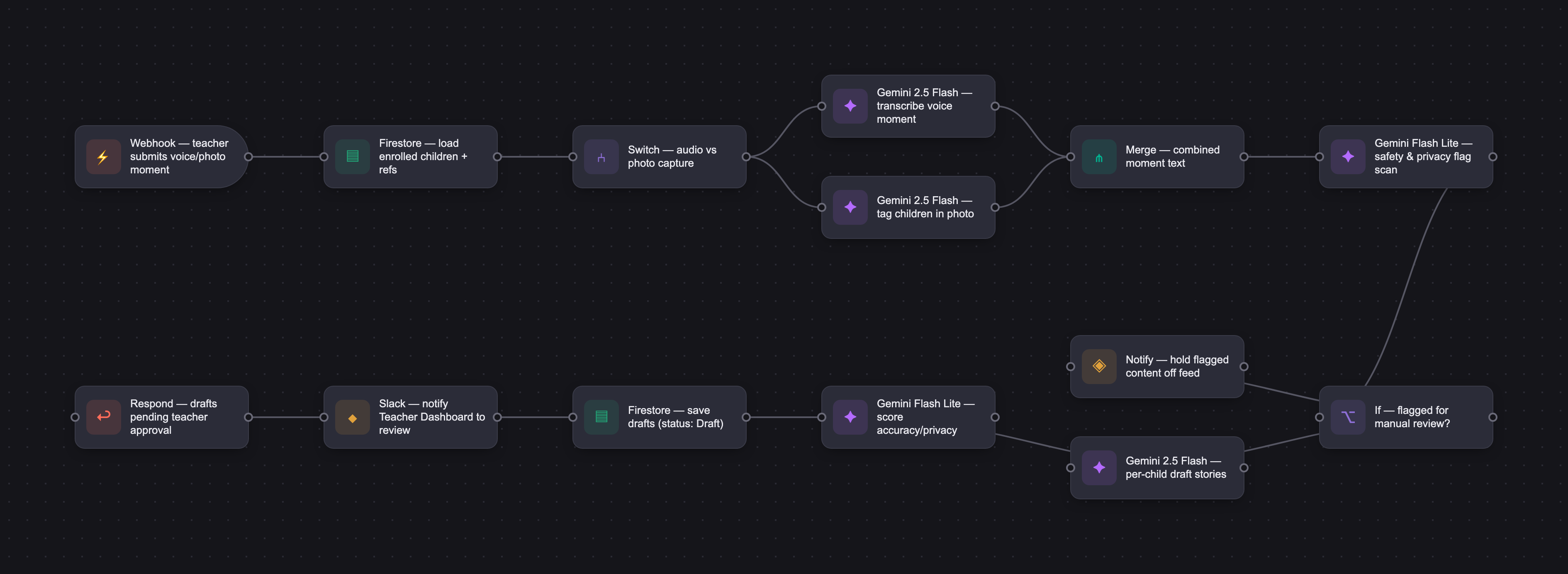
The MVP runs on Gemini 2.5 Flash for vision, voice, and story generation, with Gemini 2.5 Flash Lite handling child tagging, safety flagging, and evals at ultra-low latency. Audio or a classroom photo plus the enrolled-children list produces captured moments, which are joined and passed to story generation, all stored in Firebase/Firestore. Prompts enforce strict rules: a zero-tolerance privacy rule so a child's story never names another child (others become "friends"), grounded and realistic narratives, returning nothing on silent or unclear audio, and identifying only children whose names appear in the verified enrolled list. Evaluation is a hybrid architecture — an LLM-as-judge scores accuracy, privacy, and safety, while human review stays the final gate. After fixing the evaluator to stop penalizing omission of unrelated children, a benchmark run scored 100% on both accuracy and privacy.
Who it's for
This is a B2B2C product: childcare centers buy it, teachers use it, and parents receive the value. Primary users are teachers, who want to save documentation time, communicate clearly with parents, and capture meaningful learning moments without burnout. Secondary users are parents and families consuming the updates — busy, often multilingual working parents who want warm, meaningful stories that help them understand their child's day and feel connected and reassured.
Why it matters
The target segment is projected to grow at a ~12-16% CAGR over the next 3-5 years, driven by demand for teacher productivity tools and parent communication at scale, against headwinds of teacher shortages and burnout. Tiny Tales sells an AI storytelling app to childcare centers on a subscription model. Launch is a pilot with a childcare centre in Auckland, New Zealand to validate product-market fit and measure teacher time saved and parent engagement, aiming to prove daily use then scale via parent advocacy and director buy-in. Given the stakes of early childhood, the product is built compliance-first — aligned to the NZ Privacy Act 2020, with content moderation, teacher accountability trails, and secure, partitioned child data.
The workflow
The PRD
| PRODUCT FACULTY — AI PRODUCT REQUIREMENTS DOCUMENT (PRD) TEMPLATE Version 1.0 | ||||||
|---|---|---|---|---|---|---|
| Your Name: | Mariana Al Sayed | |||||
| Your Product: | Tiny Tales - AI-powered app that transforms childcare moments into meaningful stories for parents | |||||
| Your Industry: | Education | |||||
| Date: | May 5, 2026 | |||||
| 4D Method | AI PRD | Instructor Feedback | ||||
| Phase | Activity | Theme | Topic | Key Question(s) | Your Response Include external links to visuals/prototypes as required. | |
| DISCOVERY | Understand your market, business, product & user context | Business Value Map | Market Attractiveness | What industry is your business in? (ie Financial services, Healthcare, Education, etc)? | Early Childhood Education | Please leave this area blank. This space is for the Instructor to provide you with feedback. |
| What are the key challenges (headwinds) and opportunities (tailwinds) impacting growth in your industry? Who are the key competitors? | Headwinds - low occupancy rates, teacher shortages, risk-aversion, teacher burnout & low tolerance for anything that adds workload Tailwinds - rising tech integration, global EdTech market growth, demand for teacher productivity tools and workload reduction, need for parent communication at scale Competitors - Parent, Brightwheel, Storypark, HiMama, KinderCare, SeeSaw | |||||
| What is the projected growth rate of your target market segment over the next 3-5 years? | Target segment is projected to grow at ~12-16% Compound Annual Growth Rate (CAGR) over the next 3–5 years, reflecting strong demand for early‑childhood communication and AI‑powered documentation tools. | |||||
| Business Model | What growth stage is your business currently in (e.g., startup, scale-up, mature)? | Startup | ||||
| How does your business make money? What do they sell? What is your primary revenue model (e.g., subscription, freemium, licensing, marketplace, transactional, etc?) | By selling AI‑powered storytelling app to childcare centers using a subscription model. | |||||
| Who is your primary customer base (B2B, B2C, B2B2C)? | B2B2C business - childcare centers buy it, parents receive the value & teachers use it | |||||
| Differentiators | What are the key differentiators for your company? | We differentiate by removing the burden from teachers - capturing moments in seconds—and turning them into deeply personalised, human-sounding stories for each child. Unlike traditional childcare apps that produce generic updates, we focus on parent connection, individual storytelling and children development, all within a workflow teachers will actually use. | ||||
| Feature Value Map (IMPORTANT NOTE: This section is only relevant if you are working on enhancing an existing product. It does not apply if you are developing a new product from 0 to 1.) | Customers | Who are the customers (ie buyers) of your product? | Not relevant | |||
| End Users | Who are the end-users of your product? Which users are the most revenue-generating / revenue-impacting for your company? What are their goals, roles, and context? | Not relevant | ||||
| Current Products / Services | If you are a Product-led business: What are the core features of your product, and how do they address user needs? If you are a Service-led business: What are the key services you offer to customers? | Not relevant | ||||
| User Value Map | Target Persona | Who is your AI product / feature for? (Internal users, external users, an influencer, a buyer, etc) | Primary users - teachers (capturing moments) Goals - save time on documentation, communicate clearly with parents, meet center expectations without burnout, capture meaningful moments connected to learning highlights Context - busy, noisy environments, overwehelmed with kids & admin tasks, not always tech-savvy Secondary users - parents & families (consuming the updates) Goals - receive warm & meaningful stories, understand their child's day, feel connected & reassured Context - busy working parents, high emotional investiment, expect transparency & digital communication, often multilingual households | |||
| Journey Map (current-state) | What is the typical journey for your target persona when they are using your product / service, focusing on their ideal experience (happy path) as they interact with your product? | https://lucid.app/lucidspark/6afa1dd6-f2f3-4d4f-b22a-0f58e5c93006/edit?invitationId=inv_285f48d3-4ea5-4aba-b49e-6260f748def7 | ||||
| Pain-points | Where does the user experience friction, obstacles, or unmet needs throughout the journey? Identify which pain-points are most frequent and severe? | https://lucid.app/lucidspark/6afa1dd6-f2f3-4d4f-b22a-0f58e5c93006/edit?invitationId=inv_285f48d3-4ea5-4aba-b49e-6260f748def7 | ||||
| AI Opportunities | From your list of pain points, identify those that can effectively be addressed using Generative AI. Remember, this project focuses on leveraging LLM-powered AI to solve your target persona's pain points. Rank these pain points starting with the most severe and frequently occurring first. | Pain points & AI opportunities #1 No time in the moment -> LLM can instantly detect children, activities, emotions etc. in photos & translate unstructured voice notes into moments #2 Rushed or skipped updates -> LLM can generate all stories with a simple click #3 Stories are too generic/repetitive -> LLM can personalise story generation & incorporate children preferences, development goals, and past events #4 Inconsistent communication across classrooms -> LLM can enforce consistent tone, structure, and quality | ||||
| Develop an AI Solution Hypothesis | AI Solution Hypothesis | Diverge | Ideate potential solutions to address your AI-solvable pain points. Focus on generating a high quantity of ideas rather than evaluating their quality at this stage. | Potential solutions Voice-to-story Photo-to-story Smart moment reminders - detect children with no captured moments & nudge teachers Personalised children stories - based on family values, child preferences, child learning development, etc. Multilingual story generation Childcare centre analytics Storybook builder - print favorite stories in a keepsake for parents | ||
| Converge | Rank your ideated solutions based on impact and feasibility. Identify your top three AI solutions, and clearly select the one you'll focus on for your project. | Focus on Voice/Photo-to‑Story. It solves the most severe, most frequent pain point: teachers don’t have time to write updates. It creates the highest immediate value for both teachers and parents and will be the foundation for every other feature (translation, personalization, etc). | ||||
| DESIGN | Define Target State Workflow | UX Flows & Wireframes Suggested Tool: Excalidraw | Workflow (future) | Assuming your product or feature works as desired, what is the target state workflow? | Teacher captures moments (voice/photo) → teacher generates per-child drafts on Stories tab → teacher reviews and marks Reviewed → parent sees stories in Family Storybook for their linked child. Draft and flagged content never appears in the parent feed. | Please leave this area blank. This space is for the Instructor to provide you with feedback. |
| Build Wireframes | Wireframes | How will users navigate through your AI solution? What are the key steps and decision points? What information will be displayed at each stage? What specific UI elements are needed on each screen? How will the layout accommodate AI features? | https://drive.google.com/file/d/1SEAzh_8K7SVacP7Du-JXfWNI9R7vuRr_/view?usp=drive_link | |||
| Develop Prototype to showcase AI interactions | Prototype Screens Suggested Tool: lovable.dev | What aspects of the AI solution will you demonstrate in your prototype? How will the AI inputs, processing, and outputs be presented visually to users? Which features are essential for launch? What can be left for later releases? | Protype includes MVP AI features essential for launch Voice-to-text transcription Image-to-text transcription Story generation AI evaluation Features for future releases Translating stories Personalising stories according to the family's values, child's learning & development aspirations, etc. Parents turning favorite stories into keepsakes Smart reminders for teachers to capture moments for children who don't have any yet | |||
| Initial Prompt Design | Master Prompt [Initial Design] | Create an initial master prompt. Consider the following: What tone or personality should the AI use? How should user input and system instructions be structured for maximum clarity? What system instruction will govern the AI's behavior? What examples might improve performance? How will you format outputs for consistency? | "You are an early childhood educator. Based on unstructured notes from the day, generate a short, authentic, and positive story for each child mentioned, only if they are in the enrolled children list. If a child mentioned in the notes is not in the ""Children"" list, do not generate a story for them. For each child, write a warm, narrative summary of the child's day (3-4 sentences) including learning highlights in domains like social, motor, language, etc. Return a JSON array of objects, where each object has a 'child name' and a 'story'" | |||
| Prepare for Testing & Iteration | Evaluation Criteria & Test Plan | Evaluation Criteria | What specific quality benchmarks (e.g., clarity, relevance, tone, accuracy, SEO, hallucination avoidance) will define “good” output? | For voice transcription/photo analysis - accuracy + safety For story generation - accuracy + privacy + FPAR For golden dataset benchmark - semantic similarity, tone, recall = overall alignment | ||
| Example Cases | What specific example use cases, edge cases, and negative cases should be covered by test prompts and outputs? | Messy brain dump - "uh today was busy we did painting outside Liam got super into mixing colors blue green everywhere lol snack was apples and crackers oh and reminder parents sign permission slip" Negative input - "Eli was really grumpy today didn’t want to join anything cried a lot during snack" Multilingual input - "Hoy hicimos música, los niños tocaron tambores, Leo muy feliz, snack bananas." etc. other test cases can be found in-app. | ||||
| DEVELOP | AI Model Selection & Justification | AI Model Selection & Justification | Which AI model is best suited for your solution and why? What capabilities and limitations does it have? How will it integrate with your product? | Gemini 2.5 Flash (vision, voice, stories) + solid production quality at practical speed - weak on long, nuanced story writing Gemini 2.5 Flash Lite (children tagging, safety flagging, evals) + cost-efficient and lightweight model, optimized for ultra-low latency - trades off some advanced, multi-step reasoning capabilities in favor of raw speed. | Please leave this area blank. This space is for the Instructor to provide you with feedback. | |
| Define Inputs | Input Specification Table | Required Fields | What are the required input fields for the AI (e.g., title, description, keywords, tone)? Indicate format, source, requirement. | Voice moment transcription Input Audio - Base64 audio + MIME type (captured by teacher) Enrolled children - Comma/list (Firestore) Output (JSON array): { kidName: string, moment: string } Photo moment vision Input Classroom photo - base64 JPEG (captured by teacher) Reference photos - per child name + base64 JPEG (Firestore) Enrolled children names - string (Firestore) Output (JSON array): { kidName: string, moment: string } Story generation Input Enrolled children - comma/list (Firestore) Captured moments - multiple strings joined with \n---\n (Firestore) Date label - human-readable date string (server) Output (JSON array): [{ "kidName": "string", "story": "string" }] | ||
| Optional Fields | Are there any optional or user-customizable fields? How do they impact the AI’s output? | No. | ||||
| Define Good Output | Output Evaluation Checklist | Objective Criteria | What criteria will you use to judge output as “good”? (e.g., structure, use of keywords, tone, factuality, relevance) | Moments accuracy - readable, coherent, no garbage transcription safety - no privacy/safety flags Stories privacy - only enrolled names used, other children ommitted/generic alignment - matches what moments actually showed Other FPAR - teacher first-pass acceptance rate | ||
| Subjective Criteria | Are there any criteria that require human judgment or qualitative assessment? | Yes, all stories are quickly reviewed by teachers prior to sharing with parents. | ||||
| Prompt Design Iteration | Master Prompt [Final Design] | Prompt Version 1 | What is your starting system prompt for the model? What variations will you test? What techniques will you use to optimize performance? List initial instructions, persona, inputs, and constraints. | You are an early childhood educator. Based on unstructured notes from the day, generate a short, authentic, and positive story for each child mentioned, only if they are in the enrolled children list. If a child mentioned in the notes is not in the "Children" list, do not generate a story for them. For each child, write a warm, narrative summary of the child's day (3-4 sentences) including learning highlights in domains like social, motor, language, etc. Return a JSON array of objects, where each object has a 'child name' and a 'story' | ||
| Prompt Iterations | If revised, what changes did you make and why? How do you track and record prompt evolution? | For the story generation prompt: - Introduced a zero-tolerance privacy rule to never mention any other child's name in a specific child's story. Instead, other children must be referred to generically as "friends". - Also added a rule to keep the stories realistic and grounded as early stories tended to drift into exaggerated narratives. For the audio transcription prompt: - Instructed the model to return nothing when audio is silent or unclear, and not to invent classroom details. - Introduced a safety check to scan generated content and flag transcripts for manual review. - Instructed the model to only identify children whose names explicitly appear in the enrolled children list. If a name is mentioned in the audio but is missing from the verified database, the system is strictly forbidden from hallucinating, creating a story or tagging them. - Introduced a content enrichment & pronoun resolution prompt for when teachers record generic audios (e.g., "He walked over to the water table" or "She showed great coordination") and later tag children manually. AI dynamically resolves generic references ("him/her", "the child", "he/she") into the child’s actual name while keeping the warm, narrative tone intact. For the evaluation prompt: The evaluator compared each child’s story against the full moment text, which often mentions other children too. Omitting another child’s activity was treated as a miss, resulting in a low accuracy score, even when that activity had nothing to do with the story being scored. Updated the prompt to only penalize accuracy when the story misstates, invents, or contradicts details that specifically apply to the child being evaluated. Prompt evolution is tracked in a prompt change log. | ||||
| Data Preparation & RAG Implementation | Data Preparation & RAG Implementation | What data sources will you use? How will you prepare data for model training or evaluation? (e.g., cleaning, structuring). For RAG: How will you chunk, embed, retrieve relevant information? | N/A | |||
| Create Evaluation Set | Example Input/Output Data for Testing | Typical Examples | What are the most common inputs and expected outputs? Use real data if possible. | Story generation example Input { "enrolledNames": ["Kiyan", "Eyad", "Yasma"], "date": "2026-05-29", "combinedNotes": "Kiyan built an incredibly high tower out of wooden blocks today and showed Eyad his construction. He said, 'Look how tall it is!' before it fell down and he laughed. Eyad joined in and helped him stack them back up. Yasma spent the afternoon focused on watercolor painting, showing excellent fine-motor control as she blended mint and lavender pastes on her sheet." } Expected Output [ { "kidName": "Kiyan", "story": "Today, Kiyan became a master architect in the block corner! He showed wonderful concentration and patience as he stacked wooden blocks to build a towering structure. Though his tall construction eventually tumbled down, Kiyan met the moment with a bright laugh, showcasing great resilience. Working alongside a friend to restack the blocks also offered a lovely opportunity to enjoy cooperative play and language sharing." }, { "kidName": "Eyad", "story": "Eyad spent a delightful time in the building area today, demonstrating her helpful spirit and social-emotional growth. When a block tower built by a friend came falling down, Eyad quickly stepped in to join the fun and help rebuild it together. Stacking blocks cooperatively allowed Eyad to practice teamwork, fine-motor coordination, and kind problem-solving." }, { "kidName": "Yasma", "story": "Yasma immersed herself in a beautiful, focused sensory experience at the art table today. She chose soft mint and lavender watercolor pastes, blending them onto her canvas with wonderful fine-motor control and wrist stability. Yasma's quiet dedication during painting highlighted both her expanding creative expression and her strong attention span." } } | ||
| Edge Cases & Negative Cases | What examples test the AI’s limits? (e.g., missing data, ambiguous input, out-of-domain) | Sparse input Multilingual input Blank transcript Unsafe transcript etc. | ||||
| Test Example Data & Review Results | Manual Review | Run your input data with the prompt. How did your output perform in manual review? Which examples failed which criteria, and why? | Actual output Kiyan "Kiyan showed wonderful spatial awareness and fine motor skills today while building an incredibly high tower out of wooden blocks. With great pride, Kiyan invited a friend over to admire the tall structure, communicating happily about the build. When the tower eventually tumbled down, Kiyan showed wonderful resilience by laughing and immediately working together with a friend to stack the blocks back up." Accuracy - 100% Privacy - 100% AI Auditor Notes The story accurately reflects Kiyan's actions in the raw notes. It highlights his block tower construction, his interaction with Eyad (referred to as 'a friend'), the tower's collapse, his laughter, and the collaborative rebuilding. The story appropriately omits details about Yasma's painting, as it is not relevant to Kiyan's narrative. The tone is warm, pedagogical, and realistic, focusing on Kiyan's spatial awareness, fine motor skills, and resilience. Eyad "Eyad showed great social cooperation and enthusiasm during block play today. When a friend built a wonderfully tall wooden tower, Eyad gladly joined in to share the excitement and laughter. After the tower tumbled down, Eyad kindly helped the friend stack the blocks right back up, practicing both fine motor skills and collaborative teamwork." Accuracy - 100% Privacy - 100% AI Auditor Notes The story accurately reflects Eyad's involvement in the block building activity, highlighting his cooperation and helpfulness. No privacy or safety concerns were identified as only the evaluated child's name was used, and other children were referred to generically. The tone is warm and pedagogical. Yasma "Yasma had a wonderful afternoon showcasing great focus and dedication at the art table. Using watercolors, Yasma demonstrated excellent fine motor control while carefully blending mint and lavender shades onto the sheet. It was beautiful to see such steady concentration and creative artistic expression during this quiet hands-on activity." Accuracy - 100% Privacy - 100% AI Auditor Notes The story accurately reflects Yasma Zawawi's activity from the raw notes, focusing on her watercolor painting and fine motor control. The narrative is warm, professional, and safe, with no mention of unauthorized children or inappropriate content. The story correctly omits details about Kiyan and Eyad's block-building activity, as it does not pertain to Yasma Zawawi. | |||
| Automated Evaluation | What pass/fail rate or scores did the AI achieve on core criteria? | First eval run with the abov example scored 75% for accuracy & 100% for privacy. After amending the evaluation prompt to stop penalizing accuracy score for omitting other children's unrelated details, the refreshed evaluation scored 100% on both accuracy & privacy. | ||||
| Handle Edge Cases & Iterate | Edge Case Identification | What edge cases did you identify in testing or real usage? | Sparse input Multilingual input Blank transcript Unsafe transcript etc. | |||
| Updates & Adjustments | What prompt or system adjustments have you made based on failures, feedback, or edge case observations? | For the story generation prompt: - Introduced a zero-tolerance privacy rule to never mention any other child's name in a specific child's story. Instead, other children must be referred to generically as "friends". - Also added a rule to keep the stories realistic and grounded as early stories tended to drift into exaggerated narratives. For the audio transcription prompt: - Instructed the model to return nothing when audio is silent or unclear, and not to invent classroom details. - Introduced a safety check to scan generated content and flag transcripts for manual review. - Instructed the model to only identify children whose names explicitly appear in the enrolled children list. If a name is mentioned in the audio but is missing from the verified database, the system is strictly forbidden from hallucinating, creating a story or tagging them. - Introduced a content enrichment & pronoun resolution prompt for when teachers record generic audios (e.g., "He walked over to the water table" or "She showed great coordination") and later tag children manually. AI dynamically resolves generic references ("him/her", "the child", "he/she") into the child’s actual name while keeping the warm, narrative tone intact. For the evaluation prompt: The evaluator compared each child’s story against the full moment text, which often mentions several children. Omitting another child’s activity was treated as a miss (low accuracy), even when that activity had nothing to do with the story being scored. Updated the prompt to only penalize accuracy when the story misstates, invents, or contradicts details that specifically apply to the child being evaluated. | ||||
| Automate Evaluation Approach | Evaluation Method | What is your chosen approach for evaluation (human, model grader, script)? How will you scale testing to diverse/large test sets? | Because the safety and privacy constraints of early childhood education are critical, Tiny Tales requires a hybraid evaluation architecture that includes automated grading with human accountability. - Model Grader (LLM as a judge) - for testing accuracy, privacy & safety of transcripts & stories - Human in the loop - No generated story is ever shared without being surfaced on the Teacher Dashboard for human review To scale testing to diverse/large test sets: - An Offline Evaluation Suite decoupled from Tiny Tales was created. A golden dataset was curated and tested without impacting production latency or burning through massive API cost. - Shift Right: continuous monitoring in production so that the AI's live responses are constantly evaluated for drift and degradation. | |||
| Evaluation Frequency | How often will you re-run evaluations for new data, new prompts, or post-launch monitoring? | New prompts Every time a prompt is modified, run a regression test against a a golden dataset. New data (children enrolled, stories, moments captured, etc.) Weekly, or when we notice drift Post-launch monitoring Weekly review of the analytics dashboard - flagged moments, if a specific child's name is consistently missed (signals a need to refine the IDENTIFICATION logic), etc. | ||||
| DEPLOY | Finalize Launch & Rollout Plan | Operational Readiness Checklist | Technical Readiness | Is infra (APIs, databases, rate limits, monitoring, rollback) tested and documented? | The prototype infrastructure is partially documented in INFRASTRUCTURE.md, not systematically tested. | |
| Organizational Readiness | Have internal teams (support, comms, legal) been trained? Is documentation complete? | N/A | ||||
| Launch & Rollout Strategy | Launch Approach | What is your launch approach? Pilot, AB test, or all users—who gets access and when? | Pilot with a local childcare centre in New Zealand - Auckland to validate product market fit, refine the AI storytelling engine, and measure teacher time saved and parent engagement. before wider rollout. Plan is to prove daily use with teachers - then scale via parent advocacy & director buy-in. | |||
| Scale Readiness | How will you ensure readiness for scale? How will you monitor initial volume and scale up? | By monitoring: Teacher engagement Parent engagement AI generation quality | ||||
| Go-to-Market Plan | Marketing / Training Assets | What assets (FAQ, demo, guides) will you prepare for external communication/marketing? | - Product demo - Case studies (pilot stories) - FAQ - mainly covering Privacy & Safety (how is child data protected, how teachers are still reviewing content, etc.) | |||
| Stakeholder / Internal Comms | How will you communicate launch plans, progress, and outcomes internally? | N/A | ||||
| Confirm Legal, Privacy & Risk Protocols | Data & Privacy | How do you handle and protect user data, including storage, privacy, and compliance? | Secure Storage: All child data, photos, and stories are stored in Google Firebase using industry-standard encryption at rest and in transit. Data Protection & Privacy: Data is strictly partitioned. Access is guarded by Firebase Authentication, ensuring only registered teachers and authorized parents can view their specific centre or child's memories. Data Integrity: We use Firestore Security Rules to prevent unauthorized read/write access at the database level. Full Control: We do not share data with third parties. Administrators and teachers maintain full control, with the ability to delete daily moments or child profiles at any time. Purpose-Bound AI: Child photos are used exclusively for local identification via facial recognition to automate story generation, never for external training or tracking. Photos are sent to Google’s Gemini API for analysis only. | |||
| Policy & Compliance | Are content moderation, legal, and audit processes in place? Are you compliant with regulations needed for your domain? | Content moderation Every captured moment is analyzed to detect inappropriate content, safety concerns, or child protection issues.If the AI detects potentially sensitive or inappropriate context, the system is designed to flag the content for manual review. Compliance & audit NZ Privacy Act 2020 Alignment: Includes explicit in-app disclosures about data usage and ensures that only authorized users can generate data. Teacher Accountability: Every entry is linked to a teacherId, providing a clear audit trail of who captured a moment, generated, reviewed, or sent a story. Data Control: Educators and Admins have the "Right to Erasure" (deletion) directly through the interface. | ||||
| Define Success Metrics | Success Metrics | User/Business Metrics | What user metrics will indicate success? What business metrics will demonstrate value? | User metrics daily active teachers (DAU) - adoption capture frequency per teacher - adoption average time to generate a story story first pass acceptance rate (FPAR) (aka edit rate) parent open rate - engagement & perceived value Business metrics monthly recurring revenue (MRR) - predictable revenue. customer churn rate - % of centres cancelling support tickets per centre - lower = simpler, more intuitive product. | ||
| AI Metrics | How will you measure AI performance and accuracy? | We measure AI with automated safety checks on every output, golden-test benchmarks scored on similarity, tone, and recall against educator-written stories (tracked by prompt version over time), AI evals on live transcripts and stories (scoring accuracy, privacy, safety, alignment), and teacher review before anything reaches families. We also measure first pass acceptance rate (FPAR) for reviewed stories (aka edit rate). | ||||
| Monitor, Iterate & Improve | User Support & Feedback Plan | Support Channels | Where can users get support? Is escalation and ownership clear? | Users can report a concern in-app wih categories (privacy, story/moment, technical, other). Support tickets are managed by superusers. | ||
| Feedback Workflow | How do you gather, triage, and act on feedback and bugs? How are critical issues prioritized and communicated? | Several feedback sources - report a concern page, in-context report buttons, AI safety flags, teacher story edits, logs, AI evals, analytics. Prioritized as below: Highest - child-safety, harmful content, privacy, parent consent High - app down, data loss, error logs Medium - content quality, wrong child, teacher edits, evaluations Low - General feedback Communication back to users: For the pilot, email back to the submitter when the issue is picked up/resolved. | ||||
| Monitoring & Continuous Improvement | Monitoring Approach | What monitoring/logging is in place to spot operational/AI issues post-launch? | In-app observability for admins/superusers via logs & analytics. | |||
| Ongoing Improvement | How will you collect learnings, review performance, and update your system continuously post-launch? | After launch we run a closed feedback loop: production usage feeds logs, safety flags, and analytics; superusers run periodic AI audits and golden benchmarks versioned with PROMPT_VERSION; teachers corrections through edits and reviews. We only ship prompt or model changes after benchmark regression testing, while human review stays the final gate. | ||||