AI Tools
Zeroform.ai
Zeroform.ai is an AI sustainability co-pilot for Australian residential architects working on early-stage approval readiness. Architects can describe a project by voice or text, receive sustainability opportunities and risks across areas like water, energy, materials, and thermal performance, and build an exportable brief for formal assessment. The tool aims to reduce manual coordination with consultants and streamline fragmented approval workflows.
The problem
Early-stage residential design lacks a real-time sustainability and performance decision-support layer. Architects can't rapidly evaluate how design choices affect BASIX compliance, NatHERS performance, or construction cost while they design. Instead, feedback is delayed through fragmented, manual assessor workflows, slowing iteration and increasing rework risk. The result is redesigns, project delays, cost overruns, and compromised design outcomes — a serious drag in a market under pressure to deliver housing faster.
The solution
ZeroForm.ai is an early-stage sustainability co-pilot for Australian residential architects and building designers, focused on NSW small-scale residential projects during Schematic Design. An architect describes a project by voice or text; the tool extracts confirmed facts and AI assumptions, identifies missing inputs, asks the highest-impact priority questions, and returns readiness guidance across Water, Thermal/NatHERS, Energy, and Materials with a risk scorecard and recommended design moves. Critically, it is explicitly not a consultant, assessor, certifier, or formal compliance tool — the output is an export-ready summary that streamlines handoff to consultants and assessors.
How it works
The product uses GPT-5.5 as the primary model, chosen for complex reasoning across incomplete design inputs, BASIX/NatHERS concepts, uncertainty handling, and practical trade-offs. The UI sends project inputs to a backend that enriches the request with prompt instructions and retrieved evidence via the Responses API; the model returns structured JSON rendered as confirmed facts, assumptions, missing inputs, priority questions, risk scorecards, and recommendations. A smaller model such as gpt-5.4-mini can handle lower-risk extraction and classification. RAG is not used in the MVP — it relies on local workflow logic, structured prompts, and safety guardrails, with future retrieval planned over authoritative BASIX, NSW Planning, NatHERS, and NCC sources. Guardrails ban "guaranteed pass" language, use approved risk labels (Low to High and Unknown), separate assumptions from facts, and require architect validation before assumptions inform suggestions. Early evaluation is strong: the deterministic local rules-engine passed 11 of 11 cases and a live OpenAI prompt evaluation passed 19 of 21 checks (90%).
Who it's for
The product is B2B, sold to individual or small-scale residential architects and designers working on bespoke developments. Their goal is to design and get approved residential developments that meet client needs and satisfy compliance requirements. Revenue is a subscription or one-off payment per project. Because ZeroForm.ai operates near regulated assessment workflows, the design deliberately keeps formal compliance with official BASIX/NatHERS tools, sustainability consultants, and accredited assessors.
Why it matters
Australia faces a structural housing undersupply against a government target of 1.2 million new homes by 2029 — roughly 240,000 homes a year, versus about 177,000 delivered in 2024. Meeting it requires a 35–40% increase in annual construction, even as slow, manual approval processes and rising costs slow delivery. As an early-stage startup, the launch plan is staged: internal testing with 5–10 project examples, expert review with a sustainability consultant, a closed pilot with 3–5 architects, then broader beta once hallucination and workflow risks are controlled. Success is measured by useful early-stage guidance with zero fabricated pass, score, certificate, or rating claims.
The workflow
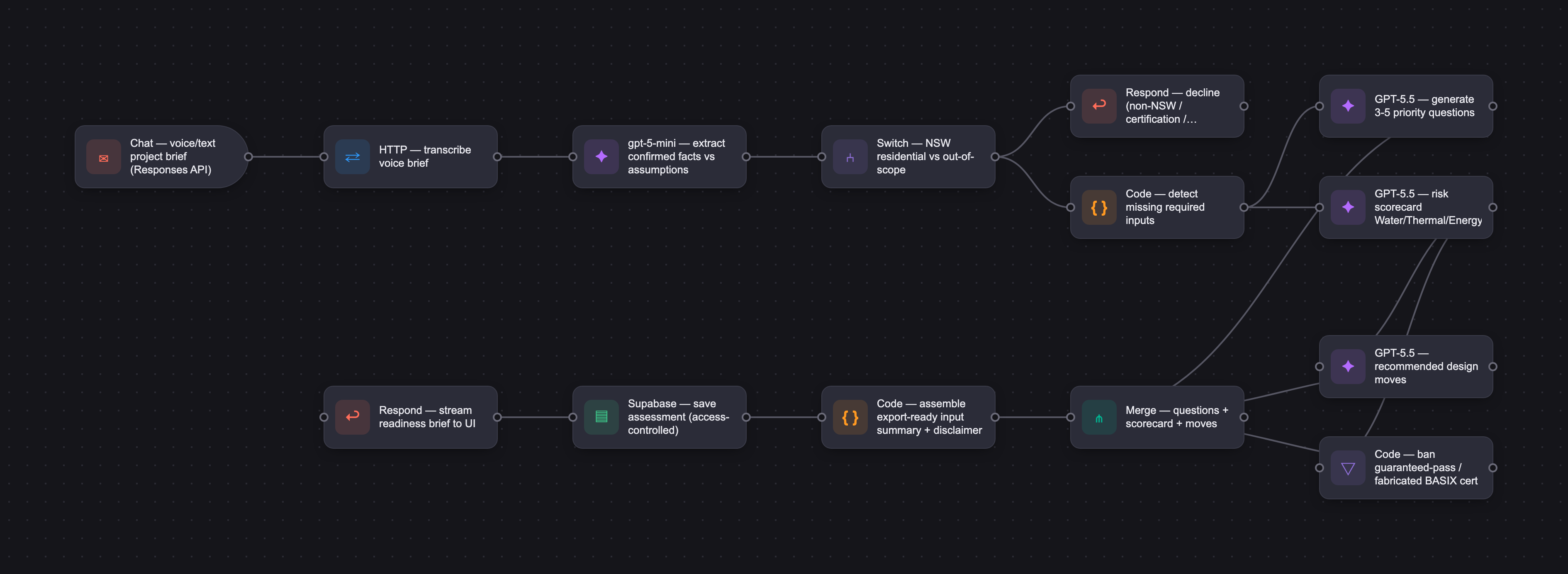
The PRD
| PRODUCT FACULTY — AI PRODUCT REQUIREMENTS DOCUMENT (PRD) TEMPLATE Version 1.0 | ||||||
|---|---|---|---|---|---|---|
| Your Name: | Robert Petrovic | |||||
| Your Product: | ZeroForm.ai- Early-stage design intelligence for sustainability compliance and performance | |||||
| Your Industry: | Residential Construction | |||||
| Date: | May 10, 2026 | |||||
| 4D Method | AI PRD | Instructor Feedback | ||||
| Phase | Activity | Theme | Topic | Key Question(s) | Your Response Include external links to visuals/prototypes as required. | |
| DISCOVERY | Understand your market, business, product & user context | Business Value Map | Market Attractiveness | What industry is your business in? (ie Financial services, Healthcare, Education, etc)? | Construction - Residential Buildings in Australia. Specifically the design and approval process | Please leave this area blank. This space is for the Instructor to provide you with feedback. |
| What are the key challenges (headwinds) and opportunities (tailwinds) impacting growth in your industry? Who are the key competitors? | Australia’s growing housing shortage is creating strong demand for faster, more efficient housing delivery, while increasing regulatory complexity and construction constraints continue to slow supply. Tailwinds (Growth Opportunities) - Structural housing undersupply driving sustained demand - Government pressure to accelerate housing delivery and approvals - Growing demand for technology that improves compliance, productivity and feasibility Headwinds (Key Challenges) - Slow, manual, complex and heavily regulated planning approval processes - Labour shortages and declining industry productivity - Rising construction costs and affordability pressures | |||||
| What is the projected growth rate of your target market segment over the next 3-5 years? | 6.3% annual housing completion over the next 5 years However, it's more to do with the required number of new home vs the current compounding shortage. Australian Government’s target of 1.2 million new homes by 2029, Australia needs to deliver approximately: - 240,000 new homes per year - 60,000 homes per quarter - Around 657 homes per day nationally Current completion rates are materially below this target: - Australia delivered approximately 177,000 homes in 2024 - This means the industry needs to increase housing delivery by roughly: - 35–40% above current annual construction levels - Equivalent to an additional 50,000–65,000 homes per year sustained over the next 3–5 years | |||||
| Business Model | What growth stage is your business currently in (e.g., startup, scale-up, mature)? | Early stage startup | ||||
| How does your business make money? What do they sell? What is your primary revenue model (e.g., subscription, freemium, licensing, marketplace, transactional, etc?) | PROBLEM Early-stage residential design lacks a real-time decision-support layer. Architects cannot rapidly evaluate how design choices impact sustainability compliance, performance, or construction cost while designing. Instead, feedback is delayed through fragmented, manual assessor workflows, slowing iteration and increasing rework risk. This results in redesigns, project delays, cost overruns, and compromised design outcomes. SOLUTION Real time insights and recommendation on sustainability compliance, performance and estimated cost impacts as the Architect designs Revenue: Subscription or one off payment per project. | |||||
| Who is your primary customer base (B2B, B2C, B2B2C)? | B2B | |||||
| Differentiators | What are the key differentiators for your company? | - Real time sustainability compliance and environmental performance insights and recommendations during early stage design. Leverage proprietor data from designs. - | ||||
| Feature Value Map (IMPORTANT NOTE: This section is only relevant if you are working on enhancing an existing product. It does not apply if you are developing a new product from 0 to 1.) | Customers | Who are the customers (ie buyers) of your product? | Residential Architects and Designers | |||
| End Users | Who are the end-users of your product? Which users are the most revenue-generating / revenue-impacting for your company? What are their goals, roles, and context? | Residential Architects and Designers Goal: Design and get approved residential developments that meet their clients needs and satisfy all compliance and approval requirements | ||||
| Current Products / Services | If you are a Product-led business: What are the core features of your product, and how do they address user needs? If you are a Service-led business: What are the key services you offer to customers? | NA | ||||
| User Value Map | Target Persona | Who is your AI product / feature for? (Internal users, external users, an influencer, a buyer, etc) | Individual or small scale Residential Architects and Designers for b-spoke developments | |||
| Journey Map (current-state) | What is the typical journey for your target persona when they are using your product / service, focusing on their ideal experience (happy path) as they interact with your product? | Current State building approval process with Pain points identified https://miro.com/app/board/uXjVHYKMvOE=/?moveToWidget=3458764670496032533&cot=14 | ||||
| Pain-points | Where does the user experience friction, obstacles, or unmet needs throughout the journey? Identify which pain-points are most frequent and severe? | Pain point assessment based on pains identified in customer journey. https://miro.com/app/board/uXjVHYKMvOE=/?moveToWidget=3458764671415504304&cot=14 Outcome of assessment Combine Pain 1, 5, 12 Re-framed Problem statement Early-stage residential design lacks a real-time sustainability and performance decision-support layer. Architects cannot rapidly evaluate how design choices impact BASIX compliance, NatHERS performance, or construction cost while designing. Instead, feedback is delayed through fragmented, manual assessor workflows, slowing iteration and increasing rework risk. This results in redesigns, project delays, cost overruns, and compromised design outcomes | ||||
| AI Opportunities | From your list of pain points, identify those that can effectively be addressed using Generative AI. Remember, this project focuses on leveraging LLM-powered AI to solve your target persona's pain points. Rank these pain points starting with the most severe and frequently occurring first. | Assessed and rank based on feasibility https://miro.com/app/board/uXjVHYKMvOE=/?moveToWidget=3458764671415504304&cot=14 | ||||
| Develop an AI Solution Hypothesis | AI Solution Hypothesis | Diverge | Ideate potential solutions to address your AI-solvable pain points. Focus on generating a high quantity of ideas rather than evaluating their quality at this stage. | Idea generation based on re-framed problem statement https://miro.com/app/board/uXjVHYKMvOE=/?moveToWidget=3458764671415966655&cot=14 | ||
| Converge | Rank your ideated solutions based on impact and feasibility. Identify your top three AI solutions, and clearly select the one you'll focus on for your project. | Ideas ranked and selected https://miro.com/app/board/uXjVHYKMvOE=/?moveToWidget=3458764671415966655&cot=14 | ||||
| DESIGN | Define Target State Workflow | UX Flows & Wireframes Suggested Tool: Excalidraw | Workflow (future) | Assuming your product or feature works as desired, what is the target state workflow? | High level future state workflow https://miro.com/app/board/uXjVHYKMvOE=/?moveToWidget=3458764671434929891&cot=14 | Please leave this area blank. This space is for the Instructor to provide you with feedback. |
| Build Wireframes | Wireframes | How will users navigate through your AI solution? What are the key steps and decision points? What information will be displayed at each stage? What specific UI elements are needed on each screen? How will the layout accommodate AI features? | The target experience is a guided workflow for architects using ZeroForm.ai during Schematic Design. Users will enter a residential project brief, confirm key assumptions, review BASIX/NatHERS readiness risks, answer priority questions, and prepare an export-ready input summary for later consultant or assessor handoff. Supporting wireframe evidence is captured in Miro | |||
| Develop Prototype to showcase AI interactions | Prototype Screens Suggested Tool: lovable.dev | What aspects of the AI solution will you demonstrate in your prototype? How will the AI inputs, processing, and outputs be presented visually to users? Which features are essential for launch? What can be left for later releases? | The prototype demonstrates ZeroForm.ai as an early-stage sustainability co-pilot for NSW small-scale residential projects. It shows the core workflow of entering a schematic design brief, extracting confirmed facts and assumptions, identifying missing inputs, and returning BASIX/NatHERS readiness guidance across Water, Thermal/NatHERS, Energy and Materials. The MVP includes Schematic Design support, priority questions, risk scorecards, assumption validation and export-ready input summaries. CAD/drawing upload, automated drawing extraction and formal assessor collaboration will not be included in MVP and are future release candidates. Evidence: 03 Prototype Zip | |||
| Initial Prompt Design | Master Prompt [Initial Design] | Create an initial master prompt. Consider the following: What tone or personality should the AI use? How should user input and system instructions be structured for maximum clarity? What system instruction will govern the AI's behavior? What examples might improve performance? How will you format outputs for consistency? | The initial prompt defines ZeroForm.ai as an early-stage sustainability co-pilot for Australian residential architects and building designers. It uses sustainability-consultant-style reasoning, but explicitly states that it is not a consultant, assessor, certifier or formal compliance tool. The AI will use a calm, practical, design-aware tone and will be clear about uncertainty. Outputs will separate confirmed facts, AI assumptions, missing inputs, priority questions, risk scorecard and recommended design moves. Evidence: master-prompt-v0.1 | |||
| Prepare for Testing & Iteration | Evaluation Criteria & Test Plan | Evaluation Criteria | What specific quality benchmarks (e.g., clarity, relevance, tone, accuracy, SEO, hallucination avoidance) will define “good” output? | Good output = useful, accurate enough for early design, transparent about uncertainty, and safe for a non-certification product. It avoids generic checklist dumps, asks only the highest-impact 3-5 questions, separates assumptions from confirmed facts, and avoids invented BASIX certificates, NatHERS ratings or formal pass/fail claims. MVP success is defined as an average manual review score of 4.0+, no safety failures, no fabricated compliance outcomes, and at least 80% of outputs asking appropriate priority questions. Evidence: 08 evaluation-plan pdf | ||
| Example Cases | What specific example use cases, edge cases, and negative cases should be covered by test prompts and outputs? | Test cases cover realistic NSW small-scale residential scenarios, including detached dwellings, secondary dwellings/granny flats, townhouses and small alterations/additions. They test whether ZeroForm.ai extracts project facts, identifies missing inputs, classifies risk across Water, Thermal/NatHERS, Energy and Materials, and asks useful priority questions. Edge cases include missing location, projects outside NSW, commercial/non-residential projects, apartment-complex developments, conflicting inputs, and requests for formal certification. Evidence: 09 Evaluation Cases pdf | ||||
| DEVELOP | AI Model Selection & Justification | AI Model Selection & Justification | Which AI model is best suited for your solution and why? What capabilities and limitations does it have? How will it integrate with your product? | ZeroForm.ai will use GPT-5.5 as the primary model for the main co-pilot experience. It is best suited because the product requires complex reasoning across incomplete design inputs, BASIX/NatHERS concepts, user intent, uncertainty handling, and practical design trade-offs. OpenAI identifies gpt-5.5 as the recommended starting point for complex reasoning and professional workflows, with support for reasoning effort, tool use, long context, and the Responses API. The model’s key capabilities are structured reasoning, strong instruction following, structured outputs, tool/RAG integration, and the ability to produce clear user-facing recommendations from messy natural-language project briefs. Its limitations are that it can still hallucinate, overstate confidence, or misinterpret regulatory context if not grounded in trusted sources. To manage this, ZeroForm.ai will use structured outputs, source retrieval over BASIX/NatHERS/NCC references, assumption labels, evaluation tests, and human/consultant review for compliance-sensitive outputs. Evidence: 05 Input Output spec.pdf ZeroForm.ai will integrate the model through the backend using the Responses API. The UI will send project inputs to the backend, the backend will enrich the request with prompt instructions and retrieved evidence, and GPT-5.5 will return structured JSON for the UI to render as confirmed facts, assumptions, missing inputs, priority questions, risk scorecards and recommendations. A smaller model such as gpt-5.4-mini or gpt-5-mini can be used for lower-risk extraction, classification and checklist validation tasks where speed and cost matter more than deep reasoning. ZeroForm.ai will not replace a qualified sustainability consultant, accredited assessor or official BASIX/NatHERS tool. | Please leave this area blank. This space is for the Instructor to provide you with feedback. | |
| Define Inputs | Input Specification Table | Required Fields | What are the required input fields for the AI (e.g., title, description, keywords, tone)? Indicate format, source, requirement. | Required MVP inputs include project phase, project description, location, project type, dwelling size, building form, orientation, glazing summary, shading summary, envelope assumptions, hot water system, HVAC, cooking system, PV capacity, water fixtures, rainwater/reuse, construction materials and assumption status. These fields allow ZeroForm.ai to provide project-specific readiness guidance rather than generic sustainability advice. When key information is missing, the AI will ask targeted clarification questions rather than over-assessing. Evidence: input-output-spec.pdf. | ||
| Optional Fields | Are there any optional or user-customizable fields? How do they impact the AI’s output? | Optional fields include client priorities, budget sensitivity, design constraints, planning constraints, consultant notes, preferred output type and voice transcript. These fields improve ranking and personalisation of recommendations, including whether the architect wants a quick risk scan, design options, a consultant brief or an export-ready input summary. Uploaded drawings are future release scope, not MVP. Evidence: input-output-spec-v0.1.pdf product-decisions-v0.1.pdf | ||||
| Define Good Output | Output Evaluation Checklist | Objective Criteria | What criteria will you use to judge output as “good”? (e.g., structure, use of keywords, tone, factuality, relevance) | A good output includes immediate guidance, confirmed facts, AI assumptions, missing inputs, priority questions, category risk scorecard and recommended design moves. It uses approved risk labels such as Low, Medium, Medium-high, High and Unknown, and avoids formal compliance language when the data is incomplete. It also flags when formal BASIX/NatHERS assessment is required. Evidence: evaluation-plan-v0.1.pdf | ||
| Subjective Criteria | Are there any criteria that require human judgment or qualitative assessment? | Human review is required to assess whether the response is useful to an architect, lightweight enough for concept design, and commercially realistic. Reviewers will judge whether the AI helps the architect decide what to do next without sounding like a dense compliance report or creating false confidence. | ||||
| Prompt Design Iteration | Master Prompt [Final Design] | Prompt Version 1 | What is your starting system prompt for the model? What variations will you test? What techniques will you use to optimize performance? List initial instructions, persona, inputs, and constraints. | Prompt Version 1 instructs the AI to act as ZeroForm.ai, an early-stage sustainability co-pilot for NSW small-scale residential projects. It defines the role, scope limits, tone, output structure, assumption handling, risk labels, priority-question rules and refusal behaviour for out-of-scope or certification-style requests. Variations will test stricter compliance language, more design-led guidance, and different approaches to cost-aware trade-offs. Evidence: 04 master-prompt-v0.1.pdf | ||
| Prompt Iterations | If revised, what changes did you make and why? How do you track and record prompt evolution? | Prompt iterations are tracked through a version log showing the change, reason and test result. Early improvements include clarifying the ZeroForm.ai identity, strengthening non-certification guardrails, improving clarification-question behaviour and making recommendation transparency clearer. Future iterations will be driven by evaluation failures, consultant feedback and pilot user feedback. Evidence: master-prompt-v0.1.pdf evaluation-plan-v0.1.pdf | ||||
| Data Preparation & RAG Implementation | Data Preparation & RAG Implementation | What data sources will you use? How will you prepare data for model training or evaluation? (e.g., cleaning, structuring). For RAG: How will you chunk, embed, retrieve relevant information? | RAG is currently not being used for MVP. The current MVP uses local workflow logic, structured prompts, evaluation cases and safety guardrails to test the product experience before adding retrieva. In future we will use authoritative and versioned sources first, including BASIX guidance, NSW Planning material, NatHERS documentation, NCC references and the internal BASIX/NatHERS checklist structure. Content will be tagged with source metadata, chunked by topic, embedded, and retrieved based on project stage, category and user question. The product will retrieve 5-8 relevant chunks, prefer official sources, and cite references when making specific claims. Evidence:07 RAG Plan.pdf | |||
| Create Evaluation Set | Example Input/Output Data for Testing | Typical Examples | What are the most common inputs and expected outputs? Use real data if possible. | The evaluation set uses realistic NSW small-scale residential examples, including a single-storey Newcastle home with large north-facing glazing, a 30 sqm Newcastle granny flat with large west-facing glazing, a Western Sydney secondary dwelling with heat pump hot water and PV, and a Construction Documentation case requiring BASIX/NatHERS input checking. Expected outputs include immediate guidance, confirmed facts, AI assumptions, missing inputs, 3-5 priority questions, a risk scorecard across Water, Thermal/NatHERS, Energy and Materials, and recommended next actions. | ||
| Edge Cases & Negative Cases | What examples test the AI’s limits? (e.g., missing data, ambiguous input, out-of-domain) | Edge and negative cases test missing information, ambiguous design inputs, out-of-scope projects and unsafe compliance requests. Examples include “New home, coastal NSW” with missing location/detail, “I need a BASIX certificate by tomorrow,” a commercial office in Melbourne, a residential project in Perth, a multi-storey apartment project in Sydney, contradictory design data, “Just tell me it passes,” and requests to avoid BASIX. These cases test whether ZeroForm.ai maintains scope, refuses unsupported compliance claims, asks for clarification and avoids formal pass/fail language. Evidence: eval-cases-v0.1.pdf | ||||
| Test Example Data & Review Results | Manual Review | Run your input data with the prompt. How did your output perform in manual review? Which examples failed which criteria, and why? | Manual review uses a 1-5 scoring rubric covering relevance, clarity, BASIX/NatHERS accuracy, uncertainty handling, question quality, tone, actionability, hallucination avoidance, consistency and safety. The MVP target is an average score of 4.0+, no safety failures, no fabricated formal compliance outcomes, and at least 80% of outputs asking appropriate priority questions. Initial review shows the local evaluation set is performing well, with the main watch-outs being overconfident pass/fail language, too many questions too early, treating assumptions as facts, and dense compliance-style responses during concept design. Evidence: evaluation-plan-v0.1.pdf. 10A Evaluation Results OpenAI eval.pdf | |||
| Automated Evaluation | What pass/fail rate or scores did the AI achieve on core criteria? | The deterministic local rules-engine evaluation passed 11 out of 11 cases, achieving a 100% pass rate on the first automated MVP guardrail suite. A live OpenAI prompt evaluation using gpt-4.1-mini passed 19 out of 21 checks, achieving a 90% overall pass rate. Failures occurred in one boundary case where the response did not fully meet the expected assessment-boundary handling, and one extraction case where the output included a prohibited “complete” concept. Evidence: local-eval-report-2026-06-01.md, openai-prompt-eval-2026-06-02T01-04-11-824Z.md. | ||||
| Handle Edge Cases & Iterate | Edge Case Identification | What edge cases did you identify in testing or real usage? | Key edge cases identified include missing project location, incomplete project details, out-of-scope jurisdictions, commercial/non-residential projects, apartment-complex developments, contradictory design information, requests for BASIX certificates, requests for exact NatHERS ratings from insufficient information, and prompts asking the AI to ignore rules or claim a project will pass. These are high-risk because ZeroForm.ai operates near regulated assessment workflows and must not create false confidence. Evidence: eval-cases-v0.1.pdf | |||
| Updates & Adjustments | What prompt or system adjustments have you made based on failures, feedback, or edge case observations? | Prompt and system adjustments include stronger non-certification guardrails, clearer out-of-scope handling, stricter separation of confirmed facts, AI assumptions and missing inputs, a maximum of 3-5 priority questions, and risk labels that avoid formal compliance language. The system also requires architect validation before AI assumptions are used as the basis for design suggestions, and future eval updates will add failure cases from consultant review and pilot feedback. Evidence: product-decisions-v0.1.pdf | ||||
| Automate Evaluation Approach | Evaluation Method | What is your chosen approach for evaluation (human, model grader, script)? How will you scale testing to diverse/large test sets? | The evaluation approach combines scripted checks, model-assisted grading and human/domain review. Scripts check required output structure, banned language and core safety behaviours; a model grader scores relevance, uncertainty handling and question quality; human review remains the final decision point for domain trust. The evaluation set will scale by adding more typical, edge and negative cases across project type, design phase, location, building systems and failure patterns. Evidence: evaluation-plan-v0.1.pdf eval-cases-v0.1.pdf | |||
| Evaluation Frequency | How often will you re-run evaluations for new data, new prompts, or post-launch monitoring? | Evaluations will run after every meaningful prompt change during prompt design, at least weekly during MVP build, and as a full evaluation set before pilot release. After launch, flagged conversations will be reviewed weekly and regression cases will run monthly. New failures from user feedback, consultant review or official-tool comparison will be added to the evaluation set before the product scales beyond pilot. | ||||
| DEPLOY | Finalize Launch & Rollout Plan | Operational Readiness Checklist | Technical Readiness | Is infra (APIs, databases, rate limits, monitoring, rollback) tested and documented? | Current readiness is early-stage. The frontend/prototype has started, speech support has started, and evaluation documentation is in progress. Backend AI calls, authentication, storage, model integration, RAG, monitoring and rollback processes are not yet complete and will be built before pilot. Evidence: launch-readiness-v0.1.pdf | Please leave this area blank. This space is for the Instructor to provide you with feedback. |
| Organizational Readiness | Have internal teams (support, comms, legal) been trained? Is documentation complete? | Organizational readiness is not complete yet. Before pilot, ZeroForm.ai will define the support owner, the sustainability accuracy reviewer, the legal/privacy reviewer and the process for triaging risky or incorrect outputs. Internal documentation will include the product scope, user promise, “not formal compliance” explanation, support escalation path, privacy/data handling summary and reviewer-facing artifact pack. | ||||
| Launch & Rollout Strategy | Launch Approach | What is your launch approach? Pilot, AB test, or all users—who gets access and when? | The launch approach is staged: internal testing with 5-10 known project examples, expert review with a sustainability consultant or assessor, closed pilot with 3-5 architects, then broader beta once hallucination and workflow risks are controlled. Evidence: launch-readiness-v0.1.pdf | |||
| Scale Readiness | How will you ensure readiness for scale? How will you monitor initial volume and scale up? | Scale readiness will be managed through staged access, starting with internal testing, expert review and a closed architect pilot before broader beta. The team will monitor daily active users, projects created, AI calls per project, cost per completed review, response latency, export completion rate, feedback severity and AI safety flags. Access will expand only once output quality, support load and operational risk are controlled. | ||||
| Go-to-Market Plan | Marketing / Training Assets | What assets (FAQ, demo, guides) will you prepare for external communication/marketing? | Launch assets will include a one-page product overview, 3-minute demo script, FAQ explaining what ZeroForm.ai does and does not do, sample consultant handoff export, example project walkthrough, privacy/data handling summary and pilot invitation email. These assets will focus on the core value proposition: faster early-stage BASIX/NatHERS readiness guidance, clearer assumptions and better preparation for consultant or assessor handoff. Evidence: launch-readiness-v0.1.pdf | |||
| Stakeholder / Internal Comms | How will you communicate launch plans, progress, and outcomes internally? | Internal communication will use a simple pilot update cadence covering launch stage, target users, evaluation results, user feedback, risks, prompt changes and next product decisions. Product decisions, evaluation outputs, prompt versions and launch-readiness evidence will be maintained in the local PRD artifact pack so stakeholders can review the basis for each decision. | ||||
| Confirm Legal, Privacy & Risk Protocols | Data & Privacy | How do you handle and protect user data, including storage, privacy, and compliance? | ZeroForm.ai will minimise collection of sensitive client and project data, keep project-specific information private, and avoid storing sensitive client information in the shared RAG knowledge base. RAG will contain official references, versioned guidance, generic reviewed examples and anonymised evaluation data only. Project data will be access-controlled, deletable and used only for agreed product purposes. Evidence: product-decisions-v0.1.pdf | |||
| Policy & Compliance | Are content moderation, legal, and audit processes in place? Are you compliant with regulations needed for your domain? | ZeroForm.ai will provide early-stage design guidance only and will not issue BASIX certificates, provide formal NatHERS ratings, guarantee approval or replace qualified professionals. Risk controls include banning “guaranteed pass” language, requiring export disclaimers, separating confirmed facts from AI assumptions, logging prompt/model versions and reviewing flagged conversations. Formal compliance will remain with official BASIX/NatHERS tools, sustainability consultants and accredited assessors. Evidence: master-prompt-v0.1.pdf | ||||
| Define Success Metrics | Success Metrics | User/Business Metrics | What user metrics will indicate success? What business metrics will demonstrate value? | User success metrics include time to first useful guidance, percentage of reviews completed, percentage of assumptions validated, export usage rate, repeat project creation and user satisfaction after review. Business success metrics include pilot conversion, paid account interest, cost per completed review, consultant handoff completion and reduced reported redesign loops. | ||
| AI Metrics | How will you measure AI performance and accuracy? | AI performance will be measured using evaluation score average, hallucination rate, correct assumption labelling rate, priority-question relevance, missing-input detection accuracy and human override frequency. The most important AI quality measure is whether ZeroForm.ai provides useful early-stage guidance while avoiding fabricated BASIX/NatHERS pass, score, certificate or rating claims. Evidence: evaluation-plan-v0.1.pdf | ||||
| Monitor, Iterate & Improve | User Support & Feedback Plan | Support Channels | Where can users get support? Is escalation and ownership clear? | Support will be available through in-product feedback and a defined support channel during pilot. Before pilot, ZeroForm.ai will assign ownership for product support, sustainability accuracy review, technical issues and legal/privacy escalation. Risky or incorrect outputs will be escalated for review rather than treated as ordinary feedback. Evidence: launch-readiness-v0.1.pdf | ||
| Feedback Workflow | How do you gather, triage, and act on feedback and bugs? How are critical issues prioritized and communicated? | Feedback will be captured inside the workflow through actions such as confirming, editing or rejecting assumptions, answering missing inputs, asking clarification questions and rating recommendations. Issues will be triaged by severity: critical for unsafe compliance claims or data/privacy issues, high for misleading BASIX/NatHERS guidance, medium for confusing workflow or poor questions, and low for copy polish or minor UI issues. Failures will be added to the evaluation set, prompt or retrieval rules will be updated, and regression tests will be re-run. Evidence: product-decisions-v0.1.pdf, launch-readiness-v0.1.pdf. | ||||
| Monitoring & Continuous Improvement | Monitoring Approach | What monitoring/logging is in place to spot operational/AI issues post-launch? | Monitoring will track errors, latency, model cost, AI calls per project, export completion, low-confidence outputs, safety flags, retrieval failures and feedback severity. Logs will include enough context to debug product and AI failures while protecting sensitive project information. During pilot, flagged conversations and high-severity issues will be reviewed manually. Evidence: launch-readiness-v0.1.pdf | |||
| Ongoing Improvement | How will you collect learnings, review performance, and update your system continuously post-launch? | Ongoing improvement will come from in-product feedback, pilot interviews, evaluation results, consultant calibration, updated RAG sources and regression testing. Each meaningful failure will be converted into an eval case or product decision, then used to update prompts, retrieval logic, UI wording or workflow rules. The revised system will be re-tested before access expands beyond pilot. Evidence: evaluation-plan-v0.1.pdf launch-readiness-v0.1.pdf | ||||