Contents · 2 of 6
Chapter 1
Understanding the brain's role
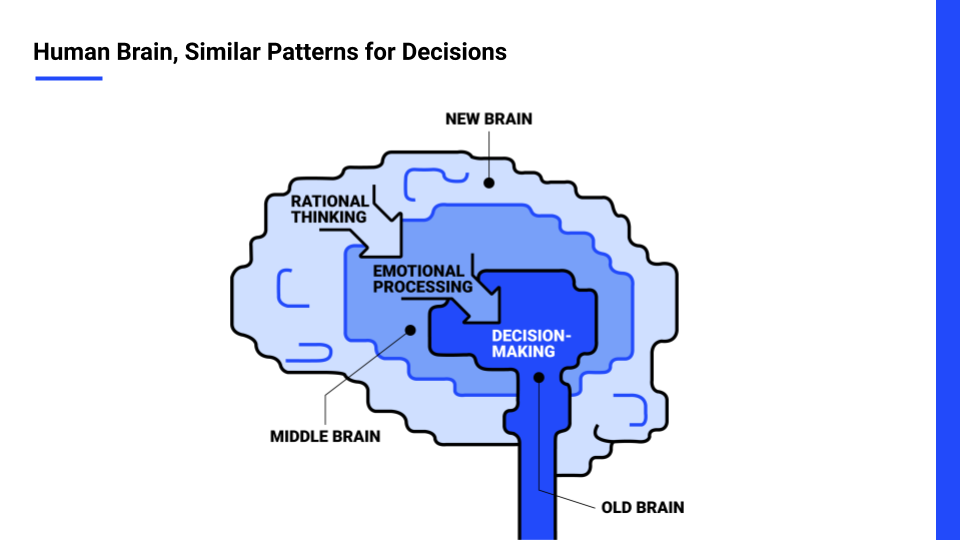
To understand user psychology, we first need to understand how our brain makes decisions. As much as we think of the brain as just one organ, it’s actually made up of three distinct parts, each with a very different role:
- The new brain (rational thinking). This is the part of your brain that’s reading this sentence and evaluating it, comparing it with information you already know.
- The middle brain (emotional processing). How do you feel about what you’re learning? Curious? Excited? Surprised? Every time you’ve cried at the end of a movie, it’s down to this part of the brain.
- The old brain (decision making). When it’s time for action, whether it’s jumping at a sudden noise or buying a new product,your old brain is the one that helps you make decisions.
When you compare the old brain with the new brain, you see that not only do they have different roles, but they also act differently.
The new brain is smart but slow. It takes into account the past while also evaluating potential futures. We can control it, but it takes effort.
The old brain, on the other hand, may not be as clever in the traditional sense, but it makes up for it with its speed. The old brain is why a boxer doesn’t have to carefully analyze and evaluate every move his opponent makes before he acts. It’s the reason you don’t need to work out the speed and trajectory of a ball before you catch it. It’s subconscious, always working in the background and making instant decisions based on our senses.
As you can see, the old brain is essential to our survival, making it the strongest part of our thought process. When we recognize the old brain as the part that makes decisions, we can use that knowledge to amplify our message.